Oder Atheriniformes Family Isonidae(Isonids)
Flower of the surf
Iso flosmaris(Jordan & Starks, 1901). Max length/6.5 cm TL
Korean name/mul-kkoch-chi(물꽃치)
Japanese name/ ナミノハナ(Naminohana)
Chinese name/浪花銀漢魚(Lànghuā yínhàn yú 랑화은한어)
Taiwan name/浪花魚(Lànghuā yú 랑화어)
D1/spine 4-6, D2/spine 1, soft rays 13-17. A/spine 1, soft ray 21-27. P1/soft ray 11-13. P2/spine 1, soft ray 5. Lateral line scale/60. Vert/43
Distribution; Northwest Pacific/Busan, Ulleungdo, and Jeju Island in Korea, Sagami Bay, Shimane Prefecture, Kagoshima Prefecture in Japan, Taiwan, and East China Sea in Fujian Province, China.
General; The five species of the genus Iso were classified in the family Notocheiridae, but were all separated a long time ago by creating a new family, Isonidae. However, in Korean literature, there are still many cases where these fishes are classified in family Notocheiridae, causing confusion.
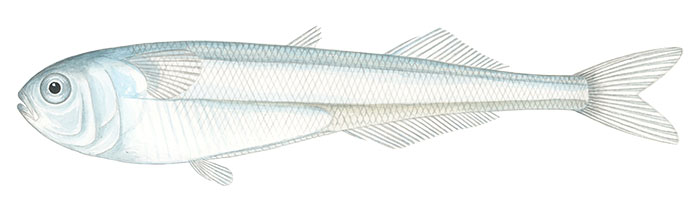
Body elongated, head and body highly compressed. Deepest at level of vertical plane through origin of pectoral fin, tapering towards caudal peduncle. Head rather small, posterior margin of head truncate, snout round, mouth oblique. First dorsal fin originating approximately at vertical through midbody. The first dorsal fin is markedly separated from the second dorsal fin. The origin of the second dorsal fin is far behind the origin of the anal fin. The anus that located in front of anal fin origin, is located slightly behind the posterior end of the first dorsal fin base. Second dorsal and anal fin high anteriorly, tapering posteriorly. Pectoral fin compressed, broad, with round posterior margin, inserted high on body with dorsomost ray originating above posteriormost point of opercle. Pelvic fin compressed, inserted low on body. The caudal fin is of the standard type that split into upper and lower lobes, with numerous small black spots lined up.
Body almost transparent, with a broad stand out silvery band running midlateral from pectoral fin base to caudal fin base. Discontinuous at the base of caudal fin. After preservation, body color change to pale yellow and the silvery band turn blackish.
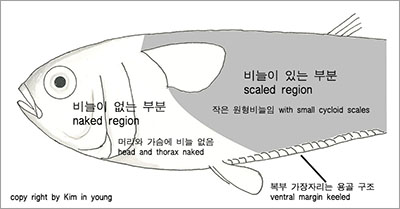
The tips of the upper and lower jaws are in the same position without protruding more than the other. The posterior end of the upper jaw does not reach the anterior margin of the eyeball. Premaxillary non-protractile, attached to head by mid-dorsal frenum. Gills opening wide. Body side covered with deciduous small cycloid scales. Scales absent in cranial, thoracic and belly region. Lateral line absent, number of scales in midlateral series is 60 Anus anterior to origin of anal fin. Keel-like form on ventral edge of abdomen between the pelvic fin and anus. It is a small fish that lives in groups in the reef area around the coast. It is mainly used for animal feed rather than food because of its poor taste. The spawning season is from June to August, and it feeds mainly on zooplankton.
|

 물꽃치 분포도. Distribution map of Flower of the surf(Iso flosmaris). Main ref. GBIF. Edited by fishillust.com. data as of 2023.
 물꽃치 어류학 문헌의 묘사도. Depiction in the ichthyological literature. Flower of the surf(Iso flosmaris). Author/David Starr Jordan(1851–1931)
 물꽃치. 갓 채집된 개체. Flower of the surf(Iso flosmaris). Freshly collected specimen. Location/Korea. Author/Jaehyun Kim(김재현), from Korea. Source/naturing.net
 물꽃치. 갓 채집된 개체. Flower of the surf(Iso flosmaris). Freshly collected specimen. Location/southern sea of Korea. Author/Shin Yushin(신유신), from Korea. Source/naturing.net
 물꽃치. 갓 채집된 개체. Flower of the surf(Iso flosmaris). Freshly collected specimen. Location/Korea. Author/SuNi, from Korea. Source/naturing.net
 물꽃치. 연구소의 보존 개체. Preserved specimen of Flower of the surf(Iso flosmaris). collected in Japan. Publisher/California Academy of Sciences
 물꽃치의 정기준표본(定基準標本) 엑스선 사진. Radiograph. Holotype of Flower of the surf(Iso flosmaris). collected in Japan. Publisher/California Academy of Sciences
 [참고 사진] 위 2 사진은 물꽃치(Flower of the surf)와 거의 동일한 다른 종이며 영명(Flower of the wave)도 거의 같아서 헷갈리는 종이다. 학명; Iso rhothophilus. 물꽃치과 물고기는 물에서 살아있을 때는 몸은 거의 투명하고 체측에 넓은 은색 띠를 가지고 있는데 죽은 지 오래 되면 오른 쪽 사진처럼 은색띠가 검어진다. 왼쪽 사진은 잡힌 지 시간이 얼마 지나지 않은 개체이다.




 검색
