
사이트 로그인
사이트 로그인
|
분류계통/경골상강/조기강→이악어목→붉평치과→붉평치 Copyright by Kim In Young. 김인영 그림
|
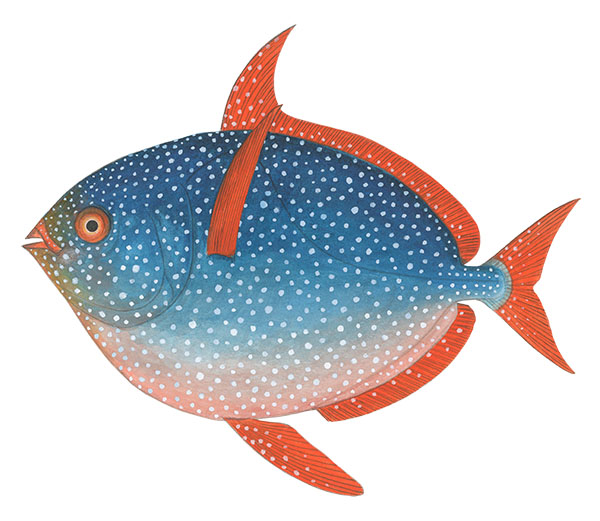 |
| 붉평치 기본 모습. 살아있을 때의 색상 기준. Lateral view of Bigeye Pacific opah(Lampris megalopsis). Color criteria when alive. 습. Lateral view of Bigeye Pacific opah(Lampris megalopsis) |
이악어목 붉평치과 분포; 열대와 온대 해역에 널리 분포/대서양의 멕시코만, 남아프리카 남서단의 인도양, 서태평양은 인도네시아, 오스트레일리아, 사모아, 일본과 한국의 동해, 중북부 태평양, 남동부 태평양의 칠레에 분포한다. 신분류에 의한 붉평치과 6종은 다음 리스트와 같다. [붉평치 해설 Lampris megalopsis] 붉평치(Bigeye Pacific opah)는 몸은 둥글고 좌우로 납작하다. 눈이 크고 튀어나와있는 눈이다. 주둥이는 뾰족하고 입은 작으며 이빨이 없다. 입은 전방으로 열리는 터널형이다. 꼬리지느러미가 넓게 갈라진 초승달형이다. 가슴지느러미가 길고 휘어져있다. 배지느러미도 가슴비느러미와 비슷하게 생겼고 조금 더 길다. 등지느러미와 뒷지느러미를 몸 쪽에 있는 홈 안으로 눕혀 넣을 수 있다. 양턱은 앞으로 튀어나갈 수 있는 구조이며 이빨은 없다. 위턱이 아래턱보다 짧다. 아래턱이 위턱 앞으로 약간 돌출하여 있고 앞 쪽으로 좁아지지만 끝에서는 뭉툭한 모양으로 뾰족하게 끝난다. 목구멍과 구개골에 이빨이 없다. 측선은 아가미뚜껑 위에서 위 방향으로 포물선을 그리면서 가슴지느러미 위를 지나갔다가 직선이 되면서 체측 중심선을 따라 꼬리자루 끝까지 이어진다. 비늘은 몸 전체에 덮여 있고 작고 얇은 원형비늘이며 쉽게 떨어져나가는 성질이다. 무지개 빛을 내는 비늘의 구아닌 코팅은 쉽게 벗겨진다. 가장 높은 체고는 기준 체장(꼬리지느러미를 뺀 몸 길이)의 1/1.5 이다. 머리 길이는 체장의 1/2.8이다. 눈의 수직 방향 지름은 두장의 30% 이다. 등지느러미는 비교적 짧으며 기저부의 길이는 체장의 1/1.8이다. 그리고 등지느러미의 평균 높이는 전체 몸 길이의 26.3% 이다. 배지느러미의 기점은 등지느러미의 기점에서 약간 뒤에 있으며 길이(높이)는 체장(SL)의 1/2.5이다. 등쪽은 금속성 청색이며 아래로 내려가면서 연해지며 은색과 자주색의 혼합색을 나타낸다. 복부는 장미색이다. 죽은 개체는 등쪽 몸은 강철 빛 회색이며 아래 쪽으로는 밝은 은빛이다. 불규칙한 백색 점이 머리와 가슴 및 지느러미를 포함한 전신에 분포하고 있다. 지느러미들은 진홍색이다. 양턱도 진홍색이다. 포르말린 액에 보존된 개체는 몸은 어두운 회색이며 점들이 보이고 등, 뒷, 꼬리지느러미는 노란 탄색yellowish tan)을 띤다. 눈 가장자리에 황금색 테두리가 있다. 붉평치(Bigeye Pacific opah/Lampris megalopsis)는 붉평치의 분포 해역 중 작은 부분에서 중복 분포하는 작은눈태평양붉평치(Smalleye Pacific opah/Lampris incognitus)와 닮았다. 두 종은 이름(영명) 그대로 눈 크기에서 서로 다르다. 붉평치(Lampris megalopsis)는 눈의 횡축 지름이 몸 전장 길이의 5% 보다 크며 두장의 1/4.7이다. 작은눈태평양붉평치는 눈의 횡축 지름이 몸 전장 길이의 5% 보다 작으며 종축 눈 지름은 두장의 1/5.4 이다. 붉평치(Lampris megalopsis)는 외해성 물고기이며 단독 생활자일 것이다. 표심해층과 중심해층 사이에서 살며 중층에서 헤엄쳐 다니는 물고기와 오징어를 주로 잡아 먹는다. 봄에 산란하는 것으로 추측된다. 다랑어를 잡는 심해 저인망 어로 작업에서 가끔 부수어로 잡혀 나온다. 맛있는 생선으로 취급되며 어시장에서 거래된다. 회로도 먹는다. 붉평치(Lampris megalopsis)의 정확한 분포도, 행태와 생태에 관해서는 아직 모르는 것이 많다. [유일한 온혈 물고기로 판명 되다] 2018년 붉평치과의 붉평치(Lampris guttatus)가 5종으로 세분 되기 전인 2015년 연구에 의하면 붉평치(Lampris guttatus)는 몸 전체가 온혈동물인 것이 발견되었다. 몸 전체의 중심부가 주변의 수온보다 약 5 °C가 높았다는 것이다. 물고기는 몸 전체가 냉혈이거나 몸의 일부분만 따뜻하게 만들 수 있는데 반하여 붉평치는 몸 전체의 체온을 올릴 수 있다는 점에서 유일한 물고기가 되었다. |
Order Lampriformes(Velifers, tube-eyes and ribbonfishes) Family Lampridae(Opahs). Distribution: Cosmopolitan, in tropical and warm temperate seas/the Gulf of Mexico(Atlantic Ocean), southwest coast of South Africa(Indian Ocean), the western Pacific Ocean(American Samoa, Australia, Indonesia, sea of Japan and central east coast of Korea), central northern Pacific, and Chile(Southeast Pacific). Species list of Family Lampridae(Opahs). Description; Lampris megalopsis, commonly known as the opah, cravo, moonfish, kingfish, and Jerusalem haddock, is a large, colorful, deep-bodied pelagic lampriform fish belonging to the family Lampridae, which comprises the genus Lampris. Body laterally compressed and rounded. The large eyes stand out as well, ringed with golden yellow. The snout is pointed and the mouth small, toothless, and terminal. The body is covered in minute cycloid scales and its silvery, iridescent guanine coating is easily abraded. Caudal fin broadly lunate; pectorals long and falcate; pelvic fins similar to pectoral fins in shape and a little longer. . Dorsal and anal fins have corresponding grooves into which they can be depressed. Swims by flapping the pectoral fins. Jaws protractible and lacking teeth; upper jaw shorter than lower jaw; lower jaw protrudes slightly forward of upper jaw, the tip narrowing to a blunt point; throat and palate without teeth. Lateral line angled above gill opening, arching above pectoral fins, and extending along mid-height of body through center of caudal peduncle. Scales small, thin, and easily removed over entire body. Its greatest depth contained 1.5 times in standard length; head length contained 2.8(2.8) times in standard length; vertical eye diameter contained 4.7 (4.5–4.7) times in head length; Dorsal fin comparatively short, the length of its base contained 1.8 (1.8) times in standard length, its height contained 3.2 (2.7–3.2) in standard length. Origin of pelvic fin below or anterior to middle of elongated portion of dorsal fin, its length contained 2.5 (2.5) times in SL Lampris megalopsis is very similar to L. incognitus with which it shares a small portion of its range. The most obvious difference is in the size of the eye. In L. megalopsis , the horizontal eye diameter is typically> 5.0 % FL and is contained ~4.7 times in head length. In L. incognitus , the horizontal eye diameter is typically <5.0 % FL and vertical eye diameter is contained ~5.4 times in head length. Coloration. Dark steely blue dorsally shading into green with silver and purple iridescence, belly rosy, golden around eyes. Fins deep red. Jaws are vermillion, too. In dead specimens(unpreserved), body steel grey on dorsal surface fading to bright silver on ventral surface. Irregular white spots distributed over entire body, including fins, head, and chest. In preserved specimens, body dark grey with spots and median fins appearing yellowish tan. Oceanic and apparently solitary. Epi- and mesopelagic. Feeds on midwater fishes and invertebrates, mainly squids. Probably spawns in the spring. It is occasionally caught in deep nets targeting big-eye tuna. Considered a good food fish; marketed fresh and frozen; prepared as sashimi. Much is still unknown about the distribution, interactions, life histories, and preferred habitats of this fish [Endothermy]. According to a 2015 study, before the 2018 when the Lampris guttatus was subdivided into 5 species, lampris guttatus was discovered to have near-whole-body endothermy in which the entire core of the body is maintained at around 5 °C above the surrounding water. This is unique among fish as most fish are entirely cold blooded or are capable of warming only some parts of their bodies. |
 붉평치의 체형. 왼쪽은 성어 오른쪽은 유어. Body shape of Bigeye Pacific opah(Lampris megalopsis). Left/adult, author/Hadal~commonswiki Right/juvenile, author/fao |
 붉평치. Bigeye Pacific opah(Lampris megalopsis). Author/BOL, source/Smithsonian Institute. |
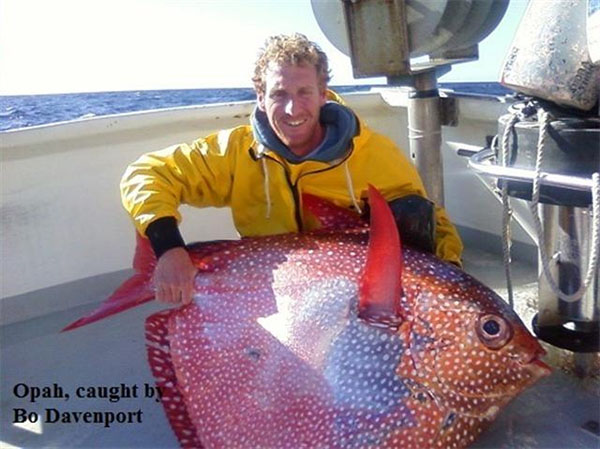 붉평치류. 종전의 학명 Lampris guttatus로 소개된 사진이며 종이 세분화되었으므로 재확인이 필요함. Opah. Country/USA. Author/David H. A picture captioned as former name “Lampris guttatus”, reconfirmation of scientific name required according to new split species of “Lampris guttatus”. |
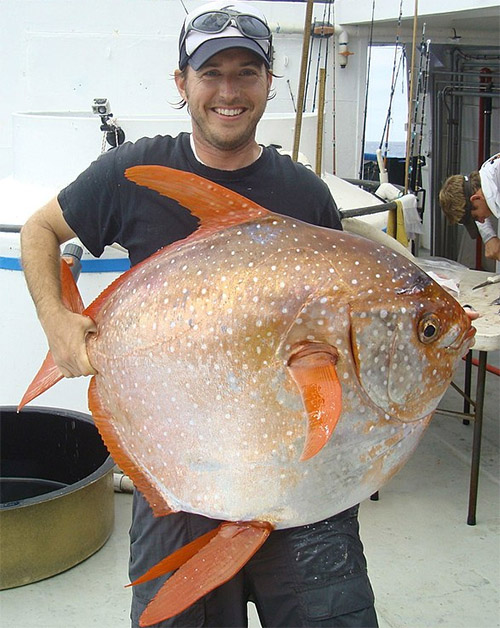 연구선에 잡혀나온 붉평치(Bigeye Pacific opah)를 생물학자(Nick Wegner)가 들어 보이고 있다. Supposedly Bigeye Pacific opah(Lampris megalopsis) NMFS biologist, Nick Wegner, holding a recently captured Opah fish. Author/NOAA |
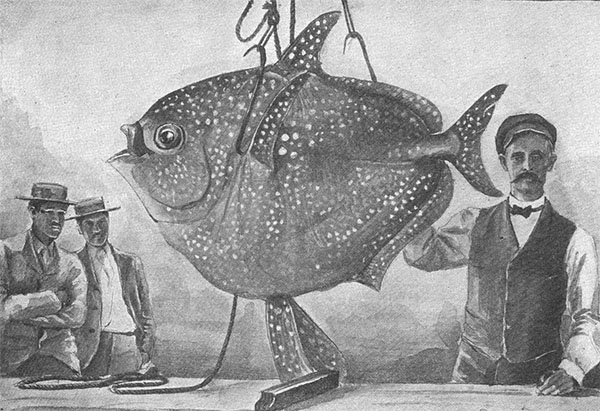 144kg 무게의 붉평치류. Date/1907, 하와이 호놀룰루의 생선 시장. 종전의 학명 Lampris guttatus로 소개된 사진이며 종이 세분화되었으므로 학명은 다른 것일 수 있다. Opah. Specimen in Honolulu market weighing 144kg. Date/1907. Author/E. L. Berndt. Reconfirmation of scientific name required because Lampris guttatus split into several species. |
 Left/붉평치 스테이크 요리. Opah from Coastal Seafood marinated in rice wine vinegar and garlic, served with a cilantro-lime sauce verte. Author/John McKenzie Right/붉평치 회와 토마토 샐러드. Moonfish(Opah) and Tomatoes. Author/Lou Stejskal |
 왼쪽/붉평치 뱃살 회 토막. 양념은 핑거 라임, 와사비, 유자 후추. 오른쪽/연어와 붉평치를 함께 담은 요리. 두 사진의 장소는 하와이에 있는 일본 식당 “Sushi Sho” Left/Opah belly, finger lime, wasabi, yuzu pepper. Right/King salmon, opah kama, luau leaf, tosazu, asparagus. Place(both)/Sushi Sho, Honolulu, Hawaii. Author/T.Tseng |


|
| Copyright ⓒ FISHILLUST.COM All rights reserved. All contents can not be used without permission of the copyright holder. |


 검색
