close_btn

종어(Long snouted bullhead). Leiocassis longirostris(Günther, 1864). Family 15


분류계통/경골상강→조기강→메기목(Siluriformes)→동자개과(Bagridae)→종어(Long snouted bullhead; Leiocassis longirostris)
Superclass Osteichthyes→Class Actinopterygii→Order Siluriformes→Family Bagridae→Long snouted bullhead(Leiocassis longirostris)

Copyright by Kim In Young. 김인영 그림
Leiocassis_longirostris_mypainting_700.jpg
종어의 기본 모습. Lateral view of Long snouted bullhead(Leiocassis longirostris)

[담수어]
메기목 동자개과 Order Siluriformes Family Bagridae(Bagrid catfishes)
종어(Long snouted bullhead).
Leiocassis longirostris(Günther, 1864). Max length: 80cm TL.
Synonym/Chinese longsnout catfish; Tachysurus dumerili(Bleeker, 1864)
Korean name/Jong-eo(종어)
D/spine 2, soft ray 7. A/spine 0, soft ray 16~18. Vertebrae/36. GR/16

※종어(宗魚)의 한자를 “鯼魚(종어)”로 표기한 글들이 있는데 “鯼魚”는 조기를 말한다. 한자사전에서 “鯼”은 조기 종 자이다.
※[빠가사리]; 동자개과 물고기들은 위협을 느낄 때 모두 가슴지느러미의 가시를 세워 흔들어서 기부의 관절면과 마찰을 일으켜 ‘빠각빠각’ 소리를 낸다. 여기서 ‘빠가사리’라는 별칭이 나왔다. 일반인들은 동자개 종류를 종에 구분 없이 모두 빠가사리로 부른다. 음식점에서도 ‘빠가사리 매운탕’으로 부른다.

분포; 아시아/중국의 랴오허(遼河; 요하) 수계와 본토지역에 주로 분포하며 한국에서는 대동강, 한강과 금강 하류에 분포하였으나 1970년 대 이후 멸종된 것으로 알려져 있다. 그러나 국립수산과학원에서 1999년부터 사라진 종어를 복원하기 위해 중국에서 종어를 도입해 연구해 왔고, 2008년 9월 인공 생산한 어린 종어 5,000마리를 금강에 방류하였다.
일반개요; 종어(宗魚) 이름의 유래는 맛이 민물고기 중에 으뜸이라 하여 으뜸 종(宗)자가 붙여진 것이라고 한다. 몸길이는 대개 30∼50cm이며 최대 7-80cm, 무게는 3-4kg에 달한다. 100cm에 달하는 것도 있다. 몸은 길고 앞부분은 위아래로 납작하며 뒷부분은 옆으로 납작하다. 머리의 아래쪽은 넓적하고 측면에서 본 외각은 거의 직선에 가깝다. 눈은 약간 타원형으로 대단히 작고 머리의 옆면 가운데보다 앞쪽에 있으며 얇은 피막으로 덮여 있다. 머리는 길면서 앞쪽으로 좁으며 주둥이는 많이 튀어나와 있고, 그 밑에 입이 있다. 입은 거의 일자형으로 양쪽 끝만 뒤로 약간 구부러져 있다. 입수염은 4쌍으로 모두 가늘고 짧으며, 맨 위 수염은 전비공과 후비공 사이에 있으며 입수염 중 가장 짧다. 아래턱은 위턱보다 짧다. 뒷지느러미는 등지느러미 밑에서 뒤쪽으로 붙어 있어 기름지느러미와는 대칭적인 관계를 나타내고 있다. 가슴지느러미와 등지느러미의 극조는 아주 단단하며, 가슴지느러미가시는 등지느러미가시 길이보다는 짧으며 바깥쪽에는 톱니가 없고 매끄럽지만 안쪽에 10여개의 톱니가 있다. 꼬리지느러미는 깊이 패어져 상엽(윗조각)과 하엽(아랫조각)의 크기는 비슷하다. 측선은 완전하며 옆구리 중앙에서 위쪽으로 치우쳐서 곧게 지나고 있다. 비늘은 전혀 없다.

몸 빛깔은 황갈색, 흑갈색, 회색, 백색까지 변이가 심하며 회색일 때가 많다. 머리의 후방 등쪽과 미병부에 걸쳐 체측에 5개 정도의 경계선이 불분명하게 넓은 어두운 반문이 기본적으로 있는데 진할 때가 있고 희미할 때도 있다. 각 지느러미는 몸색에 따라 검을 때도 있고 밝은 때도 있다. 하천 하류의 물이 흐리고 바닥이 모래나 진흙으로 된 곳과 하구 근처 기수역에서도 서식한다. 주로 낮에 활동하며 수심이 비교적 깊은 돌 밑에 여러 마리가 모여서 월동한다. 산란기는 4~6월로 추정된다. 육식성으로 수생곤충이나 어린 물고기 등을 잡아먹는다.

예로부터 금강에서 잡히는 종어는 맛이 좋기로 이름이 났으며 조선시대 역대 임금에게 진상은 물론 고관들이 상미(賞味)한 진미어이다. 중국의 랴오허 수계와 본토지역에 주로 분포하며 한국에서는 1970년 대 이후 멸종된 것으로 알려져 있다. 국립수산과학원에서 1999년부터 사라진 종어를 복원하기 위해 중국에서 종어를 도입해 연구해 왔고, 2008년 9월 인공 생산한 어린 종어 5,000마리를 금강에 방류하였다.


[Freshwater fish]
Order Siluriformes Family Bagridae(Bagrid catfishes)
Long snouted bullhead
Leiocassis longirostris(Günther, 1864). Max length: 80cm TL.
Synonym/Chinese longsnout catfish; Tachysurus dumerili(Bleeker, 1864)
Korean name/Jong-eo(종어)
D/spine 2, soft ray 7. A/spine 0, soft ray 16~18. Vertebrae/36. GR/16

Distribution; Asia/Drainage of Liao River in China. Had been inhabited Dae-dong, Han and Geum rivers in Korea until 1970s, since then not found, probably extincted. However, in 2007, an intensive breeding program was begun using specimens imported from China. The fish was re-introduced into the wild in 2008.
General; Body common length 30∼50cm, max 7-80cm with 3-4kg in weight, can reach 100 cm. Body elongated, depressed anteriorly and compressed posteriorly. Bottom side of head flat, bottom contour of the body almost straight. Eye very small with slight oval shape. Eye placed ahead of head center and covered with thin membrane. Have an elongate narrow head and a prominently protruding snout. Mouth placed below the snout and its’ direction laterally straight except the slightly curved down posterior end. 4 pairs of barbels, barbels are short and slender, the pair at the top shortest and placed between anterior and posterior nostrils. Lower jaw shorter than upper jaw. Anal fin located behind dorsal fin and symmetrically to adipose fin. Spines in pectoral and dorsal fin very strong, pectoral spine shorter than dorsal fin spine, outside margin of pectoral fin is smooth but inside margin with about 10 saw tooth. Caudal fin forked deeply, both lobes similar in size. Lateral line complete, straight and running slightly above the mid axis of flank. Absent in scales.

Generally grey in ground color, but variable from dark brown, brown, blackish grey, grey and white. Fundamentally with 5 large dark blotches on body side from head to peduncle, these blotches with indistinct margins. All fins dark or pale coordinating with body color. Inhabit sand or mud bottoms in lower reaches of streams or near estuarine areas where the water is turbid. Active in day time. Wintering below stone in groups in deep water. Probably spawn in April to June. Carnivores. Feed on aquatic insects and small fishes.

Historically a great dish offered to the king and dignitaries. The last known capture of the fish was in 1982. The species was declared extinct in Korea in 1985. However, in 2007, an intensive breeding program was begun using specimens imported from China. The fish was re-introduced into the wild in 2008.

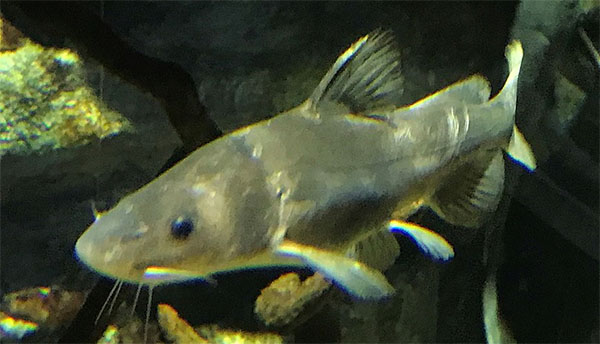
Leiocassis_longirostris_Gaeho_crop600.jpg 종어. Long snouted bullhead(Leiocassis longirostris. 장소/단양 다누리아쿠아리움. Place/Danuri Aquarium, Dayang city of South Korea. Author/Gaeho77.

Leiocassis_longirostris_CAFS_600.jpg
종어. Long snouted bullhead(Leiocassis longirostris. Author/CAFS(中國水產科學研究院)

Leiocassis_ongirostris_SuNi_600.jpg 종어. Long snouted bullhead(Leiocassis longirostris). 장소/한국. Place/South Korea. Author/SuNi


Copyright ⓒ FISHILLUST.COM  All rights reserved. All contents can not be used without permission of the copyright holder.