|
Order Lophiiformes(anglerfishes) Family Lophiidae(Goosefishes).
Yellow goosefish
Lophius litulon(Jordan, 1902). Max; 150cm cm TL
Japanes name/Ki-ankou
Chinese name/Huáng ān kāng 黃鮟鱇
D Ⅱ-Ⅰ-Ⅲ-9~10; A 8~9; P1 22~25
Distribution; Northwest Pacific/all around coasts of Korea, Gulf of Pohai. south of Hokkaido Japan,
the Yellow, Taiwan and East China sea.
General; Head and body depressed and head large and thick. Body and tail behind the head thin and short. With dozens of beard-shaped projections along the ventral rim of lower jaw. The gill opening is located behind pectoral fin. The mouth is very large, and with two rows of very sharp teeth on both jaws and the palatine also has teeth. The lower jaw protrudes forward than the upper jaw, and when viewed from above, margin of the mouth is round. Inside of the mouth is white and there are no white spots. The body surface is soft without scales. The pectoral fin large. The first spine of dorsal fin is shaped like a fishing rod that attracts prey. The second dorsal spine has a thick end. The four dorsal spines behind eye are separated from each other, and the soft second dorsal fin located close to the tail. The pectoral fin is square, and the rear margin of caudal fin is slightly rounded outward or truncated. The body has dark brown patterns scattered on a light yellow brown background. The belly side is white.
The general public in Korea does not distinguish the Yellow goosefish from Blackmouth angler, both species are called commonly “agu”(that is to say, simply anglerfish or goosefish). This species is similar to Blackmouth angler in appearance, but differs in number of soft rays in anal fin; Blackmouth angler with 5-7 soft ray in anal fin and Yellow goosefish with 8-9 rays. The tip of the first dorsal spine(fishing rod) in Yellow goosefish is thicker and longer than Blackmouth angler.
Found in coastal seas within 400m depth. Inhabits mud or sand floors. The spawning season is from February to June(peak season from March to April). The eggs are wrapped in a thin band-shaped agar that is 2 to 5 m long and 25 to 30cm wide and floats in surface water. For passing the winter, it is estimated that these fishes move southwards from Gulf of Pohai and Yellow Sea to deep western sea area of Jeju Island in October to December; and moves north when the water temperature rises. It is a predatory fish. It mainly feed on benthic fish and cephalopods. Mostly caught by low-rise trawling and net fishing, and is a fish with high commercial value. It is caught throughout the year.
|


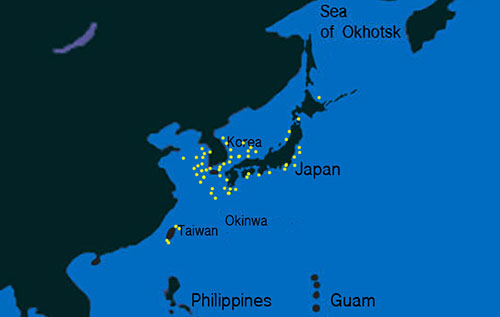 황아귀 분포도. Distribution map of Yellow goosefish(Lophius litulon). Derived from gbif. Work by fishillust.com
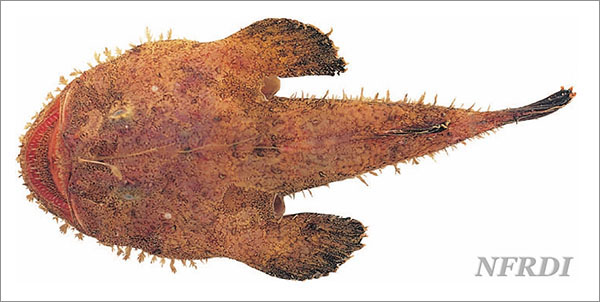 황아귀. 출처 국립수산과학원(NFRDI). Yellow goosefish(Lophius litulon). Source/National Fisheries Research and Development Institute,Korea
 황아귀 등면 묘사도. Dorsal view depiction of Yellow goosefish(Lophius litulon). Date/1907. Author/Jordan, David Starr




 검색
