
사이트 로그인
사이트 로그인
|
분류계통/경골상강→조기강→샛멸목→통안어과→태평양통안어 Copyright by Kim In Young. 김인영 그림
|
 |
| 태평양통안어의 기본 모습. Lateral view of Pacific barreleye(Macropinna microstoma) |
샛멸목 통안어과 분포; 북태평양/일본, 베링해, 바하 캘리포니아, 멕시코 이 덮개는 튼튼하고 유연한 외피이며 머리 뒤의 등과 몸통에 있는 비늘 구조에 연결되어 있고 눈 아래로는 눈을 측면에서 보호하는 투명한 골질 방패(안하골)와 연결되어 있다. 덮개 안의 방은 액체가 채워져서 밝은 녹색의 수정체를 갖고 있는 눈을 보호한다. 튜브형 눈은 전방과 상방을 모두 볼 수 있다. 수직으로 있는 튜브는 약 75도 경사로 내려질 수 있으며 이 범위로 앞쪽을 본다. 얼핏 보면 머리 앞쪽에 있는 2개의 검은 구멍이 눈처럼 보이지만 이것은 냄새를 맡는 콧구멍이다. 태평양통안어는 2004년 이전에는 생태에 관해 알려진 것이 없었다. 원래 알려지기를 튜브 모양의 눈은 고정되어 있고 터널을 통해 보듯이 머리 위쪽만 본다고 믿었다. 그러나 2008년 과학자들은 이 물고기의 눈이 투명 돔 안에서 회전하여 전방과 상방을 다 본다고 밝혀냈다. 눈의 구조를 보면 먹이를 잡아 먹는 방식에 최소한 2가지가 국면이 있는 것으로 보인다. 첫째, 몸이 수평으로 있고 눈은 수직 위를 향하고 있을 때 수면의 빛을 등지고 눈의 위쪽에 있는 먹이감의 실루엣은 잘 볼 수 있을 것이다. 이때 입을 먹이 쪽으로 가져가기 위해 몸을 제자리에서 위쪽으로 회전시키는데 눈의 시선은 먹이감을 향해 고정되어 있고 몸이 회전되어도 눈은 그대로 먹이감을 향해 고정되어 있다. 눈이 몸 안에서 회전되기 때문이다. 두 번째 방식은 몸을 수평으로 유지하고 있을 때 앞쪽 위에서 낙하하고 있는 먹이감이 있다면 몸을 회전시킬 필요없이 시선을 먹이감에 고정시키고 나서 먹이감이 입의 위치에 내려 올 때까지 먹이감을 따라 눈을 아래로 회전시켰다가 삼키는 것이다. 태평양통안어의 입은 작으며 큰 비늘이 몸 거의 전체에 덮여있다. 꼬리자루 기부 쪽에 기름지느러미가 있다. 납작하고 큰 지느러미들은 물 허공에서 거의 움직이지 않고 제자리를 유지하게 하고 아주 섬세하게 동작을 취할 수 있게 해준다. 대부분의 시간을 눈은 위로 향한 체 수평 자세로 정지해 있다. 단독 생활을 하며 온대와 아북극해의 중심해(中深海) 아래쪽 수심에 산다. 바닥 수심이 1600-3600 m 인 해역에서 트롤 어망을 중층에 띄워서 채집한다. 위장 내용물에는 자포동물의 잔해가 들어 있었으며 내장을 해부한 결과 관해파리의 촉수, 가시세포를 비롯해 젤라틴성 동물과 갑각류의 각종 플랑크톤이 나왔다. 과학자들은 태평양통안어가 관해파리의 긴 촉수(강한 독침이 있음) 에 잡혀있는 먹이를 훔쳐먹는다고 믿고 있다. 일반 해파리의 촉수에 있는 먹이도 뺐어 먹는다. 태평양통안어가는 흔하지 않은 종이며 난생이다. 자치어는 부유생활을 한다. 성어는 검은 갈색이다. |
Order Argentiniformes(marine smelts). Family Opisthoproctidae(Barreleyes or spookfishes) Distribution; North Pacific/Bering Sea to Japan, and Baja California, Mexico. The shield is a tough, flexible integument that attaches to the dorsal and medial scales behind the head, and to the broad, transparent subocular bones that protect the eyes laterally. The fluid-field chamber found beneath the shield surrounds and protects the eyes capped with vivid green lenses. The tubular eyes of this fish can look forward as well as upward(with maximum arc of rotation observed about 75 degrees). At first glance it seems that its eyes are at the front of their head in the form of two black holes; these are its olfactory organs. Pacific barreleye mostly unknown until 2004. It was originally believed that the tubular eyes of this fish were fixed in place and, therefore, only provided a tunnel vision view of what was seen above its head. However, in 2008, scientists discovered that its eyes were able to rotate both up and forward in its transparent shield. The morphology of the eyes apparently allow at least two feeding modes: (1) with body horizontal and with eyes directed upward, it can spot food silhouette against lighted waters above, it pivots its body to bring the mouth up for ingestion while eyes are locked on target, rotating from dorsal to rostral relative to the body; and (2) with body horizontal, eyes rotate dorsal to rostral while tracking the path of descending food until it reaches the level of the mouth. Pacific barreleye(M. microstoma) has a tiny mouth and most of its body is covered with large scales. Adipose at the base of the caudal peduncle. Its large, flat fins allow it to remain nearly motionless in the water, and to maneuver very precisely. Most of the time, the fish hangs motionless in the water, with its body in a horizontal position and its eyes looking upward. A solitary fish, occurring at lower mesopelagic depths beneath temperate and subarctic waters. Caught by midwater trawl nets in areas with bottom depths of 1600-3600 m. Stomach contents include cnidarian remains, however, its visceral anatomy suggests diets of mixed zooplankton, including both gelatinous and crustacean prey and siphonophore tentacles and nematocysts. Scientists speculates that M. microstoma steals food from siphonophores. The small marine creatures trapped on the tentacles of the jellies are also targeted by the barreleye fish. Uncommon species. Oviparous, with planktonic larvae. Adults dark brown. |
 태평양통안어의 분포도. Distribution map of Pacific barreleye(Macropinna microstoma). Derived work from GBIF and Fishbase.org. Author/fishillust.com |
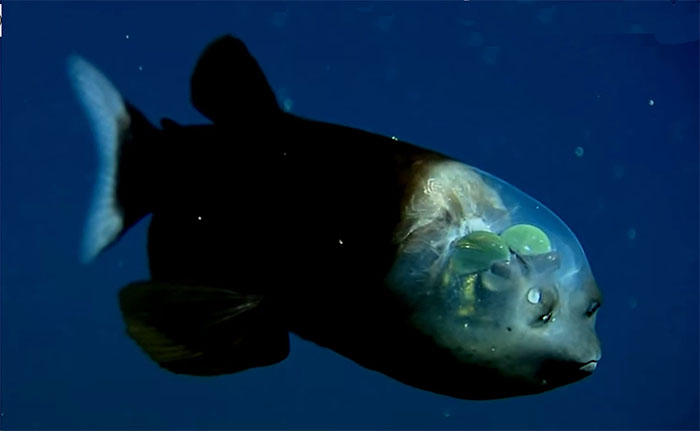 살아있는 태평양통안어 모습. 동영상 캡처 사진. Pacific barreleye(Macropinna microstoma) in live state; video capture photo. Author/Monterey Bay Aquarium Research Institute - MBARI |
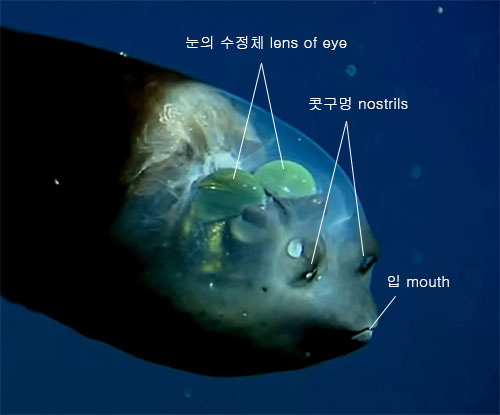 태평양통안어의 눈, 콧구멍, 입의 위치. Verification of eyes, nostrils and mouth in Pacific barreleye(Macropinna microstoma). Author/Monterey Bay Aquarium Research Institute - MBARI |
 헤엄치고 있는 상태에서의 태평양통안어 얼굴 정면 사진. 눈처럼 보이는 구멍은 콧구멍이다. 눈은 머리 꼭대기 쪽에 있어서 보이지 않는다. 동영상 캡처 사진. Frontal photo of the face while swimming. The 2 openings that look like eyes are the nostrils. The eyes are at the top of the head and are not visible from lateral level. Video capture photo. Author/Monterey Bay Aquarium Research Institute - MBARI |
 살아있는 태평양통안어 머리의 측면 사진. 연구선 실험실의 수조에 사는 개체임. (A) 통눈의 방향이 수직 위를 향하고 있다. (B) 눈의 방향이 주둥이 방향으로 돌아가 있다. 두 사진의 명암이나 색소 차이는 촬영 각도에 기인한 것이다. Lateral views of the head of a living specimen of Macropinna microstoma, in a shipboard laboratory aquarium: (A) with the tubular eyes directed dorsally; (B) with the eyes directed rostrally. Some differences in pigmentation between (A) and (B) are because they were photographed at slightly different angles. Source/researchgate.net |
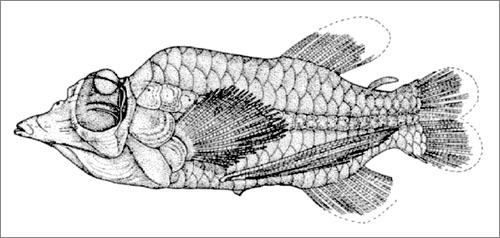 살아있는 개체를 목격하기 전 시대에 그려진 태평양통안어(Macropinna microstoma)의 묘사도. 머리의 투명한 돔 구조가 생략되어 있다. 죽은 개체는 머리의 투명한 돔 구조가 파괴되어 없어진다. Depiction of Pacific barreleye(Macropinna microstoma) from a period before the sighting of a living entity. The transparent dome structure of the head is omitted; the structure is destroyed and disappear after brought out into air. Reference: Coad, B.W., 1995 Encyclopedia of Canadian fishes. |
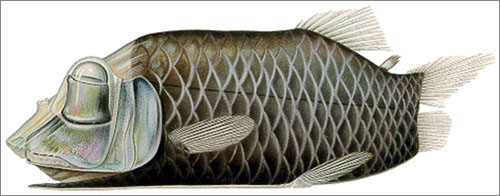 참고 사진/다른 통안어 종(Sandalled barreleye/학명; Opisthoproctus soleatus)에서 튜브형 눈의 모양을 나타낸 그림. Reference picture/a depiction of the shape of a tubular eye in another species(Sandalled barreleye/scientific name; Opisthoproctus soleatus). |


|
| Copyright ⓒ FISHILLUST.COM All rights reserved. All contents can not be used without permission of the copyright holder. |


 검색
