|
Order Lophiiformes(anglerfishes) Family Ogcocephalidae(Batfishes)
Yellow triangular batfish
Malthopsis lutea(Alcock, 1891). Max length; 10cm TL
Korean name/kkog-gal-chi(꼭갈치)
Japanese name/Fûryû-uo
Chinese name/密星蝙蝠棘茄魚
Australian name/Longnose seabat
Dorsal fin/5~6. Anal fin/4. P1/11~12. P2/Ⅰ, 5. Caudal fin/9.
Distribution; Indo-Pacific/south sea of Korea, southern Japan, Philippines, East China Sea, Andaman Sea
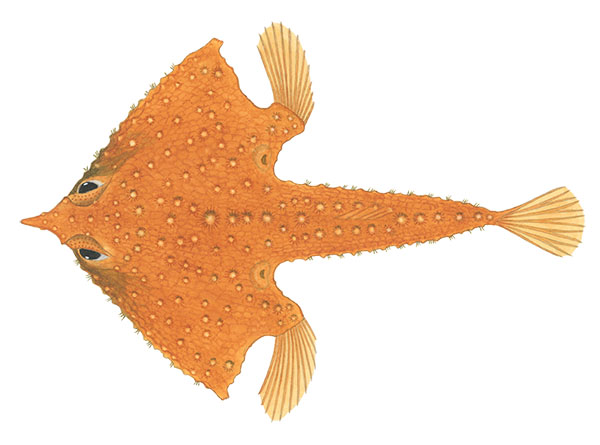
General; Body depressed, disk triangular, broad, the greatest width slightly narrower than length of body. Rostral spine more than half as long as diameter of eye, directed nearly horizontally forward. The fishing rod(illicium) is short, it comes out like piston movement from tube-shaped storage space and also be stored back. With a bait(esca) at tip of the fishing rod. The pectoral fins are attached to both sides of the back edge of the body disk and shaped like feet.
Dorsal surface of disk thickly covered with dermal ossicles except for both opercular and shoulder regions; some ossicles enlarged like shields, pointed and quite regular in their arrangement; radial striations of bony tubercles prominent and noticeably serrate. The larger shield-shaped projections are arranged approximately symmetrically on both sides of the central axis of the back. Mediolateral row developed throughout the entire length of disk, but several tubercles between those of the mediolateral row smaller than the posterior ones; occasionally, a number of tubercles scattered on both sides of mediolateral rows. Sides of body with many dermal cirri. Tail rather completely surrounded with bony tubercles.
A bony process is developed at both lower corners of the triangular body disk, which is a protrusion that the sub opercular spine is broadly extended. Sub opercular spine directed outward and backward, armed at the tip with several minute teeth, but without a prominent antrorse spinule that the Malthopsis annulifera has. The direction and shape of this bony process is different from that of conger “Malthopsis annulifera” Longest anal ray reaches to base of caudal when the fin is laid back. Ventral surface of disk, except for lateral regions, thickly covered with minute dermal prickles, some of them, more or less enlarged. Patches of vomer and palatine teeth rather large and quadrangular or circular.
In formalin, yellowish brown above; pale below; striations of dorsal bony tubercles brown. Caudal, pectoral and dorsal dusky, but the other fins pale; peritoneum also pale. In one study, half of the collected sample specimens of Malthopsis lutea had 2 to 8 large ring-like markings, which is the feature of Malthopsis Annulifera, and no ring patterns in the other half. Inhabit bottoms of 100~700m depth. Slow swimmer, and walk around the bottom with their four fins(pelvic and pectoral) that resembled legs. Caught in trawling as bycatch, not used for food fish.
|

 꼭갈치 분포도. Distribution map of Yellow triangular batfish(Malthopsis lutea). Main ref./GBIF. Author/fishillust.com. data as of march 2023.
 꼭갈치(Yellow triangular batfish) 등면. Dorsal view of Malthopsis lutea(Alcock, 1891). Date/1912 Author/Lewis Radcliffe(1880–1950)
 꼭갈치(Yellow triangular batfish) 복면. Ventral view of Malthopsis lutea(Alcock, 1891). Date/1912 Author/Lewis Radcliffe(1880–1950)
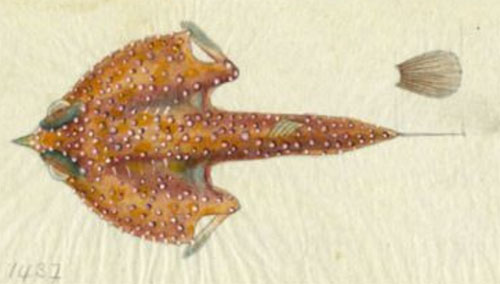 꼭갈치 대략적 스케치. preliminary sketch of Yellow triangular batfish(Malthopsis lutea). Source/Smithsonian Institution, NMNH, Fishes
 꼭갈치 등면 묘사도. Dorsal side illustration of Yellow triangular batfish(Malthopsis lutea). From plate 121 of Oceanic Ichthyology by G. Brown Goode and Tarleton H. Bean, published 1896.
 [참고사진]. 꼭갈치의 측면 모습을 이해하기 위한 참고 사진. 꼭갈치와 같은 속(Malthopsis)에 있는 대서양 꼭갈치(Atlantic triangular batfish; Malthopsis gnoma)의 측면 사진이다. [Reference photo]. A reference picture for understanding the side view of Malthopsis lutea. This photo is the side view of Atlantic triangular batfish(Malthopsis gnoma), which is included in the same genus Malthopsis. Author/D Ross Robertson
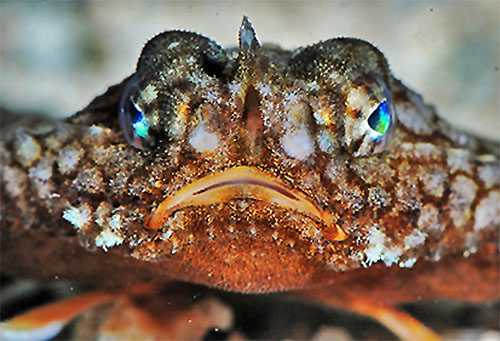 [참고사진]. 꼭갈치의 앞 정면 모습을 이해하기 위한 참고 사진. 꼭갈치와 같은 속(Malthopsis)에 있는 대서양 꼭갈치(Atlantic triangular batfish; Malthopsis gnoma)의 정면 사진이다. [Reference photo]. A reference picture for understanding the front view of Malthopsis lutea. This photo is the front view of Atlantic triangular batfish(Malthopsis gnoma), which is included in the same genus Malthopsis. Author/D Ross Robertson




 검색
