
사이트 로그인
사이트 로그인
|
경골상강→조기강→당멸치목→풀잉어과→풀잉어(Indo-Pacific tarpon; Megalops cyprinoides) Copyright by Kim In Young. 김인영 그림
|
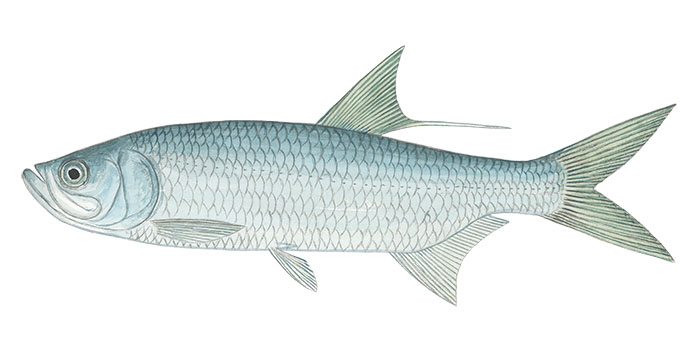 |
| 풀잉어(인도-태평양 타폰) 기본 모습. Lateral view of Indo-Pacific tarpon(Megalops cyprinoides). |
[Marine; freshwater; brackish] 분포; 인도-패시픽/남아프리카 나탈, 페르시아 만, 홍해., 오스트레일리아, 아라프라 해, 한국의 남해, 남중국해, 대만 해협, 동중국해에 분포, 미크로네시아의 팔라우 섬과 캐롤라인 제도, 아프리카의 말라위 제도와 짐바브웨 일부 지역에서는 내륙에 분포에 분포한다. 풀잉어의 외관은 대서양 타폰(Megalops atlanticus)과 같다. 등쪽은 녹청색, 체측은 은빛이다. 입이 크고 위 방향으로 놓여있고 아래턱이 주둥이보다 높게 올라가 있다. 아래턱에는 연장된 골판이 붙어있다. 등지느러미의 마지막 기조는 실처럼 생겼고 꼬리에 닿을 정도로 길다. 가슴지느러미가 배쪽에 있다. 풀잉어는 공기를 마셔 부레에 담을 수 있으며 이를 통해 산소를 흡수한다. 산소가 부족한 환경에서 살아남기 위해 진화한 기능이다. 공기를 마시기 위해 주기적으로 수면에 올라간다. 풀잉어는 진화에 성공한 대표적인 종의 하나이다. 담수에 사는 개체들은 해수 개체들 보다 크기가 작으며 50cm 정도 자란다. 해수 종은 1m 이상 자란다. 44년 수명이며 2년 생이면 성어가 된다. 풀잉어(인도-태평양 타폰)는 주로 작은 물고기를 잡아먹으며 갑각류도 먹는다. 때에 따라 식물도 먹는다. 해수 종이나 담수 종의 먹이 종류는 비슷하다. 풀잉어(인도-태평양 타폰)는 바다와 내륙의 민물을 왕복 이동한다. 수심 50m 에서도 발견되지만 대개 근해 얕은 수심 표면 층에서 발견된다. 산호초, 맹그로브 숲, 늪 지대, 호수, 강, 저수지, 홍수 범람지, 수로에 산다. 파푸아뉴기니에서는 수면에 떠서 사는 식물 살비니아 몰레스타(Salvinia molesta)가 수면을 두껍게 덮은 물에서 발견된다. 당멸치목의 나머지 어류들과 마찬가지로 바다에서 산란하고 부화되면 투명하고 길고 납작한 렙토세팔루스(leptocephalic) 형태로 자라며 해변 쪽으로 이동하면서 10일 지나면 치어로 탈바꿈한다. 풀잉어(인도-태평양 타폰)는 담수에서도 산란하고 번식할 수 있다. 풀잉어는 양식도 되고 있는 물고기이다. 해안에서 잡은 새끼를 연못에서 사육한다. 당멸치는 식용으로 사용되지만 고급 생선은 아니다. 낚시 대상어로는 인기가 있다. |
[Marine; freshwater; brackish] Distribution; Indo-Pacific/Persian Gulf, Red Sea and Natal, South Africa to the Society Islands, north to southern Korea, south to the Arafura Sea and New South Wales. Restricted to high islands(Palau, Caroline and Mariana islands) in Micronesia. Reported as far inland as the lower Shire in Malawi and the Save-Runde junction in Zimbabwe. Widespread in the Lower Zambezi River channels up to Marromeu and in the Micelo River up to Malingapanzi. South China Sea, Taiwan Strait, and East China Sea. The Indo-Pacific tarpon, is a relatively medium-sized species In appearance, it is like the Atlantic tarpon. Color blue-green dorsally; silvery on sides. The large mouth is turned upwards; lower jaw projects beyond snout; the lower jaw contains an elongated, bony plate. The last ray of the dorsal fin is filamentous and much longer than the others, reaching nearly to the tail. Ventrally located pectoral fins. It is capable of filling its swim bladder with air and absorbing oxygen from it. Rise regularly to the surface to breath air. This enabling it to survive in oxygen-depleted waters. The tarpon is truly a prime example of evolutionary success. Those living in fresh water tend to be smaller than the ones living in saltwater, growing just over 50 cm, while saltwater examples grow over 1 m. They live upwards of 44 years and mature within two. They complete their metamorphosis from their larval stage in ten days. They feed on smaller fish, crustaceans, and even plants rarely. In saltwater, they mainly feed on prawns and herring, but also many other small fish. In fresh water, no significant difference in their food habits is seen; they eat freshwater prawns and bony bream, mainly. The Indo-Pacific tarpon migrates between the open sea and inland rivers. They are found in depths to 50 m, but are commonly found by the surface in shallow inshore waters. They inhabit coral reefs, mangroves, swamps, rivers, lakes, reservoirs, floodplains, and canals. In Papua New Guinea, they are reportedly found under large mats of Salvinia molesta. As with all Elopiformes, it spawns mainly offshore. Juveniles of the species stay inshore and migrate to coastal areas while maturing to spawn. Typically, they spawn twice a year. At sea, the larvae migrate inland and are leptocephalic(flattened, transparent and eel-like). They are able to breed in fresh and salt water. Cultured in ponds, the fry being sourced from the coasts. Popular angling fish. Edible but not esteemed. |
 풀잉어 분포도. Distribution map of Indo-Pacific tarpon(Megalops cyprinoides). Author/Kim in young(fishillust.com) |
 풀잉어의 지느러미 색상에 관한 데이터는 혼란스럽다. 인터넷을 검색해 보면 지느러미가 노랑색인 사진은 거의 없으나 위 자료처럼 노랑색(왼쪽 그림) 또는 노랑색일 것 같은 사진(오른쪽 죽은 개체 사진, 죽은 개체의 색상은 본래 색상과 거리가 멀게 변할 수 있다) 이미지가 소개되어 있다. 왼쪽 묘사도는 중국수산과학연구소(CAFS)가 저작권을 가진 사진이다. 권위가 없는 기관은 아니다. Data about the color of the fins of Indo-Pacific tarpon is confusing. If you search the Internet, there are very few pictures of specimens with yellow fins, but as shown above, rarely pictures are found that have yellow(left picture) or can be interpreted as yellow(the right dead object, the color of the dead object may change far from the original color). The illustration on the left is a image copyrighted by the China Institute of Fisheries Science(CAFS). CAFS is not laboratory without authority. Right/author; Sahat Ratmunngkhwang |
 풀잉어의 지느러미 색상을 가늠해 볼 수 있는 이미지들의 일부 예. 지느러미가 노란색일 것으로 읽어지는 이미지가 없다. Some image examples of Indo-Pacific tarpon where you can guess the color of the fins. There is no image that readout yellowish hue in fins. Author/시계방향, clockwise/Sakaori. Iconographia Zoologica, Judgefloro. Melanochromis,
Indo-Pacific tarpon). Megalops cyprinoides |

| 야간에 플래시라이트 조명으로 촬영된 풀잉어 이미지. 지느러미에 노란색이 없다. Indo-Pacific tarpon image taken at night with flashlight lighting. no yellowish color on the fins. Sea Life Bangkok Ocean World. Author/NasserHalaweh |


|
| Copyright ⓒ FISHILLUST.COM All rights reserved. All contents can not be used without permission of the copyright holder. |


 검색
