close_btn

큰입배스(Largemouth bass). Micropterus nigricans(Cuvier, 1828). Family 349.

분류계통/경골상강→조기강→농어목→검정우럭과 →큰입배스(Largemouth bass ; Micropterus nigricans)
Superclass Osteichthyes→Class Actinopterygii→Order Perciformes→Family Centrarchidae→ Largemouth bass ; Micropterus nigricans)

Copyright by Kim In Young. 김인영 그림
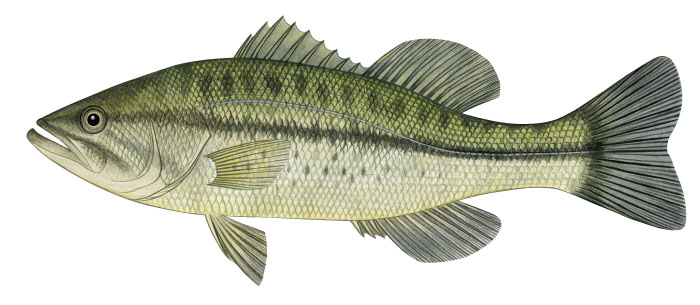
Micropterus_salmoides_700.jpg
큰입배스 기본 모습. Lateral view of Largemouth bass(Micropterus nigricans)

※담수어(freshwater fish)
농어목 검정우럭과 Order Perciformes Family Centrarchidae(sunfishes)
큰입배스(Largemouth bass).
Micropterus nigricans(Cuvier, 1828). 97cm(TL)
D/spine10, soft ray11~14, A/spine3, soft ray10~12, P₁/soft ray13~15, LLp/60~68, C/soft ray17, Vert/41-45, gill rakers/13-16, Pharyngeal teeth/3 rows

분포; 한국의 전 담수역, 아메리카, 아프리카, 유럽, 아시아의 담수역에 분포. 큰입배스 (Micropterus nigricans)의 원산지는 미국 중북부 및 동부(오대호, 미시시피강 유역)에서 캐나다 남부에 이르는 광범위한 지역이다. 추운 기후에 잘 적응한다. 종전에 한국에 알려져 있던 "배스"는 학명이 Micropterus salmoides(Florida Bass/플로리다 배스)이며 원산지가 플로리다 반도 전역과 조지아, 노스캐롤라이나, 사우스캐롤라이나의 대서양 연안 유역에 국한되어 있다. 아열대 기후에 최적화되어 있다. 두 종은 미국 남동부의 특정 강 유역(예: 플로리다 팬핸들 지역)에서 분포지가 겹친다. 혼종이 발생한다.

일반 개요;
종의 재동정 과정; 원래 본 페이지에 소개되어 있던 종은 한국명으로 "배스", 종명은 Micropterus salmoides였으나 2026년 2월 필자(김인영)는 한국명 "큰입배스" 종명 "Micropterus nigricans"로 교체하였다. Micropterus salmoides와  Micropterus nigricans의 동종착오가 발견되었다는 정보를 뒤늦게 알게 되었기 때문이다. 이 연구의 시작과 발표는 2022~2024년에 있었다고 알려져 있다. 이 두 종은 외관이 구별 불가능할 정도로 동일하다고 하며 그래서인지 웹사이트의 사진들을 보면 양쪽 사진들이 서로 엇갈려 혼잡을 이루고 있다. "큰입우럭"은 한국명 "배스" 이전에 사용되던 한국명이다.

종전에는 미국의 플로리다주, 조지아주 미시시피주 앨라배마주 4개 주가 Micropterus salmoides를 "주의 물고기(fish of the state)"로 지정하였으나 종명의 재분류가 일어난 이후 Micropterus salmoides는 플로리다주에서만 주 물고기로 남으면서 영명은 플로리다 배스(Florida Bass)가 되었고 나머지 3개 주에서는 큰입배스(Largemouth Bass/학명; Micropterus nigricans()가 주 물고기 지위에 올랐다. 그러나 플로리다 배스는 서식지가 인근 다른 주에도 중첩된다.

2026년 2월 현재 한국 정부의 수산자원 관련 사이트들에서는 아직 업데이트되지 않고 국명 "배스" 학명 "Micropterus salmoides" 로 등재되어 있다. 세계적 데이터 베이스의 하나인 fishbase.org에서도 Micropterus salmoides가 그대로 유지되어 있고 Micropterus nigricans는 이름조차 없다. 그러나 위키피디아 등 여러 인터넷 정보들은 Micropterus salmoides와  Micropterus nigricans이 별개 종이며 한국에 도입된 종은 Micropterus nigricans라고 설명하고 있다.

한국 도입 역사; 큰입배스는 1970년대 초반, 부족한 단백질원을 보충하기 위한 식용 자원 조성 목적으로 한국에 처음 도입되었다. 1973년 국립수산진흥원(현 국립수산과학원)이 미국 루이지애나주에서 치어 500마리를 공식 수입하며 시작되었다. 1975년부터 전국의 주요 댐과 호수에 대량 방류되었다. 식용 사업이 특유의 민물 비린내와 생소한 식감으로 인해 실패하면서 오히려 생태계 교란 생물로 나타났다. 천적이 없는 상태에서 토종 어류와 알, 치어 등을 닥치는 대로 잡아먹어 수생태계를 파괴함에 따라 환경부는 큰입배스를 생태계 교란 생물로 지정하여 관리하고 있다.

체형; 몸과 머리는 옆으로 납작하다. 입은 비스듬히 위를 향하며 아래턱은 위턱보다 앞에 있다. 위턱 뒤끝은 눈 뒤끝을 지난다. 눈은 작고 머리 중심축의 위쪽에 자리한다. 두 눈 사이는 약간 볼록하다. 비늘은 둥근비늘이며 옆줄은 완전하다. 꼬리지느러미 뒤는 위아래로 약간 갈라진 정형이다. 등지느러미 기점은 가슴지느러미 기부보다 뒤쪽에 있다. 배지느러미 기점은 가슴지느러미 기부 위치와 같다. 등지느러미와 뒷지느러미의 연조부 뒤 끝은 서로 같은 위치에 있다. 가슴지느러미와 배지느러미의 뒤끝은 항문(총배설강)에 훨씬 이르지 못한다. 

색상; 신선한 상태에서 올리브 녹색이나 녹갈색을 띤다. 옆구리는 등보다 밝고 황동빛 녹색을 띠며 머리 하단과 배는 흰색 또는 유백색을 띤다. 아가미뚜껑에서부터 꼬리지느러미의 기부까지 몸의 중간을 가로지르는 짙은 검은색 줄무늬(Lateral stripe)가 특징이다. 이 줄무늬는 종종 가장자리가 들쭉날쭉한 모양을 가진다. 눈은 금갈색(Golden brown)이다. 지느러미들은 옅게 색이 들어가 있고, 가슴지느러미와 같은 쌍을 이룬 지느러미는 대개 투명하다. 바닥이 진흙인 호수에 사는 성체는 짙은 올리브 갈색이나 거의 검은색에 가까워지며, 이 경우 몸 옆의 특징적인 줄무늬가 거의 보이지 않을 수 있다. 어린 개체는 꼬리지느러미 가장자리에 어두운 검은색 테두리가 더 뚜렷하게 나타나는 경향이 있습니다.

생태; 호수나 늪, 하천의 흐름이 없는 수역, 수초가 발달한 곳에 서식하며 물고기와 개구리를 유어는 갑각류, 곤충 및 작은 물고기를 주식한다. 가끔 동족을 잡아먹기도 한다. 산란기는 5-6월이다. 산란기와 수온이 5℃이하, 37℃ 이상일 때는 먹지 않는다. 수컷이 둥지의 알을 보호한다. 

먹거리 평가; 한국에서는 맛없는 물고기로 소문나 있지만 미국에서는 식용으로 먹을 만한 물고기라고 한다. 이는 주로 끓여 요리하는 한국식 방법과 튀김 위주인 미국식 조리법의 차이 때문이라고 한다. 


※freshwater fish
Order Perciformes Family Centrarchidae(sunfishes)
Largemouth bass.
Micropterus nigricans(Cuvier, 1828). 97cm(TL)
D/spine10, soft ray11~14, A/spine3, soft ray10~12, P₁/soft ray13~15, LLp/60~68, C/soft ray17, Vert/41-45, gill rakers/13-16, Pharyngeal teeth/3 rows

Distribution; All freshwater areas of Korea, America, Africa, Europe, and Asia. Largemouth bass (Micropterus nigricans) is native to a wide area from the north-central and eastern United States (Great Lakes, Mississippi River Basin) to southern Canada. It is well-adapted to cold climates. The "Bass" previously known in Korea has the scientific name Micropterus salmoides(Florida Bass) and is native to the entire Florida peninsula and the Atlantic coastal basins of Georgia, North Carolina, and South Carolina. It is optimized for subtropical climates. The distributions of the two species overlap in certain river basins of the southeastern United States(e.g., the Florida Panhandle). Hybridization occurs.

The process of re-identifying the species
The species originally introduced on this page was listed under the Korean name “Bass(배스)” and the scientific name Micropterus salmoides. However, in February 2026, the author, Kim In-young, replaced it with the Korean name “Largemouth Bass(큰입배스)” and the scientific name Micropterus nigricans. This revision was made after learning that a case of taxonomic confusion between Micropterus salmoides and Micropterus nigricans had been discovered. The related research is reported to have been conducted in 2022. The two species are known to be almost indistinguishable in appearance, which explains why photos on many websites are mixed and inconsistent. "keun-ib-u-leog(큰입우럭)" is a disappeared Korean name used before the Korean name "bass."

Previously, four U.S. states—Florida, Georgia, Mississippi, and Alabama—designated Micropterus salmoides as their "state fish." However, following the taxonomic reclassification, Micropterus salmoides remains the state fish only in Florida, where its English common name has become the "Florida Bass." In the remaining three states, the "Largemouth Bass" (Micropterus nigricans) has taken the position of the state fish. Nevertheless, the habitat of the Florida Bass overlaps with other neighboring states.

As of February 2026, official Korean government websites related to fisheries resources have not yet updated this information and continue to list the species as “Bass” with the scientific name Micropterus salmoides. Furthermore, FishBase(fishbase.org), one of the world’s major ichthyological databases, still recognizes Micropterus salmoides and does not mention Micropterus nigricans at all. However, several online sources, including Wikipedia, describe Micropterus salmoides and Micropterus nigricans as separate species, stating that the species introduced to Korea is Micropterus nigricans.

Introduction and History in Korea
The Largemouth Bass was first introduced to South Korea in the early 1970s as a food resource to supplement protein sources. Its history began in 1973 when the National Fisheries Research and Development Institute (now the National Institute of Fisheries Science) officially imported 500 fingerlings from Louisiana, USA. Starting in 1975, they were released in large numbers into major dams and lakes nationwide. However, the commercial food project failed due to the fish's distinct freshwater odor and unfamiliar texture. Consequently, it emerged as an invasive species. Lacking natural predators, the bass decimated native fish populations, including their eggs and fry, leading the Ministry of Environment to designate and manage it as an ecosystem-disturbing species.

Physical Characteristics
The body and head are laterally compressed. The mouth is angled upward, with the lower jaw protruding further than the upper jaw. The posterior end of the upper jaw extends past the rear edge of the eye. The eyes are small and positioned above the central axis of the head, with the space between them being slightly convex. It features cycloid scales and a complete lateral line. The caudal (tail) fin is homocercal and slightly forked. The origin of the dorsal fin is located behind the base of the pectoral fin, while the pelvic fin origin aligns with the pectoral fin base. The posterior ends of the soft-rayed portions of the dorsal and anal fins terminate at the same vertical position. Both the pectoral and pelvic fins fall significantly short of reaching the anus (cloaca).

Coloration and Appearance
When fresh, the body displays an olive-green or greenish-brown hue. The flanks are lighter than the back, showing a brassy-green tint, while the lower head and belly are white or milky white. A defining feature is the dark lateral stripe running from the operculum(gill cover) to the base of the tail, often with jagged edges. The eyes are golden brown. The fins are lightly pigmented, though paired fins like the pectorals are usually transparent. Adults inhabiting muddy-bottomed lakes may turn deep olive-brown or nearly black, which can cause the characteristic lateral stripe to fade. Juveniles tend to have a more distinct dark border on the edges of the caudal fin.

Ecology and Behavior
This species inhabits lakes, swamps, and still waters with abundant aquatic vegetation. Adults prey on fish and frogs, while juveniles primarily feed on crustaceans, insects, and small fish; cannibalism occurs occasionally. The spawning season is from May to June. They cease feeding during spawning or when water temperatures drop below 5°C or rise above 37°C. Males exhibit parental care by guarding the eggs in the nest.

Culinary Note
In Korea, it is often perceived as having an unappealing taste. However, in the United States, it is considered a decent food fish. This discrepancy is largely attributed to cooking methods: while Korean cuisine often involves boiling (which may highlight certain odors), American styles typically favor deep-frying.

Map_Micropterus_nigricans+salmoides_gbif_700.jpg큰입배스(Largemouth bass; Micropterus nigricans)와 배스(구 한국명; 학명/Micropterus salmoides)의 분포도.
한국에 도입된 배스(한국명)는 Micropterus salmoides(미국명; Florida bass)로 알려져 있었다. 미국이 원산지인 이 물고기는 한국을 비롯해 여러 다른 나라에 도입되었다. 이 물고기의 종명은 Micropterus salmoides가 아니고 서로 같은 모습을 하고 있는 Micropterus nigricans라고 2024년에 선언되었고 한국명은 큰입배스로 바뀌었다. 2026년 2월 현재 큰입배스의 세계 분포도는 나와있지 않으며 오래 유지되어 온 Micropterus salmoides(플로리다 배스)의 분포도가 계속 정보망에 올라와 있다. 이 지도는 2종이 1종으로 알려져 있었을 때의 것임으로 이를 감안하여 지도를 읽어야 할 것이다. 원산지 미국을 기준하면 큰입배스는 북쪽에 치우쳐 있고 플로리다 배스(Florida bass)는 플로리다 반도를 중심으로 미국 남부쪽에 치우쳐 있다. 그리고 두 종의 분포지는 중첩되는 지역이 있다.

Distribution map of the Largemouth Bass(Micropterus nigricans) and the "Bass(배스)"(former Korean name for the Micropterus salmoides).
The "Bass" introduced to Korea was previously known as Micropterus salmoides(American name: Florida bass). Originating in the United States, this fish has been introduced to various countries, including Korea. However, in 2024, it was officially declared that the species name is not Micropterus salmoides, but rather the morphologically similar Micropterus nigricans, and its Korean name has been changed to "Largemouth Bass(큰입배스)." As of February 2026, a global distribution map specifically for Micropterus nigricans has not yet been released; instead, maps for Micropterus salmoides(Florida bass) continue to circulate. These maps should be interpreted with the understanding that they were created when the two distinct species were considered one. In their native U.S. range, the Largemouth Bass(M. nigricans) is distributed further north, while the Florida Bass(M. salmoides) is concentrated in the southern U.S., primarily around the Florida peninsula. Their respective distribution ranges are known to overlap in certain regions. Source of the map; GBIF as of Feb, 2026.


Micropterus_salmoides_Tenessee_crop600.jpg text on preparation

Micropterus_salmoides_Robert_600.jpg text on preparation

text on preparation

text on preparation

text on preparation

text on preparation

text on preparation

text on preparation

text on preparation


Copyright ⓒ FISHILLUST.COM  All rights reserved. All contents can not be used without permission of the copyright holder.