
사이트 로그인
사이트 로그인
|
분류계통/경골상강→조기강→쏨뱅이목→쑤기미과→일지말락쏠치 Copyright by Kim In Young. 김인영 그림
|
| image on preparing |
| 일지말락쏠치 기본 모습. Lateral view of Grey stingfish(Minous monodactylus) |
|
Copyright by Kim In Young. 김인영 그림
|
 |
| [illustration 2] 일지말락쏠치 외형의 기본 틀. Basic external body frame of Grey stingfish(Minous monodactylus). References; Tetsuji Nakabo, Tokai University Press |
|
Copyright by Kim In Young. 김인영 그림
|
 |
| 한국 분포 말락쏠치속(genus Minous) 3종의 외형 기본 모습 비교도. 본 비교도는 체장의 크기와는 관계 없음. 각 부분의 비례, 각부분의 길이, 지느러미 모양, 무늬의 차이를 관찰한다. 복부 아래 중앙에 있는 짧은 점선은 항문(총배설강) 위치이다.
Comparative plate showing the basic external morphology of three Minous species (genus Minous) distributed in Korea. This comparative diagram does not represent actual body size (total length). It is designed to observe differences in the proportions and lengths of each body part, fin shapes, and marking patterns. The short vertical dotted line located under the center of the abdomen indicates the position of the anus (cloaca). References; Tetsuji Nakabo, Tokai University Press |
|
Copyright by Kim In Young. 김인영 그림
|
| image on preparing |
| 일지말락쏠치 기본 모습. Lateral view of Grey stingfish(Minous monodactylus) |
쏨뱅이목 쑤기미과 분포; 인도-서태평양/홍해, 동아프리카, 인도네시아, 일본남부와 한국의 남부(제주도) 말락쏠치속(genus Minous)에는 세계적으로는 15종이 있고 한국에는 말락쏠치와 제주쏠치를 더하여 3종이 있다. 일지말락쏠치의 영명은 그레이 스팅피시(Grey stingfish) 외에 그레이 고블린피시(Grey goblinfish)라고도 부른다. 가슴지느러미의 맨 아래 기조 1개가 가슴지느러미 본체와 분리(유리)되어 있는 점이 이 속의 특징이다. 이 분리된 기조는 길이가 더 길며 끝에 피질 캡(cap)이 붙어 있다. 머리와 몸통은 좌우로 납작하며 긴 타원형이다 눈 앞의 머리 가장자리는 약간 오목하다. 두 눈 사이는 오목하다. 주둥이는 긴 편이며 아래턱이 위턱보다 길다. 양턱과 서골에 이빨이 있으며 구개골에는 이빨이 없다. 코 부분에 작고 무딘 가시가 있다. 위턱 위쪽의 눈 앞뼈(누골)에 2개 가시가 있고 제2가시가 크며 뒤쪽으로 가늘고 길다. 전새개골에 5개 가시가 있으며, 제 1가시는 뒤쪽으로 길게 뻗어 있다. 전새개골 가장자리에 몇 개의 피질돌기가 있다. 주새개골(아가미덮개)에는 1개의 작은 가시가 있다. 머리 전체에 작은 가시가 빽빽하여 덮여 있다. 눈 위쪽에 흔적적으로 작은 여러 개의 피질돌기가 있다. 눈 위쪽과 뒤통수 부위에 골질돌기는 없으며, 작은 여러 개의 뼈-융기가 있다. 아래턱의 배쪽에 길쭉한 피질돌기 2개(2곳의 좌우에 1개씩)가 있다. 위턱 뒤끝은 동공의 앞 가장자리에 이른다. 눈 아래와 눈 앞쪽 부위에 골질돌기는 흔적적이며 뒤쪽의 뼈-융기는 분명하다. 측선은 완전하며 등쪽으로 치우쳐 있으며, 꼬리지루에서도 등쪽으로 치우쳐 있다. 몸통에 비늘은 없다. 몸통 피부는 몸통근육과 약간 덜 밀착되어 있는 유동성 피부이다. 모든 지느러미의 연조들은 불분지 기조이다. 등지느러미 기점은 아가미뚜껑 뒤끝보다 훨씬 앞에 자리한다. 등지느러미 제 1극조는 제 2극조보다 약간 더 길다. 등지느러미 극조의 기조막은 다음 극조와 패임이 깊으며 제 1-3극의 기조막은 뒷부분 극조보다 패임이 더 깊다. 등지느러미 마지막 바로 앞의 극조 길이는 마지막 극조보다 길이가 같다. 등지느러미 극조부와 연조부의 연결 점에서는 패임이 없고 연조부의 가장자리는 둥글다. 등지느러미 연조부 가장자리는 둥글다. 등지느러미 극조부 바닥길이는 연조부 바닥 길이보다 약간 길다. 등지느러미 연조부 바닥 시작점은 뒷지느러미 연조부 바닥 시작점보다 약간 앞에 자리한다. 뒷지느러미 기저부 뒤끝은 등지느러미 연조부 기저부의 뒤끝과 같다. 가슴지느러미는 몸통 중앙보다 약간 아래에 자리하며 그 뒤끝은 항문(총배설강)을 지나, 뒷지느러미 앞부분 제1연조 기부에 이른다. 항문은 몸통 중앙에 자리한다. 가슴지느러미의 맨 아래 연조 1개는 길며 본체로부터 분리되어 있는 유리연조(遊離軟條)이다. 유리연조의 뒤끝은 항문(총배설강)에 이르지 못한다. 배지느러미는 가슴지느러미 기부 상단의 기점보다 앞에 자리하며 그 뒤끝은 항문을 지나, 뒷지느러미 기점에 거의 이른다. 꼬리지느러미 뒤는 둥글다(말락쏠치보다 야간 더 둥글다). 몸 색깔이 다양하며 보통 등 부분은 황갈색이나 다갈색 바탕이다. 여러 개의 좁고 불규칙한 줄 무늬가 등지느러미에서 시작하여 사선 방향으로 몸통으로 이어지고 측선을 넘어 몸통 중간까지 내려가 있다. 등지느러미 연조부 앞쪽 위에 눈 지름 보다 더 큰 흑갈색 타원무늬가 있다. 꼬리지느러미에는 눈 굵기의 갈색 수직 띠 무늬 2개가 있다. 몸의 아래 쪽은 색이 연하다. 가슴지느러미 전반적으로 검고, 배지느러미, 뒷지느러미는 바깥쪽이 검다, 배부분은 연한 선홍색 빛깔을 띤다. 일지말락쏠치를 포함하여 말락쏠치속(Gneus Minous) 물고기들은 가시가 있는 지느러미(등지느러미, 배지느러미, 뒷지느러미)의 가시들에 독샘이 있어서 가시 끝으로 독을 보낸다. 육식성이다. 연안 가까운 바다와 부분적으로 외해와 차단된 바다에서 발견된다. 수심 10-55 m의 모래나 부드러운 바닥에서 산다. 소량이 어획되어 매매 되며 선어, 건어, 염장어로 판매된다. 본 종은 Kim et al. (2005)에 의하여 한국산 미기록종으로 기록되었다. [일지말락쏠치 학명 미노우스 모노닥티루스(Minous monodactylus)의 어원] |
Oder Scorpaeniformes Family Synanceiidae(Stonefishes). Distribution; Indo-West Pacific/Red Sea and East Africa to Indonesia, north to southern Japan and southern Korea(Jeju Island) The genus Minous comprises approximately 15 species worldwide, of which three species, including Mal-lak-ssol-chi(말락쏠치) and Jeju-sol-chi(제주쏠치) are reported in Korean waters. The species Il-ji-mal-lak-ssol-chi(일지말락쏠치) is commonly referred to in English as the “Grey stingfish” and is also known as the “Grey goblinfish.” A defining morphological characteristic of this genus is the separation of the lowermost pectoral fin ray from the main fin structure. This detached ray is elongated and terminates in a fleshy cap, distinguishing it from the remaining fin rays. The head and body Grey stingfish(Minous monodactylus) are laterally compressed and elongated ovals. The anterior margin of the head in front of the eyes is slightly concave. The interorbital region is concave. The snout is relatively long, and the lower jaw is longer than the upper jaw. Teeth are present on both jaws and the vomer, but absent on the palatine. A small, blunt spine is present on the nasal region. Two spines are on the lacrimal bone above the upper jaw, with the second spine being larger and extending posteriorly in a thin, elongated form. Five spines are on the preopercle, and the first spine extends posteriorly. Several cortical processes are on the margin of the preopercle. One small spine is on the opercle. The entire head is densely covered with small spines. Several small cortical processes are vestigial above the eyes. No osteoid processes are present above the eyes and on the occipital region, but several small bony ridges are present. Two elongated cortical processes are on the ventral side of the mandible, one on each side. The posterior end of the maxilla reaches the anterior margin of the pupil. Osteoid processes below and in front of the eyes are vestigial, while the posterior bony ridge is distinct. The lateral line is complete and deviates dorsally, and it also deviates dorsally in the caudal fin. There are no scales on the body. The skin of the trunk is loosely attached to the trunk muscles, making it mobile. The soft rays of all fins are unbranched. The origin of the dorsal fin is well anterior to the posterior margin of the operculum. The first dorsal spine is slightly longer than the second spine. The interspinous membranes of the dorsal spines are deeply notched, and the interspinous membranes of the first to third spines are more deeply notched than those of the posterior spines. The length of the spine immediately preceding the last dorsal spine is equal to the length of the last spine. There is no notch at the junction of the dorsal spinous and soft-rayed portions, and the margin of the soft-rayed portion is rounded. The margin of the dorsal soft-rayed portion is rounded. The basal length of the dorsal spinous portion is slightly longer than the basal length of the soft-rayed portion. The origin of the dorsal soft-rayed portion is slightly anterior to the origin of the anal soft-rayed portion. The posterior end of the base of the anal fin is level with the posterior end of the base of the dorsal soft-rayed portion. The pectoral fins are situated slightly below the midbody, and their posterior ends pass the anus and reach the base of the first soft ray of the anterior part of the anal fin. The anus is located in the midbody. The lowest soft ray of the pectoral fin is long and is a free soft ray separated from the main body; its posterior end does not reach the anus. The pelvic fin is positioned anterior to the upper part of the pectoral fin base, and its posterior end passes the anus and almost reaches the origin of the anal fin. The posterior part of the caudal fin is rounded(more rounded than that of Dwarf stingfish(Minous pusillus). Body color varies, with the dorsal part usually having a yellowish-brown or dark-brown ground color. Several narrow, irregular stripes start from the dorsal fin, extend obliquely toward the body, and descend past the lateral line to the middle of the body. A dark oval mark larger than the eye diameter is present above the anterior part of the dorsal soft-rayed portion. The caudal fin has two dark vertical bands as thick as the eye diameter. The ventral part of the body is paler. Almost all area of pectoral fins are blackish, the outer parts of the pelvic and anal fins are blackish. The belly with pale pinkish hue. Including the Grey stingfish(Minous monodactylus), fishes of the genus Gneus Minous have venom glands in the spines of all their spiny fins(dorsal fin, pelvic fin, and anal fin), which deliver venom through the tips of the spines. It is carnivorous and found in coastal waters and waters partially enclosed by the open sea. It lives on sandy or soft bottoms at depths of 10–55 m. Small quantities are caught and traded, sold as fresh, dried, or salted fish. This species was recorded as a new record for Korea by Kim et al. (2005). [Etymology of Minous monodactylus] The specific epithet monodactylus is a compound word derived from the Greek "monos," meaning "one" or "single," and "daktylos," meaning "finger" or "toe." This name alludes to the species' most representative morphological feature: the single, elongated soft ray at the lowermost part of the pectoral fin that is detached and completely separated from the main fin body(free ray), which is here likened to a finger. This detached ray functions as a leg, enabling the fish to prop itself up and crawl across the seafloor. While all species within the genus Minous share this common characteristic of possessing a free pectoral ray at the lowermost portion of the fin, this defining feature was specifically assigned as the name for this particular species. |
 일지말락쏠치 분포도. Distribution of Grey stingfish(Minous monodactylus). Main ref./OBIS. Author/fishillust.com |
 일지말락쏠치 묘사도. Illustration of Grey stingfish(Minous monodactylus). Author/CAFS |
 일지말락쏠치 묘사도. 출처/고전 문헌. Illustration of Grey stingfish(Minous monodactylus). Source/old literature. Date/between 1828 and 1849. Author/Buffon, Georges Louis Leclerc. |
 일지말락쏠치 보존개체 표본 사진. Preserved specimen of Grey stingfish(Minous monodactylus). Locality/India, Cochin. Author/Randall, J.E., 1997 |
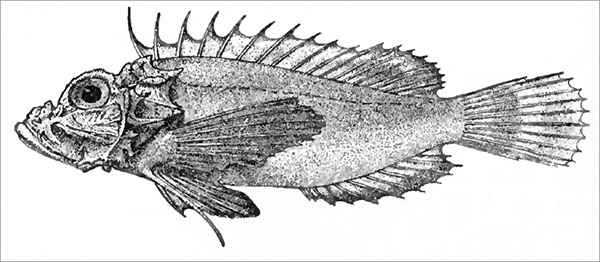
| 일지말락쏠치 묘사도. Illustration of Grey stingfish(Minous monodactylus). Source/Fauna of British India(Date/1889) Author/Sir Francis Day |
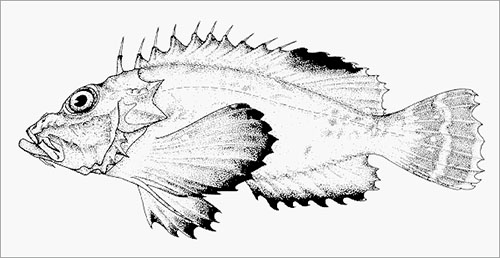 일지말락쏠치 묘사도. Illustration of Grey stingfish(Minous monodactylus). Author/FAO |
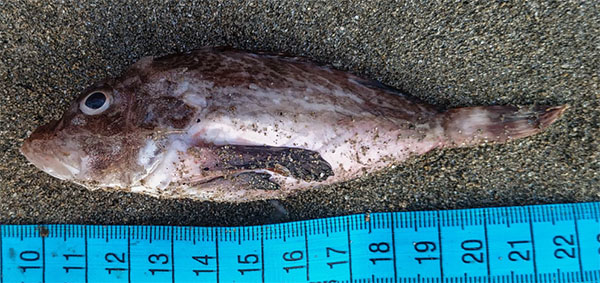 일지말락쏠치 연구 과정 콜렉션. Collection for study. Grey stingfish(Minous monodactylus). Observed in India. Author/Kaustubh Sandip Warde |
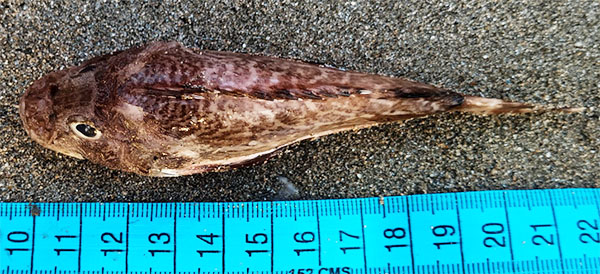 일지말락쏠치의 등면 사진. 연구 과정 콜렉션. Dorsal view. Collection for study. Grey stingfish(Minous monodactylus). Observed in India. Author/Kaustubh Sandip Warde |
 일지말락쏠치 보존 개체 표본 사진. Preserved specimen of Grey stingfish(Minous monodactylus). Location/India, Mangalore. Author/R.Saravanan |
 일지말락쏠치 X레이 사진. Radiograph of Grey stingfish(Minous monodactylus). Collected in Somalia. Attribution/"208387-r" |
| text on preparation |
| text on preparation |
| text on preparation |
| text on preparation |


|
| Copyright ⓒ FISHILLUST.COM All rights reserved. All contents can not be used without permission of the copyright holder. |


 검색
