
사이트 로그인
사이트 로그인
|
분류계통/경골상강→조기강→쏨뱅이목→쑤기미과→말락쏠치 Copyright by Kim In Young. 김인영 그림
|
| image on preparing |
| 말락쏠치 기본 모습. Lateral view of Dwarf stingfish(Minous pusillus) |
쏨뱅이목 쑤기미과 분포; 중부와 서북태평양/한국의 남gg해, 일본 남부, 동중국해, 남중국해, 필리핀에 분포한다. 보르네오섬, 북한의 동해안, 파푸아 뉴기니, 뉴칼레도니아에서도 드물게 발견된다는 정보가 있다. 입은 중간 크기며 35도 각도로 위로 기울어져 있고 입이 열리는 구간 길이는 머리 길이의 2/5이다. 아래턱이 위턱보다 길며 아래턱 앞 끝에서 하악 결합부(mandibular symphysis)가 돌출되지 않았다. 입술은 얇다. 양턱과 서골에 작은 이빨들이 있고 구개골에는 이빨이 없다. 서골의 이빨은 좌우측 열이 분리되어 나 있다. 혀는 넓고 두꺼우며 앞부분은 위아래로 납작하고 바닥에 고정되어 있지 아니하고 자유스럽다. 아가미구멍은 넓고 아래 쪽은 눈의 앞 가장자리 아래에 이른다. 아가미 막들은 서로 분리되어 있고 협부에서 결합되어 있다. 아가미에는 가짜 아가미(pseudobranch)가 발달하여 있다. 두개골은 심하게 거칠지는 않으며 낱알 모양의 돌기들이 넓은 간격으로 흩어져 있다. 전새개골에 5(5~7개의 가시가 방사상으로 배열되어 있으며 두번째 가시가 가장 길고 날카롭다. 주새개골(아가미뚜껑)에 두 가닥의 뼈 융기선이 있고 각각의 끝은 가시로 솟아나 있다. 주새개골과 전새개골 사이 공간에는 가시가 없다. 위턱과 맞닿는 누골 하부에 2개의 가시가 밑으로 향해 있으며 첫째 가시는 작고 두번째 가시는 길고 뾰족하다. 앞콧구멍에 튜브 모양의 돌기 1개, 눈앞가시(preocular spine) 앞에 작은 돌기 1개, 눈 위에 피부 돌기(dermal cirri) 4~6개, 아래턱 아래에 여러 개의 수염돌기(barbels)가 있다. 몸, 옆줄, 지느러미에는 뚜렷한 피부 돌기가 없다. 몸에 비늘이 없으며 피부는 매끄럽고 부드럽다. 측선은 등쪽으로 치우쳐 있고 일반적인 경우과 달리 미병부에서 중앙을 지나가지 않고 미병부 위쪽으로 치우쳐 끝난다. 모든 지느러미의 연조들은 불분지 연조이다. 등지느러미는 1개로 구성된다. 등지느러미의 기점은 주새개골(아가미뚜껑) 상단 모서리 보다 훨씬 앞쪽에 위에 위치한다. 등지느러미의 가시들은 필라멘트처럼 매우 가늘고 길다. 등지느러미의 가시부 기저는 등지느러미의 연조부 기저보다 약간 길다. 등지느러미의 제1극조와 제2극조는 거의 붙어 있고 제1극조는 제2극조보다 길이가 짧다. 등지느러미의 앞쪽 가시들은 막의 상단이 안으로 깊게 패였다. 등지느러미 연조부의 뒤 끝은 꼬리지느러미 기부에 이르며 마지막 막은 미병부 끝에 붙어 있다. 뒷지느러미 기점은 등지느러미의 1번 연조 아래에 있고 마지막 연조의 막은 미병부 끝에 붙어있다. 가슴지느러미는 넓고 둥글며 몸의 아래쪽에 붙어있으며 뒤 끝은 뒷지느러미의 3번 연조(극조 포함하면 5번째)에 닿는다. 가슴지느러미의 맨 아래 연조 1개는 길며 본체로부터 분리되어 있는 유리연조(遊離軟條)이다. 배지느러미는 가슴 위치에 있으며 배지느러미 가시는 1번 연조 길이의 3/4이며 3번, 4번 연조가 가장 길다. 마지막 5번 연조의 막은 체벽에 붙어 있다. 배지느러미의 뒤는 거의 항문에 이른다. 꼬리지느러미 뒤는 둥글다. 말락쏠치의 체색은 환경에 따라 변화가 심하다. 매우 신선한 상태일때를 기준하면 몸 바탕에 진하거나 연한 황색이 깔려 있고 그 위에 다른 색이 올라타고 있어서 황갈색이나 적황색으로 보이며 이 바탕 위에 다시 어두운 색들이 얹혀져 얼룩을 만들어 낸다. 등지느러미의 위쪽 부분은 밝은 황색 또는 오렌지색이 강렬하게 나타난다. 가슴 및 배지느러미는 흑갈색을 가지며 촘촘한 그물망 무늬가 있다. 배지느러미와 뒷지느러미는 가장자리를 따라 짙은 검은색 띠가 있어서 몸 윤곽을 잘 드러내 준다. 등지느러미 극조 막의 상단부는 검다. 등지느러미 연조부에는 어두운 줄 무늬가 있다. 복부는 유백색이며 연한 주황빛이 감돈다. 꼬리지느러미는 반투명한 연한 황색 바탕에 기조들이 들어나 있으며 굵은 띠 무늬는 없고 기조를 따라 검은 점들이 일정한 간격으로 점박이처럼 배열되어 있다. 뺨과 주둥이 주변에는 눈을 중심으로 뻗어나가는 방사형의 어두운 줄무늬가 보인다. 열대와 온대 해역에 살며 체장이 5cm~7cm 밖에 안 되는 소형 물기이다. 체강이 크며 복막은 백색이다. 위장이 크며 포낭형이다. 창자는 체장보다 짧고 두 번 꼬여(coiled) 있다. 부레가 없다. 바닥에 살며 느리게 움직인다. 말락쏠치속(Gneus Minous) 물고기들은 가시가 있는 모든 지느러미(등지느러미, 배지느러미, 뒷지느러미)의 가시들에 독샘이 있어서 가시 끝으로 독을 보낸다. 활동 범위가 크지 않으며 멀리 이동해 다니지 않는다. 주로 갑각류를 먹으며 기타 다른 것도 먹는다. 가슴지느러미 맨 아래에 있는 분리 기조를 이용하여 바닥을 기어 다닐 수 있다. 난생이다. 저인망에 잡히는데 어획량이 많지 않지 않으며 상품적 가치는 별로 없다. 잘못 만지면 독침 가시에 찔릴 수 있다. 히드라충류의 기생 생태(Parasitic Ecology with Hydroids): [한국명의 어원] 일본명 Yase-okoze(ヤセ-オコゼ)의 Yase(ヤセ)는 마른 사람의 뜻이며 okoze(オコゼ)는 쑤기미(쏠치)의 뜻이다. 쏠치류(쑤기미류) 중에서 몸이 여윈 듯 보이기 때문에 붙여진 일본명인 것 같으며 한국명의 “말락”은 “말라깽이”에서 나온 말인 것 같다. 즉 말락쏠치는 일본명을 차용한 것으로 보인다. 영명은 난장이 쏠치(Dwarf stingfish)인데 크기가 작은 “난장이”와 “야윈 사람” 두 어휘에 연관성이 있어 보인다. [말락쏠치 학명 미노우스 푸실루스(Minous pusillus)의 어원] 말락쏠치의 종소명인 pusillus(푸실루스)는 '매우 작은(very small)', '앙증맞은(tiny)'이라는 뜻을 가진 라틴어 pusus 에서 유래했다. 생물학의 학명(종소명)으로 쓰일 때는 주로 "해당 가문(속) 내에서 크기가 유독 왜소하고 아주 작은 종"을 지칭할 때 사용된다. 말락쏠치는 성체 체장이 약 5~7cm 내외밖에 되지 않아, 다른 쑤기미류나 양볼락과 어류들에 비해 체구가 현저히 작고 왜소하다. 이를 기반으로 영명 또한 '난쟁이 쏠치(Dwarf stingfish)' 혹은 '왜소한 쑤기미(Puny goblinfish)'라는 이름이 붙었다. |
Oder Scorpaeniformes Family Synanceiidae(Stonefishes). Distribution; Central and northwest Pacific/south sea of Korea, southern Japan, East China Sea, South China Sea, and Philippines. There is information that it is also rarely found on Borneo Island, the east coast of North Korea, and Papua New Guinea and New Caledonia. The mouth is moderate in size, oblique at an angle of approximately 35 degrees, and the gape length is about two-fifths of the head length. The lower jaw is longer than the upper jaw, and the mandibular symphysis does not protrude at the anterior tip of the lower jaw. The lips are thin. Small villiform teeth are present on both jaws and the vomer, while the palatine is edentulous(lacks teeth). The vomerine teeth are arranged in two separate patches on the left and right sides. The tongue is broad, thick, dorsoventrally depressed anteriorly, and free from the floor of the mouth. The gill opening is wide, with its lower margin extending below the anterior margin of the eye. The gill membranes are separate from each other and attached to the isthmus. Pseudobranchiae are well-developed. The cranium is not severely rugose, with granulate protuberances widely spaced and scattered. The preopercle has 5(5~7) spines arranged radially, with the second spine being the longest and sharpest. The opercle has two bony ridges, each ending in a spine. There are no spines in the space between the opercle and the preopercle. The lower part of the lacrimal bone, which meets the upper jaw, bears two downward-pointing spines; the first spine is small, and the second spine is long and sharp. There is one tube-like flap on the anterior nostril, one small flap in front of the preocular spine, 4 to 6 dermal cirri on the upper part of the eye, and several barbels on the underside of the lower jaw. No distinct dermal flaps are present on the body, lateral line, or fins. The body lacks scales, and the skin is smooth and soft. The lateral line is dorsally elevated and, unlike in typical cases, remains displaced dorsally on the caudal peduncle rather than passing through its center, ending near the upper margin of the caudal peduncle. All soft rays of all fins are unbranched. The dorsal fin consists of a single continuous fin. The origin of the dorsal fin is located well anterior to and above the upper corner of the opercle. The dorsal fin spines are extremely thin and long, extending like filaments. The base of the spinous dorsal fin is slightly longer than the base of the soft-rayed dorsal fin. The first and second dorsal spines are closely set together, with the first spine being shorter than the second. The anterior dorsal fin spines have their upper membranes deeply incised. The posterior end of the soft dorsal fin reaches the base of the caudal fin, The posterior end of the soft dorsal fin reaches the base of the caudal fin, and the last membrane is attached to the end of the caudal peduncle. The origin of the anal fin is positioned below the first soft ray of the dorsal fin, and the membrane of the last anal ray is attached to the end of the caudal peduncle. The pectoral fin is broad, rounded, and attached to the lower part of the body, with its posterior tip reaching the third soft ray (the fifth ray if counting the spines) of the anal fin. The lowermost single soft ray of the pectoral fin is elongated and detached from the main fin body, forming a free ray. The pelvic fin is thoracic in position; the pelvic spine is three-fourths the length of the first soft ray, and the third and fourth soft rays are the longest. The membrane of the last(fifth) soft ray is attached to the body wall. The posterior tip of the pelvic fin nearly reaches the anus. The posterior margin of the caudal fin is rounded. The body coloration of Minous pusillus is highly variable depending on its environment. Based on specimens in a freshly caught(fresh) condition, a bright or pale yellow base is laid down first, over which other shades layer to present a yellowish-brown or reddish-yellow appearance. Upon this primary layer, darker colors overlay to form irregular, cloud-like marbled patterns. The upper portion of the spinous dorsal fin membrane is intensely colored with a brilliant yellow or orange band. The pectoral and pelvic fins possess a dark blackish-brown coloration, intricately adorned with a dense, net-like(reticulated) pattern. The pelvic and anal fins are with black margins, which sharply defines the body contours. The ventral side is clean milky-white with soft orange undertone. The caudal fin features translucent, pale yellow background that exposes the fin rays; it completely lacks thick vertical bands, and instead, minute black dots are neatly arranged at regular intervals along the rays. Distinct radial stripes are visible around the cheek and snout, extending outward from the center of the eye. The upper part of the dorsal-fin spine membrane is dark. The soft-rayed portion of the dorsal fin has dark stripes. It is a small fish with a body length of only 5 to 7 cm, inhabiting tropical and temperate waters. The body cavity is large, and the peritoneum is white. The stomach is large and sac-like (saccular). The intestine is shorter than the body length and twice coiled. Swim bladder is absent. It is a bottom-dweller and moves slowly. All fishes of the genus Genus Minous have venom glands in the spines of all their spiny fins(dorsal, pelvic, and anal), which deliver venom through the tips of the spines. Its home range is limited, and it does not migrate long distances. It feeds primarily on crustaceans and other small organisms. It can crawl along the seafloor using the detached lowermost ray of the pectoral fin. It is oviparous. It is occasionally caught in bottom trawls, but the catch is not abundant and it holds little commercial value. Mismanagement or handling can result in a sting from its venomous spines. Parasitic Ecology with Hydroids: [Etymology of the Korean Common Name] [Etymology of Minous pusillus] The specific epithet pusillus is a Latin adjective meaning "very small," "tiny," or "puny." In zoological nomenclature, this term is traditionally assigned to a species that exhibits a significantly smaller, more diminutive body size compared to its generic congeners. Measuring only 5 to 7 cm in total length, Minous pusillus is the smallest member within the genus Minous distributed in East Asian waters. This characteristic lean and miniature physique directly mirrors its English common names, "Dwarf stingfish" and "Puny goblinfish," as well as its Korean common name "Mallak-ssolchi" (derived from the word for a skinny person). |
 말락쏠치 분포도. Distribution map of Dwarf stingfish(Minous pusillus). Main ref./fishbase.org. Author/fishillust.com |
말락쏠치(Minous pusillus)의 사진은 매우 귀하며 저작권이 조건부 무료사용(CC BY NC)인 사진은 더욱 귀해서 유감스럽게도 이 물고기의 모습을 느낄 수 있는 사진 이미지를 소개하지 못한다. 다음 사이트(일본)에 직접 들어가면 제한적이지만 사진들을 볼 수 있다. Photos of the Dwarf stingfish(Minous pusillus) are very rare, and photos with the conditionally free CC BY-NC license are even rarer, so unfortunately I cannot introduce photo-image that conveys the appearance of this fish. However, If you visit the following site in Japan directly, you can view some photos. |
| text on preparation |
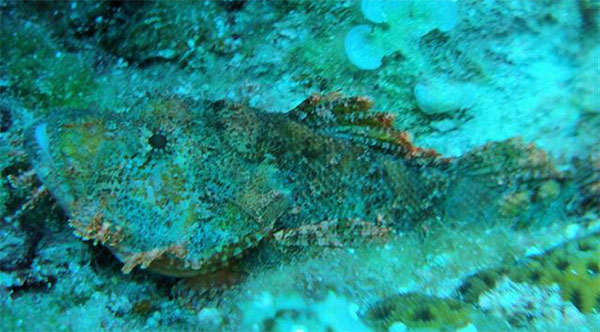 환경 색에 은폐하고 있는 말락쏠치 수중사진. Underwater photo of Dwarf stingfish(Minous pusillus) disguised as environmental color. |
 |
| 말락쏠치 묘사도. Illustration of Dwarf stingfish(Minous pusillus). Author/鄭義郎(정의랑). Source/臺灣魚類資料庫(Fish Database of Taiwan). CC BY NC) |
 말락쏠치 묘사도. A depiction of Dwarf stingfish(Minous pusillus). Source/fishbiosystem.ru |
 |
| 말락쏠치 보존개체. Preserved specimen of Dwarf stingfish(Minous pusillus). Source/The Fish Database Of Taiwan. (CC BY NC) |
 |
| 말말락쏠치 X 레이 사진. Xray photo of Dwarf stingfish(Minous pusillus). Source/The Fish Database Of Taiwan. (CC BY NC) |
 |
| 해양 무척추동물 히드로충(Hydroid)이 무성하게 기생하여 몸이 거의 다 가려진 말락쏠치(Minous pusillus)의 모습. 이 부착물들은 위장을 위하여 물고기 몸에서 나온 돌기나 피편이 아니다. 물고기의 체액이나 피를 빨아먹는 기생충이다. 본문에 "히드라충류의 기생 생태" 해설을 참고할 것. 촬영자의 멘트; "소문대로 정말 기괴하면서도 귀여웠는데, 마치 쥐처럼 모래 위를 아장아장 기어 다니고 가끔씩 하품을 하기도 했습니다. 또한, 다이버들이 그 물고기를 둘러싸고 웃음을 터뜨리는 모습도 꽤 특이한 광경이었습니다".
An individual of the dwarf stingfish(Minous pusillus) with its body almost entirely obscured by a heavy infestation of the marine invertebrate hydroid. These attachments are not dermal papillae or skin flaps derived from the fish's own body for camouflage; rather, they are parasites that feed on the fish's blood and body fluids. For more details, please refer to the commentary "Parasitic Ecology with Hydroids" in the main text. [Photographer's Comment]; "True to the rumors, it was incredibly bizarre yet adorable. It crawled totteringly across the sand just like a mouse and occasionally yawned. Seeing the divers surrounding the fish and bursting into laughter was also quite a peculiar sight in itself." Location/-16m, 大瀬崎(Osezaki Bay, Japan), Japan. Author/Izuzuki Diver(Japan). (CC BY NC). |
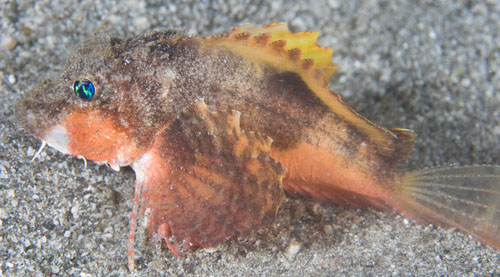 [참고사진]말락쏠치의 외관을 알아볼 수 있는 사진이 희귀하여 비슷하다고 생각되는 근연 종(Painted Stingfish; Minous pictus)의 사진을 참고로 소개해 둔다. [Reference photo] Photos of the Dwarf stingfish(Minous pusillusis) are rare, so a photo of closely related species, Painted Stingfish(Minous pictus), which is thought to be similar in appearance, is provided here for reference. Location/komodo, Indonesia. Author/maractwin. (CC BY NC). |
 |
| [참고사진] 말락쏠치의 외관을 알아볼 수 있는 사진이 희귀하여 비슷하다고 생각되는 근연 종(Painted Stingfish; Minous pictus)의 사진을 참고로 소개해 둔다. [Reference photo] Photos of the Dwarf stingfish(Minous pusillusis) are rare, so a photo of closely related species, Painted Stingfish(Minous pictus), which is thought to be similar in appearance, is provided here for reference. Location/Bali, Tulamben, Indonesia. Author/Scott Johnson. (CC BY NC). https://fishbase.se/photos/UploadedBy.php?autoctr=33662&win=uploaded |
| text on preparation |


|
| Copyright ⓒ FISHILLUST.COM All rights reserved. All contents can not be used without permission of the copyright holder. |


 검색
