[Freshwater fish]
Order Cypriniformes Family Cobitidae(loaches).
European weather loach
Misgurnus fossilis(Linnaeus, 1758). Max. 30.0 cm TL(male), 30.7 cm TL(female). common length: 15.0 cm TL
Dorsal spines 3, Dorsal soft rays5-6 . Anal spines3 , Anal soft rays 8 - 11. Vert/49~50.
Distribution; Europe/north of the Alps, from Meuse eastward to Neva drainages and Lake Ladoga; northern Black Sea basin from Danube eastward to Kuban, Caspian basin in Volga and Ural drainages. Locally introduced in other Europian regions.
General; It is commonly known as Weatherfish, European weatherfish, or European weather loach, due to its activity patterns changing when air pressure rises or falls. If there is a sudden change in barometric pressure, the weatherfish comes to the surface and swims about excitedly. Broad midlateral stripe from eye to caudal base and narrow stripe from opercle at least to anal fin origin. Lamina circularis absent in males. Caudal fin with 14-16 rays.
Found in lower reaches of slow-flowing rivers, but can also be found in still pools, on sandy bottoms of ponds, pools and ditches. Adults are nocturnal which burrow into mud during dry periods and strong frosts. Usually, burrows are 20-30 cm deep, occasionally down to 70 cm during dry periods. During the day, they stay buried in the sand. Feed on insect larvae and small mollusks. Facultative air-breathers. In water with low oxygen content it gulps air; it extracts oxygen through its intestinal mucous membrane, which has a complex system of blood vessels. When mating in spawning season, male follows female into dense vegetation and forms a complete ring around her body, behind dorsal fin.
|


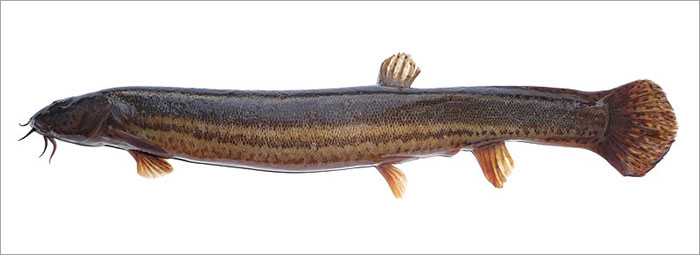 유럽미꾸라지. European weather loach(Misgurnus fossilis). Locality; Ukraine. A studio shot. Author/George Chernilevsky
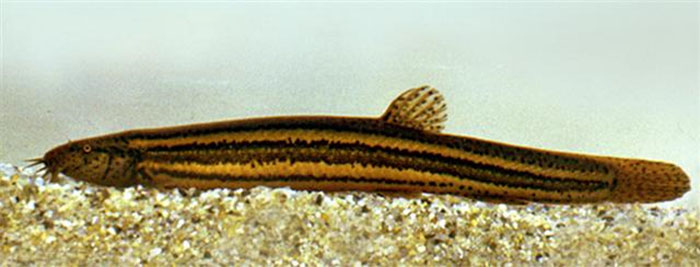 유럽미꾸라지. European weather loach(Misgurnus fossilis). Locality; Hungary. Author/Harka, Akos
 유럽미꾸라지. 일러스트. Illustration of European weather loach(Misgurnus fossilis). Date 1869. Author Anonymous
 유럽미꾸라지. European weather loach(Misgurnus fossilis). photographed in a fish tank. Author/Bernt René Voss Grimm
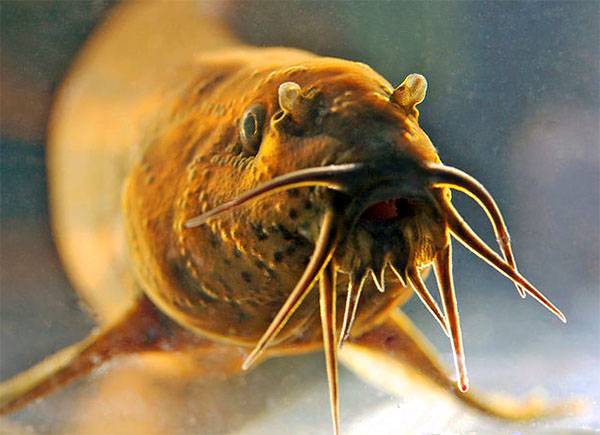 유럽미꾸라지의 수염 모습. Barbel system of European weather loach(Misgurnus fossilis). Locality; Estonia. Author/Tiit Hunt




 검색
