Oder Anguilliformes Family Muraenesocidae(Pike congers)
Daggertooth pike conger
Muraenesox cinereus(Forsskål, 1775). Max length/ 220 cm TL. common length/ 80cm TL
Korean name/gaet-jang-eo(갯장어)
Japanese name/Hamo
Chinese name/海鰻 Hǎi mán
P1/16~17. LLP/146~154(before anus/40~47). Vert/142~159
Distribution; Indo-West Pacific/Red Sea, Persian Gulf, west coast of India, and Sri Lanka to Fiji and Tuvalu, north to Japan and Korea, south to the Arafura Sea and northern Australia. Migrated to the Mediterranean via the Suez Canal.
General; The name by Korean language is “gaet-jang-eo(갯-장-어)”, the first syllable “gaet” means tidal mud flats and the rest syllables means an eel fish. In terms of the term itself, it is eels that live in mud tidal flats, but this is not true and misrecognized even in Koreans. “Gaet” was written as “gae” in the old language, but this changed to pronounce of “Gaet”. “Gae” means dog. In other words, the original meaning was dog eel. The original name come from its reminiscent of dog’s sharp teeth and behavior often bites fisherman. It has no relation with the tidal flat because it is caught in off shore areas
The body is thin and long, almost cylindrical fore body and compressed to the side posteriorly. The mouth is very large compared to the body size and is triangular when viewed from the side. Snout long. Two to three rows of sharp teeth are lined up on both jaws, and stiff and large fangs are located in the front part. Posterior nostrils much closer to eyes than to anterior nostrils. Daggertooth pike conger similar in body shape to conger eel, but differs in that the snout is slightly longer and the mouth is larger. In particular, the teeth are large and sharp, and they are characterized by large fangs that are curved in the front. There are no pelvic fins. The number of sensory pores in lateral line is 146~154 in total, lateral-line pores before anus 44-47. There are no scales on the surface of the body and skin is smooth. The dorsal fin starts slightly in front of the base of the pectoral fin. The dorsal and posterior fins meet each other in the caudal fin. Dorsal-fin rays before anus 66-78.
Dorsal side grayish brown or dark brown, and the belly is white. The pectoral fin is slightly red, and the edges of the dorsal and posterior fins are dark. Mainly in shallow coastal waters with rocks, sand, and mud, where many places to hide. Sometimes found in brackish water and freshwater close to the sea. Nocturnal and stays in the cracks of rocks during the day and begins to be active mainly at night. Grow to adult hood in 5 years after birth, and the female lays about 18 to 1.2 million eggs per year. It spawns around June-July. The hatchlings goes through the willow-shaped larvae called “leptocephalus”, and the female grows in size faster than the male. it feeds on benthic fish, crustaceans and cephalopods. Daggertooth pike congers near the Korean Peninsula lives in the west and south seas, Jeju Island, and in the East Sea, Spends winter in the southern seas of Jeju Island, moves north in spring, and descends south for winter again in autumn.
It is caught by low-floor trawling at night, snarling, trap bag nets, etc. The harvest is high between June and November. It is mainly captured for edible purposes, but is also used as bait for shark fishing or used in Chinese medicine. Because the bones are strong, remove the bones and use only the flesh. Eaten in raw sashimi. The sashimi is said to be more savory and sweet as you chew it. It can be eaten by grilling or blanching, and it can also be eaten with the intestines. It is characterized by higher protein content than other eel such as common eels, conger eel, and hagfish. Captured and cultured for fishery in Japan. Marketed mainly fresh
|

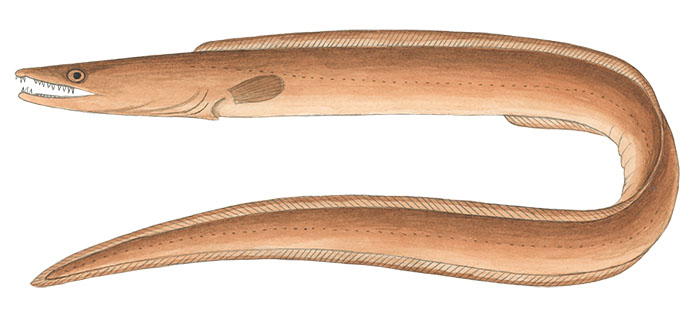
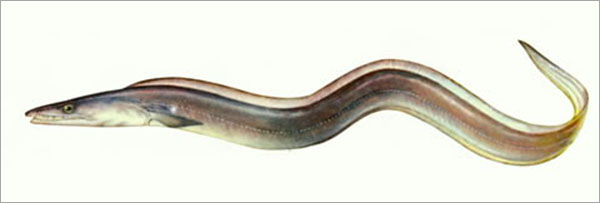 갯장어 도감 그림. Illustrated Daggertooth pike conger(Muraenesox cinereus). Author/ CAFS(Chinese Academy of Fishery Sciences)
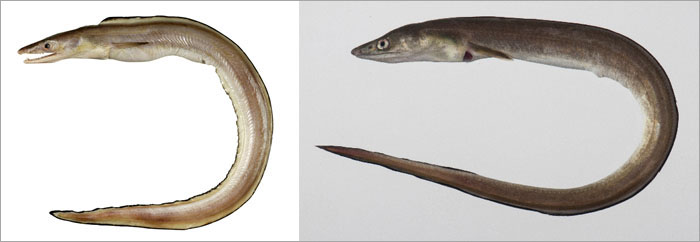 갯장어 죽은 개체 사진. Dead specimens of Daggertooth pike conger(Muraenesox cinereus). Author/left; CSIRO, right; Smithsonian
 실물로 보는 갯장어의 머리 모습. Head portion of fresh Daggertooth pike conger(Muraenesox cinereus). Author/Smithsonian
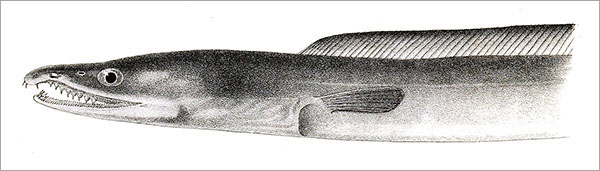 세밀화로 표현된 갯장어의 머리 모습. The head portion in miniature of Daggertooth pike conger(Muraenesox cinereus). Date/1878. Author/Francis Day
 갯장어(영명; 단검이빨갯장어)의 아래턱 이빨 구조. Teeth array of lower jaw in Daggertooth pike conger(Muraenesox cinereus). Country: Pakistan. Author/Hamid Badar Osmany
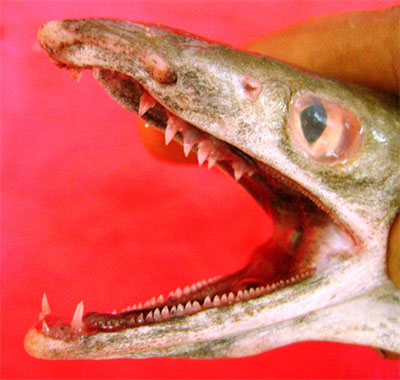 갯장어(단검이빨갯장어)의 벌린 입 구조. Wide opened mouth of Daggertooth pike conger(Muraenesox cinereus). Country: Pakistan. Author/Hamid Badar Osmany
 시장 바닥의 갯장어. Daggertooth pike conger(Muraenesox cinereus). At the yard of a market in Sindhudurg district, Maharashtra state, India. Author/kaustubhw
 자두 픽클을 곁들인 갯장어 회 요리. Sashimi of pike eel served with pickled plum. Author/ayustety from Tokyo




 검색
