Order Ophidiiformes Family Ophidiidae(cusk-eels)
Whitespotted brotula.
Neobythites sivicola(Jordan & Snyder, 1901). Max length/27.6 cm TL
Korean name/geu-mul-me-gi(그물메기; Reticulated cusk)
Japanese name/Shio-itachiuo (シオイタチウオ)
Chinese name/新鳚(신위)
Chinese name/黑潮新鼬魚(흑조신유어)
D/soft ray 93-96. A/soft ray 75 - 79. P1/26~.30. C/8. LLs/100. gill raker/10-11.
Distribution; Northwest Pacific/South Sea, Southeastern sea and Jeju Island of Korea, the Western coasts of Japan, and Pacific coasts in south of central Japan, Taiwan, East China Sea, and the Philippines. also found near Vanuatu island.
General; Body long and compressed laterally. Snout round and dull, slightly protruding from the mouth. Snout longer than the diameter of eye. Length of both jaws is almost equal. The rear end of the upper jaw passes the rear edge of the eye. On both jaws, small teeth are clustered in front, but in a row at the rear end. Preoperculum with 2 small spines at the lower angle, and 1 long spine on operculum. The base of dorsal and anal fins very long, and both fins start at the front of body and connected to the caudal fin, and the tip of caudal fin is pointed. The pelvic fin is long like thread and located below the gill hole, slightly behind the posterior margin of eye. The anus is located much anterior to the center of the body. Head and body fully covered with small round scales. The lateral line complete, and number of lateral line scales is 100.
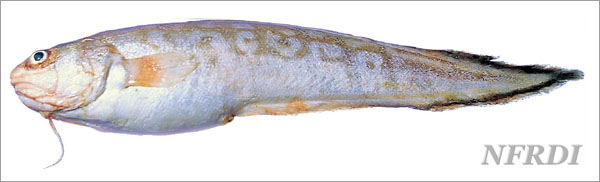
The body has a few irregular and indistinct small white spots on the dorsal part on a dark brown background. The belly is silvery white. The dorsal fin is light brown and the posterior part is blackish. It feeds mainly on crustaceans, with some small fish. It inhabits sandy or muddy bottoms at a depth of 60 to 200 m.. Oviparous, with oval pelagic eggs floating in a gelatinous mass. Usually, small fish are treated as trash fish, and large ones are used for food. The meat has a fishy smell, cooked by removing the fishy smell with various seasonings such as pepper. ginger, garlic, basil, wolfberry and other edible.
|


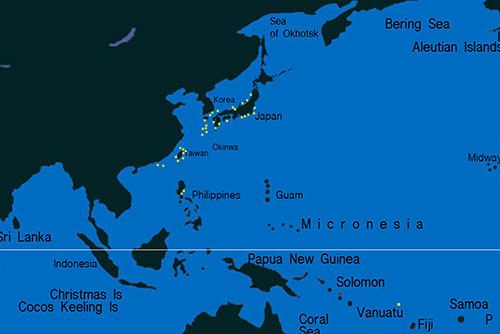 그물메기 분포도. Distribution map of Whitespotted brotula(Neobythites sivicola). Derived work. Author/Kim in young(fishillust.com)
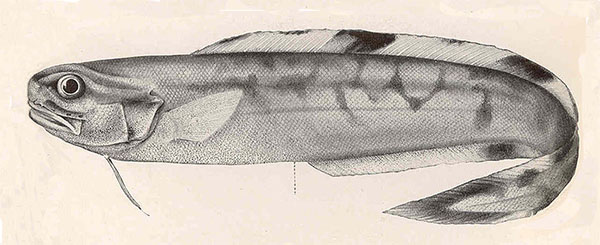 그물메기 묘사도. Illustration of Reticulated cusk(Neobythites sivicola). Author/David Starr Jordan(1851–1931)
 그물메기. Whitespotted brotula(Neobythites sivicola). Source/fishbiosystem.ru.
 그물메기 묘사도. Illustration of Whitespotted brotula(Neobythites sivicola). Author/Matsubara(1955). Source/fishbiosystem.ru
 그물메기. Whitespotted brotula(Neobythites sivicola). Source/fishbiosystem.ru.




 검색
