Oder Beryciformes Family Holocentridae(Squirrelfishes, soldierfishes)
Sammara squirrelfish
Neoniphon samara(Forsskål, 1775). Max length/32.0cm TL, common length/23.0cm TL
Korean name/mu-neui-eol-ge-dom(무늬얼게돔)
Japanese name/ウケグチイットウダイ(Ukeguchi-ittoudai)
Chinese Taipei name/莎姆金鱗魚(사모금린어)
D/spine 10+1=11, soft ray 11~12. A/spine 4, soft ray 7~8. P1/13~14. P2/spine 1, soft ray 7. LLP/39~43. 새파수(Gill raker)/5~8+8~12=14~19.
Distribution; Indo-Pacific/Red Sea and East Africa to the Marquesan and Ducie islands, north to Tong-yeong city and Jeju Island of Korea, south of central Japan, the Ogasawara and Hawaiian islands, south to northern Australia and Lord Howe Island.
General; The body is relatively more slender than other squirrelfishes and is less flat laterally. The head has a mucus sac, and most of the exposed bones have ridges. Big eyes. Mouth terminal, cleft oblique. The lower jaw protrudes from the upper jaw. The jaws, hoe and palate all have villiform teeth. There is a strong spine on the posterior lower corner of the preopercle; both the opercle and the lower orbital bone have spines of different strengths. The body is covered with large ctenoid scales; the lateral line is complete, the number of scales on the lateral line is 38-43, and the number of scales from the lateral line to the middle point of the hard spines of the dorsal fin is 2.5. Dorsal fin continuous, single, with deep recess between spiny part and soft ray part. The last hard spine is longer than the previous hard spine. Caudal fin deeply forked.
The dorsal side is yellowish with a silvery-white undertone, and the ventral side is white. Each scale is stamped with a single blackish red dot, so there appears to be one stripe for each row of horizontal scales, and the stripe of lateral line scales are red. There are about 10 of these stripes. There is a large broad row of blotches on the spinous part of dorsal fin, the blotches between the 1st and 3rd spine are black and those behind them are red. The number of black blotches at the front part is a diagnostic characteristics of the species. The top and bottom of the blotches are white. A broad reddish band on the gill cover.
|


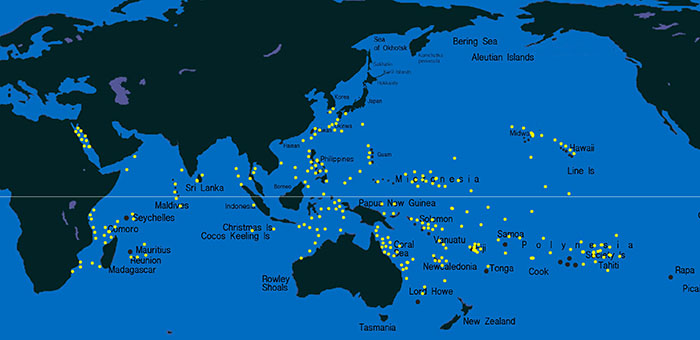
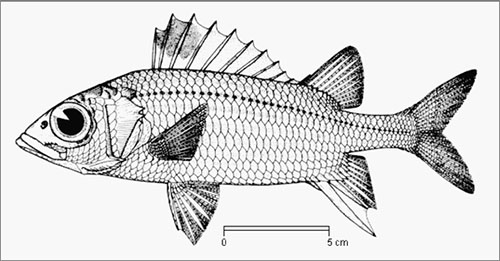 무늬얼게돔 체형도. Illustration of Sammara squirrelfish(Neoniphon samara). Author/fao.
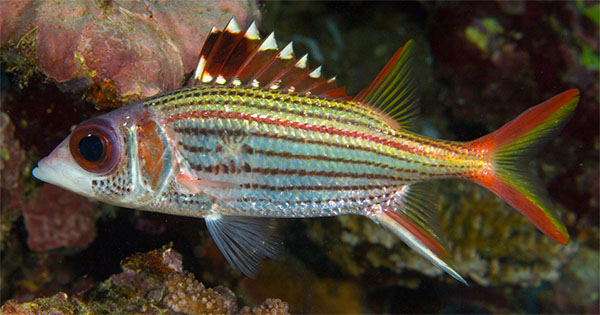 무늬얼게돔. Sammara squirrelfish(Neoniphon samara). Location/Rewa, central, FiJi. Author/Nick Hobgood. (CC BY-NC)
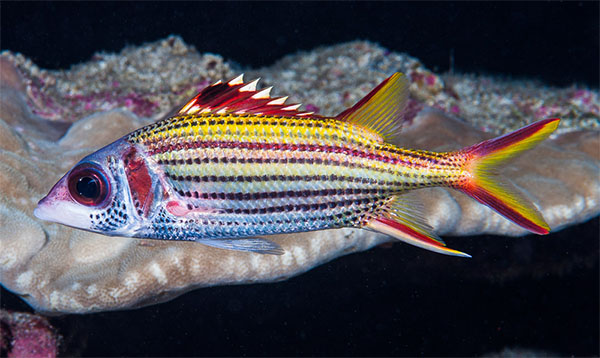 무늬얼게돔. Sammara squirrelfish(Neoniphon samara). Location/Réunion(레위니옹). Author/Francois Libert. (CC BY-NC)
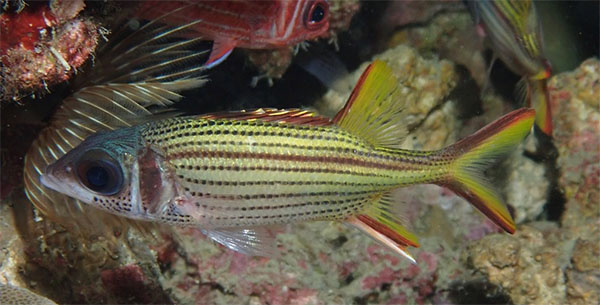 무늬얼게돔. Sammara squirrelfish(Neoniphon samara). Location/Batangas, Philippines. Author/Albert Kang. (CC BY-NC)
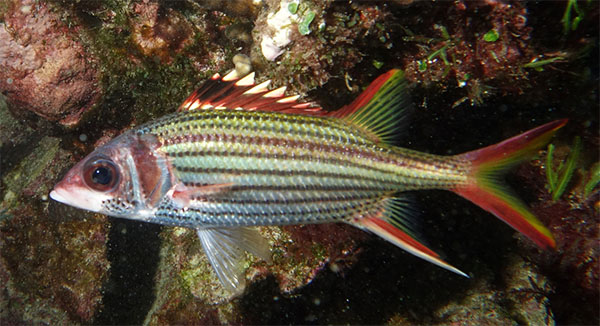
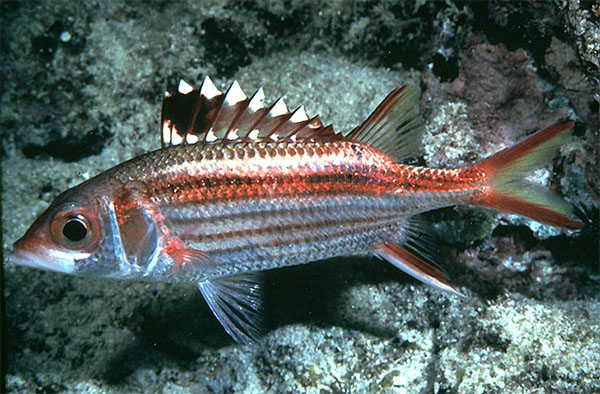
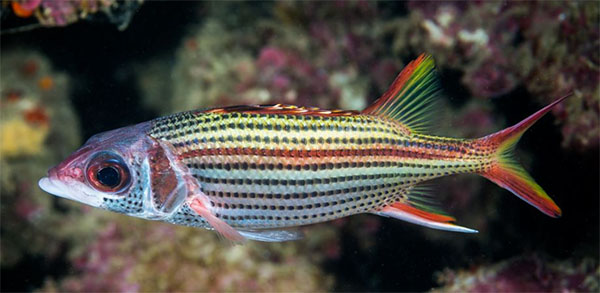 무늬얼게돔. Sammara squirrelfish(Neoniphon samara). Location/observed in the United States of America. Author/David R. (CC BY-NC)
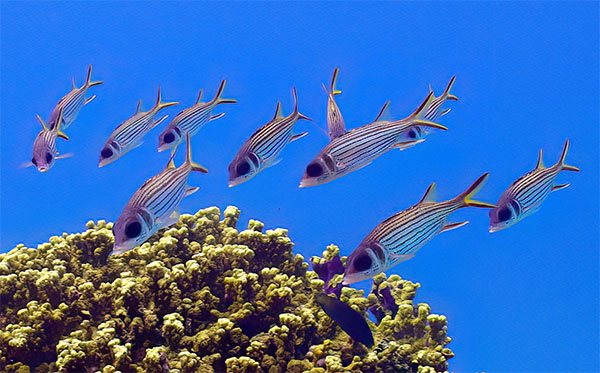
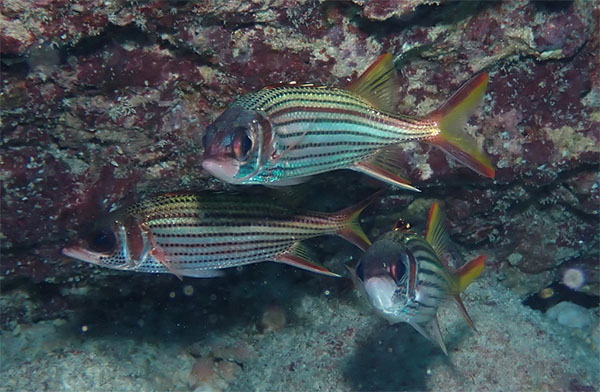 무늬얼게돔. Sammara squirrelfish(Neoniphon samara). Location/Honolulu, Hawaii, US. Author/Sara Thiebaud. (CC BY-NC)
 무늬얼게돔. 채집된 후 시간이 많이 지나가지 않은 상태. Sammara squirrelfish(Neoniphon samara). Not much time has passed since it was collected. Location/Ogasawara Archipelago, Japan. Author/cinnamon34. (CC BY-NC)
 Left/무늬얼게돔 유어. Juvenile Sammara squirrelfish. Location/US. Author/waxworms. (CC BY-NC). Right/무늬얼게돔 우표. Stamp of Sammara squirrelfish. Issued country/Pitcairn islands. Author/waxworms. (CC BY-NC)




 검색
