
사이트 로그인
사이트 로그인
|
분류계통/경골상강→조기강→색줄멸목→서프은줄멸과→서프은줄멸 Copyright by Kim In Young. 김인영 그림
|
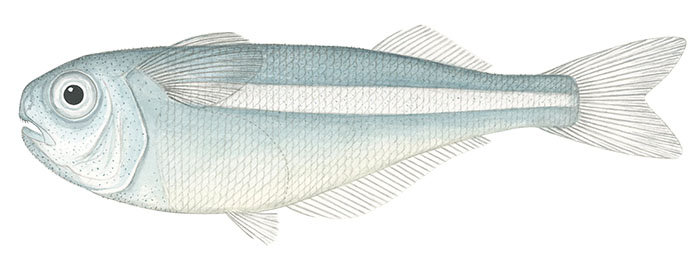 |
| [painting 1] 서프은줄멸 기본 모습. Lateral view of Swell scum sardine(Notocheirus hubbsi). |
|
Copyright by Kim In Young. 김인영 그림
|
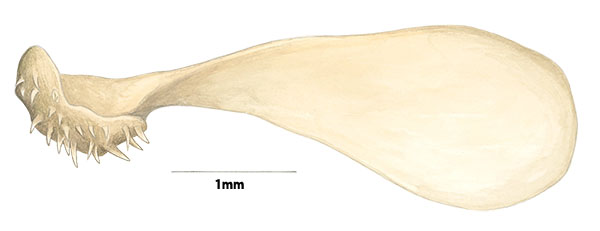 |
| [painting 2] 서프은줄멸의 앞위턱뼈(전상악골) 최전방의 이빨 모습. Appearance of the teeth at the forefront of the anterior upper jaw(premaxilla) of Notocheirus hubbsi. Illustrated by Kim In Young(fishillust.com). ※ Derived work from (pdf); ~a redefinition of Isonidae(Atheriniformes). Department of Biological Sciences, Macquarie University 2109, Australia. Authors/Basim Saeed, Walter Ivantsoff and Aarn |
색줄멸목 서프은줄멸과 분포; 태평양 남동부와 대서양 남서부 끝/칠레와 아르헨티나 최남단 해역. 서프은줄멸과(Notocheiridae)의 유일 종이다. 매우 작은 소형 물고기이다. 몸이 좌우로 매우 납작하다. 머리와 가슴지느러미 기부 아래 쪽 일부 몸 표면을 제외한 나머지 몸은 둥근비늘로 덮여 있다. 일반적으로 비늘의 위 아래 방향 배열은 약간 비스듬한데 서프은줄멸은 수직인 것이 특징이다. 체고는 가슴지느러미 기부에서 가장 높으며 미병부쪽으로 가면서 점차적으로 좁아진다. 항문 전 복부 가장자리는 날카로운 용골 모양을 이룬다. 머리는 작고 머리 뒤는 수직형이다. 주둥이는 둥글고 입은 위로 비스듬하게 놓여있다. 전상악골(premaxillary)은 앞으로 돌출하는 기능이 없으며 머리 등 면 중간에 있는 소대(小帶; frenum)에 붙어있다. 위턱의 앞 부분은 약간 안으로 패여 있다. 위턱 앞 끝 쪽에 안쪽으로 휘어진 작은 이빨들이 발달하여 있고 구개골에는 퇴화된 이빨이 있고 서골에는 이빨이 없다. 연구용으로 채집된 서프은줄멸(Notocheirus hubbsi)의 개체들 중에서 나타난 특징은 턱이나 전상악골 외에 머리의 외피 골판들에도 이빨이 나 있다는 점이다. 아가미 구멍이 넓으며 제1 아가미 궁에 아가미 갈퀴가 발달하여 있다. 항문은 뒷지느러미 기점 바로 앞에 있다. 생식기 구멍 뒤에 작은 막이 있다. 물꽃치과 어류는 2개의 등지느러미를 가졌지만 서프은줄멸(Notocheirus hubbsi)은 등지느러미가 1개뿐이다 등지느러미 기저부 길이는 뒷지느러미 기저부 길이의 1/2 보다 더 짧으며 뒤 끝은 뒷지느러미의 뒤 끝 위치와 대칭되는 지점에 있다. 등지느러미와 뒷지느러미의 마지막 연조는 불분지 기조이며 나머지는 모두 분지된 기조이다. 가슴지느러미는 넓고 둥글며 몸의 등쪽으로 높게 있으며 맨 위쪽 기조가 아가미 뚜껑 맨 위 끝에서 시작된다. 가슴지느러미의 하단부가 몸 중심선 띠의 기점을 가린다. 배지느러미는 몸의 하부 낮은 쪽에 붙어 있다. 몸색은 은빛이며 겨드랑이(axilla)에서부터 꼬리지느러미 기부까지 폭이 넓은 어두운 색의 수평 띠가 있다. 서프은줄멸(Notocheirus hubbsi)에 관해서는 알려진 것이 별로 없다. 해변가의 거품 파도가 일어나는 곳에서 주로 발견되지만 분포지인 칠레에서도 매우 드문 물고기이다. 드문 이유는 난모세포(oocytes)가 줄어들어서 생식력이 낮기 때문인 것으로 추측된다. [매우 혼란스러운 물꽃치과, 서프은줄멸과의 분류 역사] |
Oder Atheriniformes Family Notocheiridae(Surf sardines or surf silversides) Dustrubution; Southeast Pacific and Southwest Atlantic/Chile and Argentina's southernmost waters. The only species in the Notocheiridae family. Swell scum sardine is very small fish. Body is covered with cycloid scales, absent in head and some body surfaces below the base of pectoral fin. In most fishes, arrangement of scales from top to bottom is oblique, whereas in Notocheirus hubbsi, the arrangement is characteristically vertical. Body highly compressed, deepest at level of vertical plane through origin of pectorals, tapering towards caudal peduncle. The ventral edge anterior to the anus forms a sharp keel. Head small, truncate posteriorly, snout round, mouth oblique. The premaxillary bone has no forward protruding function and is attached to the frenum in the middle of the dorsal surface of the head. Maxillary slightly concave anteriorly. Small teeth that are curved inward are developed at the front end of the upper jaw, the palatine bone has degenerated teeth, and the vomer has no teeth. A notable external character of some specimens of Notocheirus is the presence of "odontodes", teeth in dermal bones of the head other than the dentary and premaxilla. The gill opening wide and gill rakers developed on the first gill arch. The anus is located just in front of the origin of the anal fin. There is a small membrane behind the genital opening. Notocheirus hubbsi has only one dorsal fin, whereas the Iso flosmaris in sister group has two dorsal fins. The base length of dorsal fin is shorter than 1/2 the base length of anal fin, and posterior ends of both fins are in a symmetrical position, facing each other. The last soft ray of the dorsal and anal fins is unbranched ray, and the rest are all branched rays. Pectoral fin broad, rounded, inserted high on body with dorsalmost ray originating above posteriormost point of opercle. The lower part of the pectoral fin covers the starting point of mid lateral band. The pelvic fin is attached to the lower part of the body. The body color is translucent silver and with a wide opaque silvery lateral band from the axilla to the base of the caudal fin. Little is known about the Notocheirus hubbsi. It is mainly found in places where foamy waves occur on the beach, but it is a very rare fish even in Chile, where it is distributed. It is presumed that the reason it is rare is because the number of oocytes is reduced and fertility is low. [Designation history of Family Isonidae and Family Notocheiridae is fraught with confusion] ※The text on this page was created with reference to the paper below(내용 출처). |
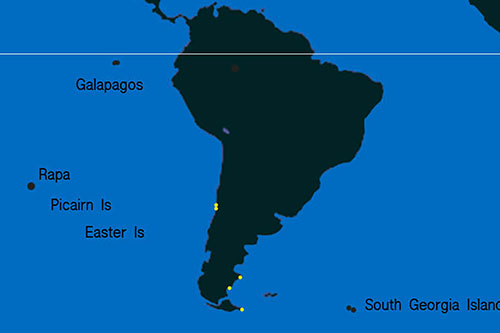 서프은줄멸 분포도. Distribution map of Swell scum sardine(Notocheirus hubbsi). Main ref./GBIF. Edited by fishillust.com |
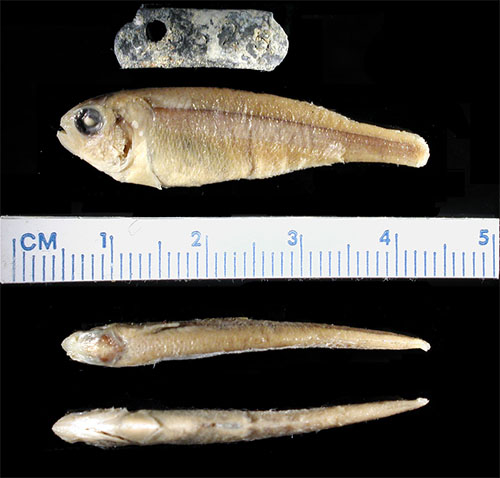 서프은줄멸 보존 개체. Preserved specimen of Swell scum sardine(Notocheirus hubbsi). Collected in Chile. Source/The California Academy of Sciences |
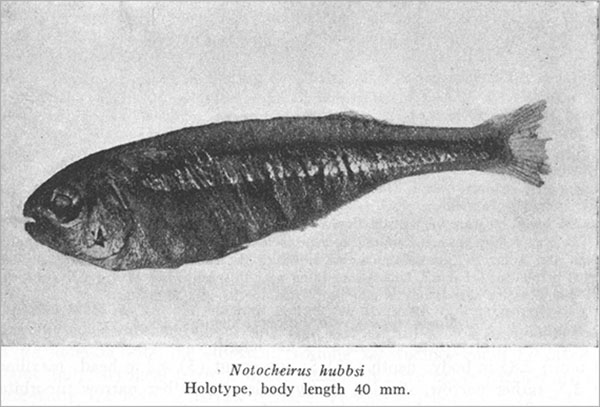 서프은줄멸 연구 문헌에 인쇄된 사진. Photograph printed in the research literature of Swell scum sardine(Notocheirus hubbsi). Collected in Chile. Source/The California Academy of Sciences |
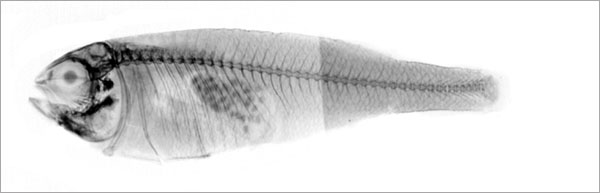 서프은줄멸 X 레이 사진. X-ray photo of Swell scum sardine(Notocheirus hubbsi). Collected in Chile. Source/The California Academy of Sciences |


|
| Copyright ⓒ FISHILLUST.COM All rights reserved. All contents can not be used without permission of the copyright holder. |


 검색
