
사이트 로그인
사이트 로그인
|
분류계통/경골상강→조기강→연어목 Order Salmoniformes(salmons)→연어과 Family Salmonidae(Salmonids)→ 곱사연어(Pink salmon; Oncorhynchus gorbuscha) Copyright by Kim In Young. 김인영 그림
|
 |
| [painting 1] 산란기가 오기 전 바다에 서식할 때의 곱사연어 성어의 모습. Adult Pink salmon in ocean phase. |
|
Copyright by Kim In Young. 김인영 그림
|
 |
| [painting 2] 산란기에 담수에 올라온 곱사연어 성어의 모습. Adult Pink salmon in fresh water spawning phase. |
[소하성/Anadromous] 분포;. 북극해와 태평양 연안/알래스카에서부터 캐나다, 캘리포니아까지, 아시아 북부는 러시아의 북극해 연안에서부터 캄차카반도, 쿠릴열도, 사할린섬, 연해지방, 일본 북부, 한국(북한 동해 북부)까지 분포한다. 바다에서 살아있을 때는 등쪽이 금속서 청록색이며 측면은 은색, 배는 백색이다. 등과 기름지느러미, 꼬리지느러미에는 큰 타원형의 점들이 있다. 산란기의 수컷은 등이 검어지고 측면은 붉어지고 여기에 녹갈색의 반점들이 있다. 산란기 암컷의 몸색은 수컷과 비슷해 지지만 색상이 덜 뚜렷하다. 소하성 물고기로 해양과 연안 하천에서 발견된다. 표해수층(表海水層)에 살며 담수의 경우 유속이 중간이거나 빠른 하천의 자갈 바닥에 산다. 산란기의 어미는 먹이를 먹지 않으며 산란 직후 모두 죽는다. 죽은 연어의 사체는 질소와 인 성분을 공급하여 하천 주변 생태계에 영양분이 되어 주며 새로 태어난 새끼들의 성장에도 도움이 된다. 산란은 수심이 얕고 깨끗한 자갈이 깔린 여울에서 한다. 산란된 새끼는 18개월 바다에서 살다가 태어난 모천으로 돌아온다. 그러나 모천으로 회귀하는 정확성이 불확실해서 일부는 방황하다가 태어난 곳에서 640 km 로 먼 하천에서 산란하기도 한다. 자갈바닥에서 나온 부화된 새끼는 곧바로 하류로 내려가 연안 바다에서 몇 달을 살다가 외해로 나간다. 새끼는 담수에서는 곤충 애벌와 번데기를 먹지만 전혀 먹지 않을 수도 있다. 새끼는 바다에서는 요각류, 피낭류의 애벌레를 먹는다. 그러다가 더 자라면 단각류(端脚目), 난바다곤쟁이류, 물고기를 먹는다. 진성 연어류 중에서 가장 작은 종이다. |
 곱사연어 산란기가 오기 전의 성어 모습. Illustration of adult Pink salmon(Oncorhynchus gorbuscha) before reproduction stage. Author/A. Hoen and Co. Date 1907. |
 산란기가 다가오고 있는 곱사연어 모습. Illustration of adult Pink salmon close to spawning season. Author/Timothy Knepp |
[Anadromous] Distribution; Arctic and Pacific drainages/Alaska, Canada, California, USA, occasionally southern California, northeast Asia/Artic Russia, Kamchatka peninsula, Kuril Is, Sakhalin, Maritime Province of Siberia, northern Japan, north east of North Korea. An anadromous species which inhabits ocean and coastal streams. Epipelagic. Pelagic at the sea. In freshwater, lives in rivers with moderate to fast current and gravel bottom. Spawns in riffles or at head of riffles in shallow water with current up to 1.5 m/s, and clean coarse gravel. Spends 18 months at sea after which spawning migration to the natal river or stream occurs; but because the species is less certain of its homing and there is a certain degree of wandering, streams as much as 640 km from natal streams may be used. In freshwaters, adults do not feed. After salmon spawn and die, salmon carcasses are a valuable source of energy and nutrients to the river ecosystem. Carcasses have been shown to improve newly hatched salmon growth and survival by contributing nitrogen and phosphorous compounds to streams. Upon emerging from the gravel, fry immediately move downstream and remain inshore for a few months before going out to sea. Fry may feed on nymphal and larval insects while in fresh water, but may not feed at all. In the sea, young feed on copepods and larvacean tunicates, its diet shifting to amphipods, euphausiids and fishes as the fish grows. The smallest of the true salmon |
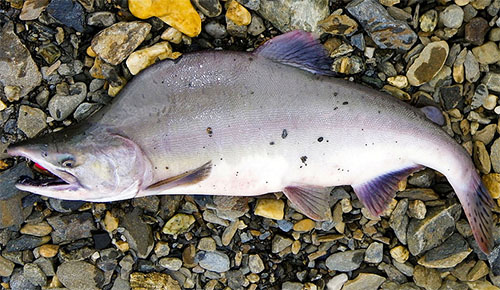 산란기에 잡힌 곱사연어 모습. A specimen of Pink salmon collected in spawning season. Author /Bering Land Bridge National Preserve |

산란기의 곱사연어 모습 그림. |
 수족관의 곱사연어. Pink Salmon in aquarium. カラフトマス。ja:サケのふるさと 千歳水族館飼育個体. Author/Totti |
 미국 하천에서 산란기에 낚시에 잡힌 곱사연어. Male pink salmon caught by a fly fisherman in its freshwater spawning phase. Author/Jack Roberts, U.S. Fish and Wildlife Service |
 미국 인디언강(Indian River)에 올라와 상류로 이동하고 있는 연어 떼. Pink salmon(Oncorhynchus gorbuscha) migrating up Indian River in the Sitka National Historical Park on September 6, 2018. Author/Erector |


|
| Copyright ⓒ FISHILLUST.COM All rights reserved. All contents can not be used without permission of the copyright holder. |


 검색
