
사이트 로그인
사이트 로그인
|
분류계통/경골상강→조기강→뱀장어목→바다뱀과→갈물뱀 Copyright by Kim In Young. 김인영 그림
|

|
| 갈물뱀 기본 모습. Lateral view of Manetail snake eel(Ophichthus urolophus) |
뱀장어목 바다뱀과 분포; 인도-태평양/한국(군산, 부산, 남해), 일본 남부, 중국, 태평양. 인도양에 분포한다. 머리 감각공은 작으며 분명하다. 두 눈 사이와 두정부의 감각공은 1개이다. 안상골공(supraorbital pores)은 4개, 안하골공(infraorbital pores)은 6개, 하악골공(mandibular pores)은 6~7개, 전새개골 구멍(preopercular pores)은 2개, 상측두골공(supratemporal pores)은 3개이다. 희미하게 보이는 아주 작은 감각돌기들의 열이 목덜미와 안구의 앞쪽 경계선을 따라 나 있고 전비공 기부에는 말굽형으로 둘려져 있다. 측선공은 뚜렷이 보이며 머리에 9개가 곡선 방향으로 배열되어 있고 등지느러미 전에 17개, 항문 전에는 56~57개, 총 수는 133~135개이다. 마지막 측선공은 마지막 측선공은 꼬리 끝에서 눈 지름의 2배 거리 앞 위치에 있다. 이빨은 중간 크기이며 원추형이며 이빨들의 기부는 거리 간격이 잘 분리되어 있다. 상악의 앞부분 가운데에는 3–5개의 이빨이 곡선 방향으로 놓여있고 그 뒤를 이어서 17–19개의 서골 이빨이 1열로 놓여있는데 뒤로 갈수록 크기가 작아진다. 상악치는 1열이며 17-19 개 이빨로 구성되어 있다. 뒷콧구멍 앞 쪽에 5‒6 이빨로 구성된 내측 치열이 한 줄 있다. 하악치도 1열이며 21 개 이빨로 되어있으며 뒤로 갈수록 크기가 작아진다. 신선할 때 등쪽은 황갈색이며 모가지에서부터 항문까지 배쪽은 하얀 크림색이다. 등지느러미는 회색이며 뒷지느러미는 하얀색이다. 가슴지느러미는 연한 회색이다. 보존 개체도 색상은 비슷하다. 수심 약 200m 정도의 깊이에서 서식한다. ※ 영명 Manetail snake eel의 mane은 말이나 사자 목덜미의 갈기를 의미한다. |
Oder Anguilliformes Family Ophichthidae(Snake eels). Distribution; Indo-Pacific/southern Korea(Gun-san, Busan, South Sea), southern Japan, and China. Head pores small but apparent. Single median interorbital(frontal) and temporal pores. Supraorbital pores 1 + 3, infraorbital pores 4 + 2, mandibular pores 6‒7, preopercular pores 2, supratemporal pores 3. Faint rows of minute sensory papillae are present along nape, along anterior margin of orbit, and in a horseshoe-shaped pattern around base of anterior nostril. Lateral-line pores apparent; 9 on head, in an arching sequence, 17 before dorsal-fin origin; 56‒57 before anus, 133‒135 in total, the last ca. 2 eye diameters before tail tip. Teeth moderate, conical, and separated from each other at base. Intermaxillary with 3–5 teeth in a curved row, followed by 11–14 uniserial vomerine teeth, which decrease slightly in size posteriorly. Maxillary teeth uniserial with 17–19 in a row, with an inner row of 5‒6 teeth at front of the posterior nostrils. Mandibular teeth also uniserial, with 21 in a row, decreasing in size posteriorly. Coloration: When fresh: yellowish-brown dorsally, slightly contrasting with the white throat and belly, extending to the anus. Dorsal fin grayish; anal fin uniformly white. Pectoral fin light grayish. When preserved: yellowish-brown dorsally, slightly contrasting with the white throat and belly, extending to anus. Dorsal fin grayish. Pectoral fin grayish. Inhabit sand and mud bottoms in around 200m depth. |
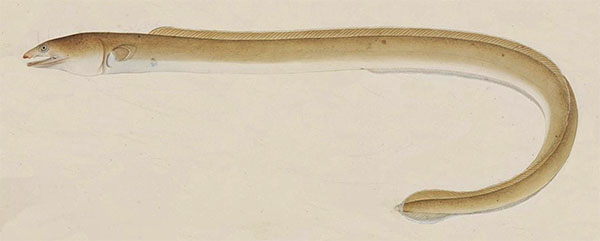 갈물뱀 묘사도. Illustration of Manetail snake eel(Ophichthus urolophus). Collection/Naturalis Biodiversity Center, Nagasaki Japan. Artist/Kawahara Keiga (1786–) |
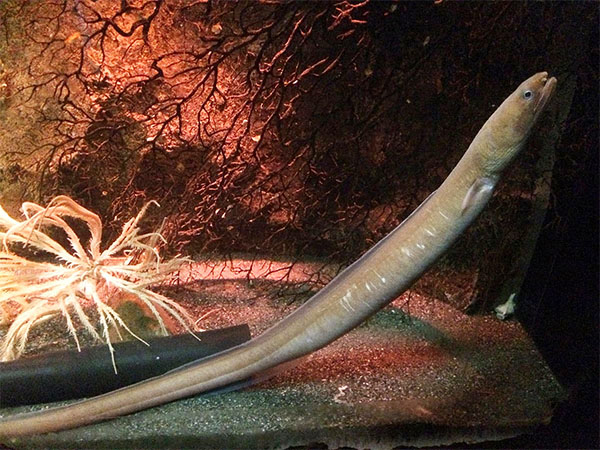 갈물뱀. 일본의 수족관. Manetail snake eel(Ophichthus urolophus). in Numazu Deepblue Aquarium, Sizuoka, Japan. 沼津港深海魚水族館. Author/ゆうき315 |


|
| Copyright ⓒ FISHILLUST.COM All rights reserved. All contents can not be used without permission of the copyright holder. |


 검색
