
사이트 로그인
사이트 로그인
경골상강/Superclass Osteichthyes(bony fishes)→조기강/Class Actinopterygii(ray-finned fishes)→아미아목/Order Amiiformes(bowfins)→아미아과/Family Amiidae(bowfins) Freshwater 목과 과 공통 해설 |
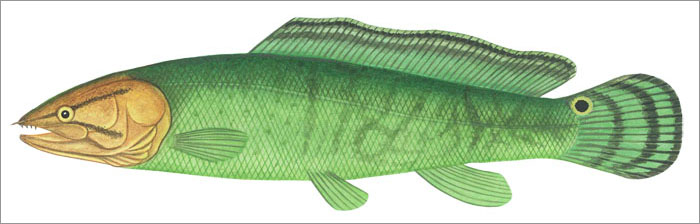 보우핀 기본 모습. Lateral view of bowfin(Amia calva). Author/Kim In Young from Korea |
 수조 안의 보우핀. Bowfin(Amia calva) in a watertank. Author/Stan Shebs |
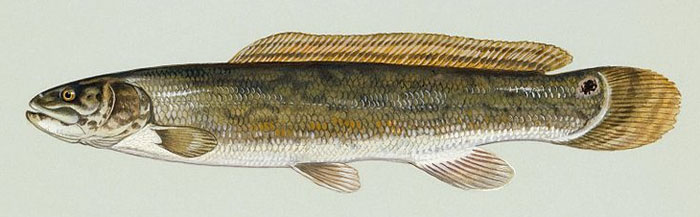 보우핀 일러스트. Illustated Bowfin. Author/Duane Raver, U.S. Fish and Wildlife Service |
|
북아메리카/캐나다 퀘벡주와 미국 뉴욕주 북동부와 버몬트주에 걸쳐 있는 세인트 로렌스 강 수계와 섐플레인호(Lake Champlain) 수계에서부터 미네소타주의 미시시피강 수계에 분포한다. 아미아목(Order Amiiformes/bowfins)은 1과 1속 1종만 존재한다. 보우핀(Bowfin)은 레피소스테우스목의 가르(gars/)와 함께 원조 격 경골어류에 들어가는 원시형 물고기이다. 보우핀과 가르는 강(綱/class)과 목(目/order) 사이 중간 분류단계(infraclass 또는 super order)인 전골류(全骨類/Holostei)에 소속된다(참조; 상단 메뉴 “어류의 진화경로도”의 [진화계통분기도3 ]을 보면 이해에 도움이 됨). 영명 bowfin의 bow는 활이라는 뜻이 있지만 여기서는 “휘다, 굽다, 파도 모양을 이루다” 등의 뜻이다. Bowfin은 등 앞쪽에서부터 꼬리까지 긴 등지느러미의 높이가 파도 모양으로 구불구불한 모양에서 나온 이름이다. 보우핀(Bowfin)의 다른 이름들에는 머드피시(mudfish), 머드파이크(mud pike), 독피시(dogfish), 그리들(griddle), 그린넬(grinnel), 사이프레스 트라우트(cypress trout), 쵸피크( (choupique)가 있다. 보우핀은 쥐라기에서 시신세(始新世)까지 생존했던 아미아목(Amiiformes) 물고기 무리 중에서 현재까지 유일하게 살아남은 1종으로 이를 분류학 용어로 “잔존생물(relicts)”이라 한다. 보우핀은 잘 진화된 물고기이지만 초기 조상의 형태적 특징들이 남아있기 때문에 “원시 물고기”라고 부른다. 보우핀은 민물에 사는 저서성, 육식성 어류로 북아메리카에 분포하며 주로 미국 동부와 온타리오주 남부와 퀘벡주에서 많이 발견된다. 화석들의 발견지로 보면 보우핀은 과거에 북아메리카, 남아메리카, 유럽, 아시아, 아프리카에 걸쳐 민물과 해수 양쪽에 살았다. 수초가 많은 진구렁, 저지대 강과 하천, 호수, 늪지대 환경을 선호한다. 기수에서도 발견된다. 기습 공격형 포식자이며 야간에 얕은 수심에 나타나 물고기와 가재, 조개, 수생 곤충 같은 무척추동물을 잡아먹는다. 가르(gar)와 마찬가지로 보우핀은 물과 공기 양쪽을 호흡할 수 있다. 아가미로는 물의 산소를 흡수하여 호흡하고 부력을 만들어 주는 부레로는 공기를 호흡할 수 있다. 부레에 연결되어 있는 작은 공기 통로를 통해 호흡을 한다. 다른 물고기 같으면 질식해 죽을 저산소 물 환경 조건에서도 수면에 올라가 공기를 머금어서 살아남는다. 형태 갓 부화한 새끼는 7–10 mm 크기일 때는 색갈이 검고 올챙이 모양이며 25 mm 정도 크기일 때는 판피어(板皮魚/placoderms) 모양을 띤다(※판피어/고생대 멸종 원시어류). 보우핀을 “살아있는 화석”이나 원시 물고기라고 부르는 이유는 그들의 고생대 조상의 특징들이 남아있기 때문이다. 꼬리지느러미가 외형적으로 둥글게 변해 있기는 하지만 내부 구조상으로는 위 엽이 더 큰 부등미(不等尾/heterocercal caudal fin)라는 점, 부레에 혈관이 발달해 있는 점, 나선 창자의 흔적이 남아있는 점, 목에 골질 판이 있는 점 등이 원시 특징이다. 또 다른 특징들로는 이빨이 길고 날카로운 점, 튀어나온 2개의 튜브형 콧구멍이 있다. 다른 현생하는 원시형 조기어류(actinopterygians)들과 다른 점은 보우핀의 비늘은 굳비늘이 아니고 좀 더 진전된 경골어류에 가까운 외겹(single-layered) 이고 크기가 큰 원형비늘이라는 점이다. 보우핀과 유사해서 혼동을 일으키는 물고기 2가지 생리 물이 매 말라 버린 환경에서 땅속에 묻혀 동면하여 살아남는다는 입증이 되지는 않은 학자의 주장이 있다. 실험실 연구에서는 보우핀이 공기 호흡만으로 3일 내지 5일 이상 살 수 있다는 판단을 얻었다는 설이 있다. 그러나 야생에서 실험된 것은 아니다. 위 주장들이 모호하기는 하지만 여하튼 보우핀이 공기를 호흡할 수 있어서 물 밖에 놓여져도 오래 견딜 수 있다는 것은 사실이다. 아가미 필라멘트와 판들이 딱딱해서 물 밖에 있어도 그 구조가 눌려 막히지 않음으로 공기 유통이 막히지 않는다. 번식 둥지 하나에는 2,000~5,000개의 알이 담아진다. 암컷 한 마리가 밴 알 수는 크기에 따라 다르지만 55,000개 이상이다. 알은 점착성이 있어서 바닥에 내려가면 어디에나 들러붙는다. 부화 기간은 8~10일이다. 갓 부화된 치어는 먹이를 찾아 헤엄을 치지 못하며 주둥이에 있는 부착기관을 이용하여 수초에 붙어서 난황 주머니의 영양분으로 9~10일 간 성장을 더 한다. 수컷이 계속 보호한다. 새끼들이 헤엄칠 수 있게 되면 무리로 모여 이동을 시작하게 되는데 수컷이 서서히 주위를 돌면서 새끼들이 흩어지지 않게 몰이를 한다. 부우핀을 2년, 3년 후에 성어가 되며 자연에서 10년 내지 12년 살고 수족관에서는 30년을 살았다. 수컷보다 암컷이 더 오래 산다. 이용가치, 캐비어 대체품을 만들어 낸다. 보우핀은 살이 무르고 별 맛이 없어서 상업적으로 가치가 없었다. 그러나 잘 씻어서 훈제하거나 튀기거나 굽거나 어묵으로 만들면 맛을 낼 수 있다. 캐비어 거래는 오랫동안 국제적으로 금지되어 왔다. 특히 캐비어 중에서 가장 고급인 가스피해 지방의 벨루가 철갑상어 캐비어의 규제가 심하다. 그리하여 그 대체품으로 다른 종의 철갑상어나 패들피시, 보우핀 같은 물고기의 캐비어가 시장에서 값이 오르게 되었다. 미국 루이지애나주에서는 야생에서 보우핀을 잡아 가두리에서 사욕하여 살코기와 알을 생산한다. 이 보우핀의 알이 캐비어로 가공되어 케이준 캐비어(Cajun caviar)라는 이름이나 츄픽 로이알(Choupiquet Royale)이라는 상표로 판매되고 있다. |
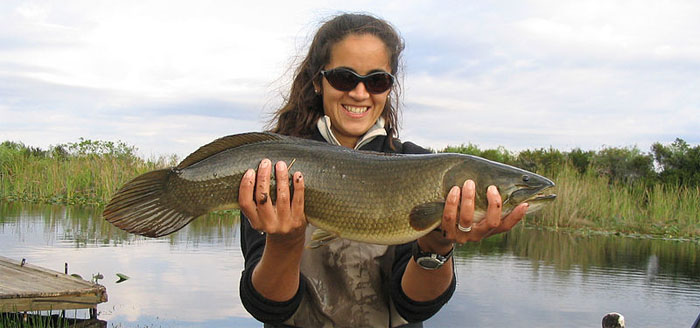 보우핀. Bowfin. Author/Everglades NPS from Homestead, Florida, United States |
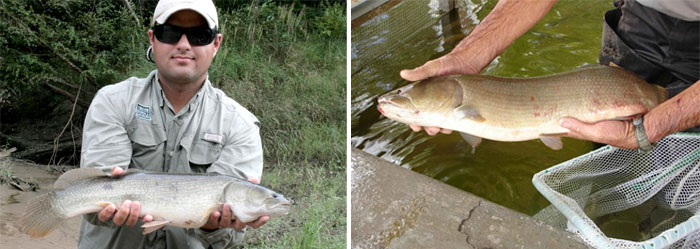 Left/보우핀. Bowfin(Amia calva). Author/Clinton & Charles Robertson from RAF Lakenheath, UK & San Marcos, TX, USA & UK Right/보우핀. Bowfin(Amia calva). Author/Galvez John, U.S. Fish and Wildlife Service |
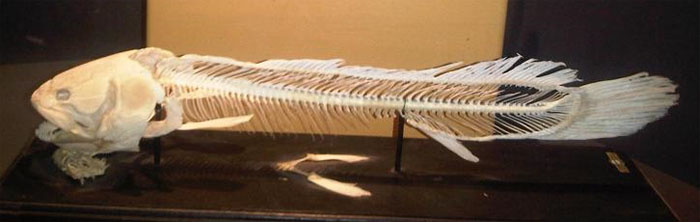 몰타공화국 빌헤나 궁전 자연사 박물관의 보우핀 해골. Bowfin(Amia calva) skeletons, at the National Museum of Natural History, Vilhena Palace, Republic of Malta. Author/Emőke Dénes |
|
Superclass Osteichthyes(bony fishes)→Class Actinopterygii(ray-finned fishes)→Order Amiiformes(bowfins)→Family Amiidae(bowfins) Freshwater Common description for order and family. Distribution/North America: St. Lawrence River, Lake Champlain drainage of Quebec and Vermont west across southern Ontario to the Mississippi drainage in Minnesota. Order Amiiformes(bowfins) comprises only one family, with 1 genus and 1 species. The bowfin is so named for its long, undulating dorsal fin consisting of 145 to 250 rays, and running from the middle of the back to the base of the tail. Bowfin(Amia calva) are basal bony fishes related to gars in the infraclass Holostei. Common names include mudfish, mud pike, dogfish, griddle, grinnel, cypress trout and choupique. They are regarded as taxonomic relicts, being the sole surviving species of the order Amiiformes which dates from the Jurassic to the Eocene, persisting to the present. Although bowfin are highly evolved, they are often referred to as "primitive fishes" because they have retained some morphological characteristics of their early ancestors. Bowfin are demersal freshwater piscivores native to North America, and commonly found throughout much of the eastern United States, and in southern Ontario and Quebec. Fossil deposits indicate Amiiformes were once widespread in both freshwater and marine environments with a range that spanned across North and South America, Europe, Asia and Africa. Their preferred habitat includes vegetated sloughs, lowland rivers and lakes, swamps and backwater areas; they are also occasionally found in brackish water. They are stalking, ambush predators known to move into the shallows at night to prey on fish and aquatic invertebrates such as crawfish, mollusks, and aquatic insects. Like gars, bowfin are bimodal breathers which means they have the capacity to breathe both water and air. Their gills exchange gases in the water allowing them to exploit oxygen for breathing, but they also have a gas bladder that serves to maintain buoyancy, and also allows them to breathe air by means of a small pneumatic duct connected from the foregut to the gas bladder. They can break the surface to gulp air, which allows them to survive conditions of aquatic hypoxia that would be lethal to most other species. Morphology The body of the bowfin is elongated and cylindrical, with the sides and back olive to brown in color, often with vertical bars, and dark reticulations, or camouflaged pattern. The underside is white or cream, and the paired fins and anal fin are bright green. The dorsal fin has horizontal bars, and the caudal fin has irregular vertical bars. During larval stage, hatchlings from about 7–10 mm total length are black and tadpole-like in appearance. At approximately 25 mm total length they have been described as looking like miniature placoderms. Fishes similar in appearance Physiology While aestivation is anecdotally documented by multiple researchers, laboratory experiments have suggested instead that bowfin are physiologically incapable of surviving more than three to five days of air exposure. However, no field manipulation has been performed. Regardless of the lack of evidence confirming the bowfin's ability to aestivate, it has been noted that bowfin can survive prolonged conditions of exposure to air because they have the ability to breathe air. Their gill filaments and lamellae are rigid in structure which helps prevent the lamellae from collapsing and aids gas exchange even during air exposure. Life cycle A nest may contain 2,000 to 5,000 eggs, possibly more. Fecundity is usually related to size of the fish, so it isn't unusual for the roe of a large gravid female to contain over 55,000 eggs. Bowfin eggs are adhesive, and will attach to aquatic vegetation, roots, gravel, and sand. After hatching, larval bowfin do not swim actively in search of food. During the seven to nine days required for yolk-sac absorption, they attach to vegetation by means of an adhesive organ on their snout, and remain protected by the parent male bowfin. When the fry are able to swim and forage on their own, they will form a school and leave the nest accompanied by the parent male bowfin who slowly circles them to prevent separation. Bowfin reach sexually maturity at two to three years of age. They can live ten to twelve years in the wild, and 30 years in captivity. Females are longer-lived than males. Utilization Bowfin were once considered to have little commercial value because of its poor tasting meat which has been referred to as "soft, bland-tasting and of poor texture". However, it is considered quite palatable if cleaned properly and smoked, or prepared fried, blackened, used in courtbouillion, or in fishballs or fishcakes. Over the years, global efforts have imposed strict regulations on the international trade of caviar, particularly on the harvest of sturgeons from the Caspian Sea where the highly prized caviar from the beluga sturgeon originates. The bans imposed on Caspian sturgeons have created lucrative markets for affordable substitutes in the United States including paddlefish, bowfin, and various species of sturgeon. In Louisiana, bowfin are harvested in the wild, and cultured commercially in hatcheries for their meat and roe. The roe is processed into caviar, and sold as "Cajun caviar", or marketed under the trade name "Choupiquet Royale". |
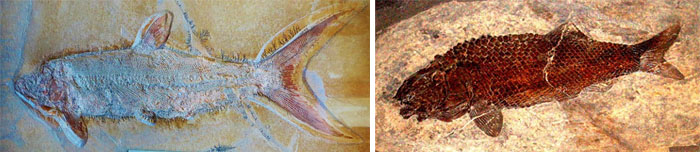 Left/보우핀 조상의 화석. Fossil of Caturidae, an extinct ancestor of bowfin. Author/Ghedoghedo. Right/보우핀 조상의 화석. Fossil of Heterolepidotus pectoralis, an extinct ancestor of bowfin. Author/Ghedoghedo |
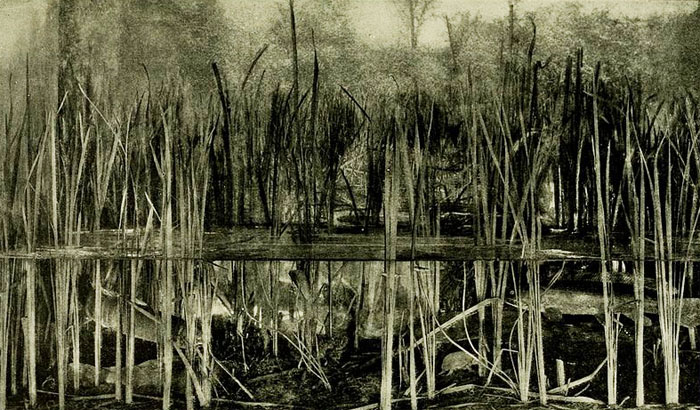 수중과 수면 위를 동시에 촬영한 사진. 수면 아래 수초 사이로 몇 마리의 보우핀이 보인다. 실험실인지 자연 환경인지 설명이 없는 사진이다. Simultaneously photographed picture of underwater and surface, bowfins are viewed through weeds below the surface. Authors/American Museum of Natural History |


|
| Copyright ⓒ FISHILLUST.COM All rights reserved. All contents can not be used without permission of the copyright holder. |


 검색
