
사이트 로그인
사이트 로그인
경골상강/Superclass Osteichthyes(bony fishes)→조기강/Class Actinopterygii(ray-finned fishes)→ 메기목 Order Siluriformes(catfish). Order 31 목 번호는 Nelson "Fishes of the World" 2006 4th edition. 기준임 ---------------------------------------------------------------------------------------------------------------------------------------------------------------- ※목 차원의 메기류를 이해하는데 있어 유의해야 할 사항은 우리가 평소에 아는 “메기”만을 연상해서는 안 된다는 것이다. 메기목에는 40개의 과가 있고(넬슨의 "Fishes of the World" 2016년 제5판 기준; 제4판에서는 35과였음) 메기과는 그 중 하나에 불과하다. 한국에 분포하는 메기류에는 6개 과가 있다; 찬넬동자개과(Ictaluridae/도입종), 메기과(Siluridae), 동자개과(Bagridae), 퉁가리과(Amblycipitidae), 바다동자개과(Ariidae), 쏠종개과(Plotosidae). 그러나 국제적 명칭으로는 동자개과든 퉁가리과든 또는 쏠종개과든 다 메기(catfishes)라고 부른다. 예를 들어 동자개류는 “바그리드 메기(Bagrid catfishes)”, 쏠종개과는 “뱀장어꼬리 메기(Eeltail catfishes)” 이다. ---------------------------------------------------------------------------------------------------------------------------------------------------------------- |
|
메기는 영어로 켓피시(catfish)라고 하는데 고양이 수염처럼 긴 수염을 가진 데서 생긴 이름이다.메기류 중 크기가 커서 유명한 종 3가지는 동남아시아의 메콩강 자이언트 켓피시(Mekong giant catfish/ Pangasianodon gigas), 유라시아의 웰스 켓피시(wels catfish/Silurus glanis), 남아메리카의 쿠마무마(Kumakuma /Brachyplatystoma filamentosum)이다.
바닥에 있는 부패된 물질만 먹는 종이 있고 기생 생활을 하는 작은 칸디루(candiru/학명; Vandellia cirrhosa/17cm SL)라고 부르는 종도 있다. 몸이 인갑으로 덮인 종이 있는가 하면 비늘이 없는 종이 허다하다. 메기류는 캣피시라는 이름에 맞게 모두 긴 수염을 가진 것은 아니다. 메기목을 규정하는 해부학적 특징으로는 수염이 아니라 두개골과 부레의 특징이다. |
 수염이 4쌍인 전형적인 메기 외관. 북아메리카 산(Black bullhead, 과명;Ictaluridae 종명;Ameiurus melas). A typical catfish shape with 4 pairs of barbels. Black Bullhead(Ameiurus melas). Author/U.S. Fish and Wildlife Service |
| 현생하는 메기류는 남극을 빼고는 전셰계의 내륙과 해안에서 산다. 과거 지질시대 한때는 전 대륙에 분포하였다. 메기류는 총 40과가 존재하는데 남아메리카, 아시아, 아프리카의 열대 지방에 가장 다양한 종류가 있으며 북아메리카와 유럽에는 1과 씩만 있다. 종 수로만 보면 남북아메리카에 총 종 수의 반 이상이 산다. 마다가스카르, 오스트레일리아, 뉴기니의 메기들은 이 지역에 유일하게 서식하는 골표류(골표상목;Superorder Ostariophysi)이다. 골표류에는 잉어 종류 청어 종류 등 여러 가지가 있음(본 홈페이지 ‘바다이야기’ 에서 “잉어의 사실들” 칼럼을 볼것).
대부분 메기류는 담수의 얕은 수심 흐르는 물에 산다. 8개과의 메기류는 땅속에서 살며 3개 과는 굴 속에 산다. 유일하게 한 종(Phreatobius cisternarum)은 땅 속의 침윤층(浸潤層; 물이 솟아나오는 지층이나 암층)에 산다. 해수에 사는 종들도 많으며 해수에서 사는 종을 포함하고 있는 과에는 다음과 같은 과가 있다. 메기류는 상업적으로 매우 중요한 어종으로 식용으로 어획되며 큰 종들은 사육되는 경우가 많다. 작은 종들은, 특히 장갑메기류인 코리도라스 속(genus Corydoras/과명; Callichthyidae)은 관상어로 중요한 자리에 있다. 메기류는 대부분 야행성이지만 주행성인 것들도 있다. |
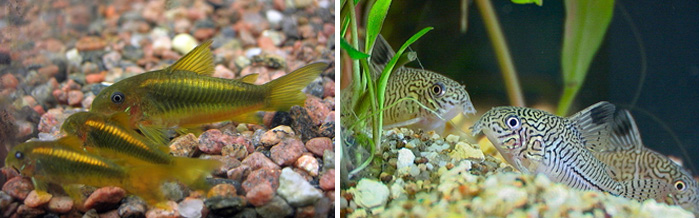 “코리도라스 메기”라고 불리는 인기 있는 관상어들. Valuable aquarium catfishes. Left/그린 골드 캣피시(Green gold catfish;Corydoras melanotaenia). Author/Soulkeeper. Right/쓰리스크라이프 코리도라스(Threestripe corydoras; Corydoras trilineatus). Author/Sychriscar |
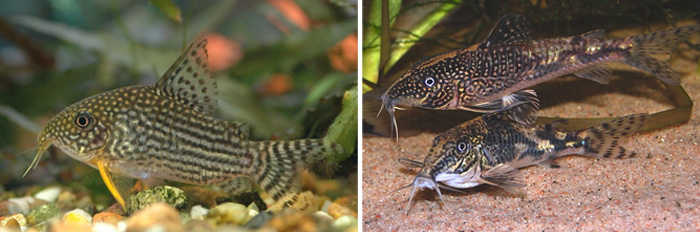 “코리도라스 메기”라고 불리는 인기 있는 관상어들. Valuable aquarium catfishes. Left/스테르바스 캣피시(Sterba's Catfish;Corydoras sterbai). Author/Tino Strauss Right/밴디드 코리도라스(Banded corydoras; Scleromystax barbatus) 한 쌍. 위가 수컷. A couple of Scleromystax barbatus(the male above). Author/Birger. A |
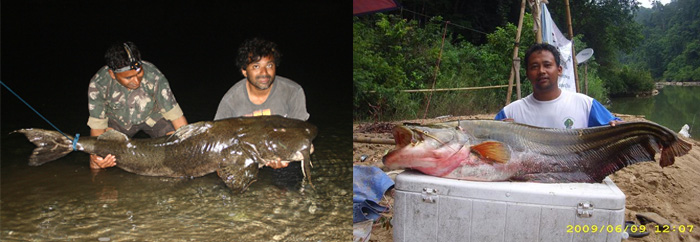 Left/인도 북부 칼리강(Kali River)에서 잡힌 대형 군치 메기(goonch catfish). 시소리드(Sisoridae)과, 속명;Bagarius yarrelli. 바가리우스 속 메기의 일반 명칭이 군치(Goonch)이다. 사람과 물소를 공격할 정도의 큰 대형이 있을 수 있다. Giant Bagarius yarrelli(Goonch) caught in India. Some Goonch in the Kali river grow large enough to attack humans and water buffalo.Author/Derek Dsouza. Right/말레이시아 템벨링 강(Tembeling river, Malaysia)에서 잡은 140cm 짜리 메기. 메기과(Siluridae), 종명(Wallago leerii). 55 inch specimen of Wallago leerii, captured in the Tembeling river, Malaysia. Author/Mustafa-Asmuni. |
메기류의 외부적 특징 External anatomy of catfish 여러 큰 메기들은 몸 전체에 화학감응기가 있다. 냄새를 맡거나 몸으로 물체의 맛을 알아낼 수 있다. 메기는 미각으로 먹이의 방향과 위치를 찾아낸다. 메기류는 수염과 화학감응기가 먹이를 찾아내는 주요한 수단이어서 대부분 눈은 작다. 다른 골표상목의 물고기들이나 마찬가지로 메기류도 베버기관(Weberian apparatus;청각보조기관)을 갖고 있다. 잘 발달된 베버기관과 축소된 부레는 청각과 발성을 발달시켰다. |
 Left/수염이 4쌍인 북아메리카의 채널 메기(Channel catfish; Ictalurus punctatus; 붕메기과/Ictaluridae). Channel catfish equipped with 4 pairs of barbels. Author/USGov. Center/수염이 3쌍인 메기(메기과, 종 미상). A catfish with 3 pairs of barbels. Siluridae; species unidentified. Author/Michel Royon. Wikimedia. Right/수염이 2쌍인 유럽의 웰스 메기(Wels catfish), 코에 1쌍, 턱에 1쌍이 있다. Wels catfish(Silurus glanis/메기과; Siluridae). With two pairs of mental barbels. Author/Joe Pell |
메기류는 비늘이 없다. 어떤 종은 피부를 덮은 점액이 비부 호흡을 하는데 사용된다. 어떤 종은 몸을 장갑으로 덮고 있다. 비늘이 아니라 골질의 인판(scutes)이다. 장갑은 종에 따라 타입이 다르다. 전기뱀장어과(electric catfish; Malapteruridae)를 제외한 모든 뱀장어들은 등지느러미와 가슴지느러미의 첫 기조가 속이 빈 골질의 강한 가시 기조이다. 이 가시는 외부 쪽으로 방향을 고정시키는 잠금 장치가 있으며 방어할 때 작동되며 쏘이면 매우 심한 상처를 입을 수 있다. 메기가 위협을 느끼면 이 가시로 단백질 독소를 내보낸다. 독소는 가시를 둘러싼 피부 조직의 샘세포에서 생산된다. 뱀꼬리메기과(Eeltail catfishes; 쏠종개과/Plotosidae)의 메기들과 공기주머니메기과(Airsac catfishes Heteropneustidae)의 메기들은 가시의 독성이 매우 강해서 쏘이면 입원 치료를 해야 할 정도이다.
대부분 메기들은 입의 모양, 지느러미들의 모양과 위치, 수염의 길이 특성들이 어릴 때나 성어일 때나 차이가 없다. 또한 색상도 성어와 새끼 간에 차이 거의 없다. 따라서 유어는 유어의 특징이랄 것이 없어서 그대로 성어로 진입된다. 그러나 예외 종들은 있다(예; ariid catfishes와 pimelodids). 메기목의 40개 과 중에서 암수의 외관 차이를 알아볼 수 있는 종들은 약 반이라고 한다. 11개 과에서 뒷지느러미가 삽입 성기로 변했거나 체외 또는 체내 수정용 악세서리 기관으로 변한 것이 발견된다. |
 Left/메기들은 비늘이 없으며 일부 종은 장갑(골판)을 두르고 있다. 사진의 코리도라스 메기(Corydoras semiaquilus)는 장갑 구조가 잘 나타나 있다. 수족관 사진. The armor plates are evident in Corydoras semiaquilus. Vancouver Aquarium. Author/Stan Shebs. Right/메기목에 속하는 동자개과(Bagridae/바그리드 메기과)의 메기. 영명; Twospot catfish,학명;Mystus nigriceps. 65mm SL. From Napuh River, Sumatra, Indonesia. Author/W.A. Djatmiko |
 Left/유리 메기(glass catfish). 메기과(Siluridae). 학명/Kryptopterus vitreolus. 최대 크기/6.5cm SL. 비늘과 색소가 없어 몸이 투명하다. 내장들도 머리 쪽으로 몰려 있다. 몸이 투명한 메기에는 여러 종이 있다. Kryptopterus vitreolus(glass catfish) have transparent bodies lacking both scales and pigments. Most of the internal organs are located near the head. Many glass catfishes in family Siluridae. Author/Sonni. Right/흡혈메기 칸디루(Candiru). 과명/흡혈메기과 또는 기생메기과(Trichomycteridae). 종명/Vandellia cirrhosa. 남아메리카 토종으로 반델리아 속(genus Vandellia) 종들은 기생 메기이다. Vandellia cirrhosa 한 종을 “칸디루(Candiru).”라고 부르는 경우가 있고 속 전체 또는 과 전체를 “칸디루(Candiru)”라고 부를 때도 있다. 칸디루는 큰 물고기의 아가미 조직을 공격한다. 종명이 Vandellia cirrhosa인 칸디루가 사람의 요도 속으로 들어가는 사건이 있었다고 알려져 있다. 1997년에 다큐멘터리로 공개된 사건이 있다. 그러나 갑론을박이 존재한다. Candiru(Vandellia cirrhosa), a species of parasitic catfish(family Trichomycteridae). Vandellia is a genus of catfishes native to South America. The species in this genus are the most well-known of the parasitic catfishes also known as candiru, known for their alleged habit of entering the human urethra, the first documented case of the removal of a candiru from a human urethra did not occur until 1997, and even that incident has remained a matter of controversy. Drawing by Robbie Cada. |
 Left/바다동자개과(Ariidae)의 메기. 종명/Arius manillensis. 필리핀 고유종이며 바다와 민물 양쪽에 산다. A species in family Ariidae(Sea catfishes), Arius manillensis. endemic to the Philippines. Author/Ramon FVelasquez. Right/쏠종개과(Family Plotosidae)의 쏠종개(Striped eel catfish/학명; Plotosus lineatus). 쏠종개도 메기류이다. 쏠종개과는 10속 41 종으로 구성되어 있고 이들 중 하나가 한국에도 분포하는 쏠종개이다. 쏠종개과 종들은 대부분 민물고기이며 해수어가 일부 있다. 한국 분포 종 쏠종개는 해수어이다. 제주도 남해에 나타난다. 열대 바다 산호초에 서식하는 쏠종개과 어류는 쏠종개 뿐이다. Striped eel catfish(Plotosus lineatus) is marine fish and one member of 41 species in Family Plotosidae(Eeltail catfishes). Most are freshwater species, few are marine. A sting from the striped eel catfish, Plotosus lineatus, may be fatal. The only catfish found in coral reefs. Also found in estuaries, tide pools and open coasts. Author/Jens Petersen |
메기의 크기 북아메리카의 최대 메기 기록은 59kg 정도이다. 이 무게는 타일랜드에서 2005년에 잡힌 293kg 짜리 자이언트 메콩강 메기와 비교도 되지 않는다. 이 메콩강 메기는 1981년부터 시작된 타일랜드의 공식 기록부 상으로 가장 큰 자이언트 메콩강 메기이다. 이 종에 관한 과학적 연구는 이 지역이 개발 도상국이라 잘 이루어져있지 않다. 이 종은 아마 더 큰 크기로 자랄 수 있을 것이다. 1998년과 2007년 사이에 인도 네팔 접경지역의 칼리 강(Kali River)에서 3 사람이 메기 공격으로 사망한 사건 후 제레미 웨이드(Jeremy Wade)라는 사람이 이 강에 들어가 75.5 kg 짜리 군치 메기(Goonch catfish/종명;Bagarius yarrelli 과명;Sisoridae)를 잡았는데 이 사람의 판단에 따르면 18세 소년을 잡아먹은 군치 메기는 이보다 훨씬 클 것이라고 했다. 아마존 강에 사는 쿠마쿠마(Kumakuma 또는 Piraíba/과명; Pimelodidae, 종명; Brachyplatystoma filamentosum)는 181 kg까지 잡히는데 이 메기에게도 사람이 잡혀 먹혔다는 보고들이 존재한다 |
 Left/210kg 짜리 남아메리카의 쿠마쿠마(Kumakuma). 긴수염메기과(Pimelodidae/Long-whiskered catfishes). 종명; Brachyplathystoma filamentosum. 최대 360 cm로 자란다. 위장 속에서 원숭이 유해가 나왔다고 전해져있다. 아마존강에서는 가끔 사람이 잡아먹힌다고 한다. Kumakuma(Brachyplathystoma filamentosum) with 210 kg. South America. Family Pimelodidae(Long-whiskered catfishes). Max length of this fish is 360 cm TL. Stomach contents are said to include parts of monkeys. In parts of the Amazon, this catfish occasionally makes prey of a man. Author/Eliodmsr. Center/124 cm 크기의 유럽 메기 웰스 캣피시(Wels catfish; Silurus glanis), 과명;메기과(Siluridae;Sheatfishes). Author/Lucas van der Geest. Right/러시아 서부 볼고그라드(Volgograd) 주 북부의 볼가강 수계에서 잡은 메기과 대형 메기. 종명은 미상. Fishermen caught a catfish. Silurus-catfish. Nature Park Shcherbakovskaya, Kamyshin district of the Volgograd Region. Author/Администрация Волгоградской области |
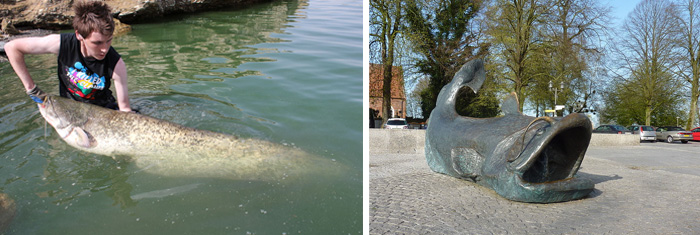 Left/스페인 에브로강(Rio Ebro)의 웰스 메기(Wels catfish; Silurus glanis). Silurus glanis, Rio Ebro, Spain. Author/Joe Pell. Right/웰스 메기 동상. 독일 북부 소도시 바트 츠비셰난(Bad Zwischenahn). Wels statue in Bad Zwischenahn, Germany. Author/Xocolatl |
메기가 내는 의사소통 소리 메기는 가슴지느러미에도 발성기관이 있다. 메기류 중 많은 종들이 가슴지느러미의 첫 기조가 가시로 되어있다. 이 가시는 큰 외전근(abductor/부속지를 밖으로 펴내는 곳에 붙어 있는 근육)을 가지고 있다. 가시의 기부에는 일련의 융기선이 있는데 이 융기선에 마찰을 일으켜 소리를 낸다. 이것은 머리빗살을 손가락으로 훑는 것과 같은 원리로 소리를 내는 것이다. 발성 특징은 성 차이도 나타난다. 같은 크기의 암수에서 가슴지느러미의 길이가 수컷이 긴 경우가 많은데 이 차이로 나는 소리가 다르다. 과들 간에도 그리고 종들 간에도 내는 소리가 다르다. 산란과 수정행위를 할 때 내는 소리도 종들 마다 다르다. 북소리는 상대를 위협할 때 마찰음은 방어적 위치에 있을 때 낸다. |
메기목의 40개과 명단(넬슨의 "Fishes of the World" 2016년 제5판 기준) Akysidae(Stream catfishes) |
 Left/미국의 메기 양식장. 수확 장면. Loading U.S. Farm-Raised Catfish. Author/Jim Steeby. Right/중국 식당의 메기 요리. Catfish in a restaurant in Wuhan(China). Author/J. Patrick Fischer |
Order Siluriformes(catfish). Order 31(Order number based on Nelson "Fishes of the World" 2006 4th edition). Named for their prominent barbels, which resemble a cat's whiskers, catfish range in size and behavior from the three largest species, the Mekong giant catfish from Southeast Asia, the wels catfish of Eurasia and the Kumakuma of South America, to detritivores(species that eat dead material on the bottom), and even to a tiny parasitic species commonly called the candiru, Vandellia cirrhosa. There are armour-plated types and there are also naked types, neither having scales. Despite their name, not all catfish have prominent barbel. Members of the Siluriformes order are defined by features of the skull and swimbladder. Catfish are of considerable commercial importance; many of the larger species are farmed or fished for food. Many of the smaller species, particularly the genus Corydoras, are important in the aquarium hobby. Many catfish are nocturnal, but others (many Auchenipteridae) are crepuscular or diurnal (most Loricariidae or Callichthyidae for example). Extant catfish species live inland or in coastal waters of every continent except Antarctica. Catfish have inhabited all continents at one time or another. Catfish are most diverse in tropical South America, Asia and Africa with one family native to North America and one family in Europe. More than half of all catfish species live in the Americas. They are the only ostariophysans that have entered freshwater habitats in Madagascar, Australia, and New Guinea. They are found in freshwater environments, though most inhabit shallow, running water. Representatives of at least eight families are hypogean(live underground) with three families that are also troglobitic(inhabiting caves). One such species is Phreatobius cisternarum, known to live underground in phreatic habitats. Numerous species from the families Ariidae and Plotosidae, and a few species from among the Aspredinidae and Bagridae, are found in salt water. External anatomy of catfish Catfish may have up to four pairs of barbels: nasal, maxillary (on each side of mouth), and two pairs of chin barbels, even though pairs of barbels may be absent depending on the species. Catfish barbels always come as pairs. Many larger catfish also have chemoreceptors across their entire bodies, which means they "taste" anything they touch and "smell" any chemicals in the water. "In catfish, gustation plays a primary role in the orientation and location of food". Because their barbels and chemoreception are more important in detecting food, the eyes on catfish are generally small. Like other ostariophysans, they are characterized by the presence of a Weberian apparatus. Their well-developed Weberian apparatus and reduced gas bladder allow for improved hearing as well as sound production. Catfish do not have scales; their bodies are often naked. In some species, the mucus-covered skin is used in cutaneous respiration, where the fish breathes through its skin. In some catfish, the skin is covered in bony plates called scutes; some form of body armor appears in various ways within the order. All catfish, except members of Malapteruridae(electric catfish), possess a strong, hollow, bony leading spine-like ray on their dorsal and pectoral fins. As a defense, these spines may be locked into place so that they stick outwards, which can inflict severe wounds. In several species catfish can use these fin rays to deliver a stinging protein if the fish is irritated. This venom is produced by glandular cells in the epidermal tissue covering the spines. In members of the family Plotosidae, and of the genus Heteropneustes, this protein is so strong it may hospitalize humans who are unfortunate enough to receive a sting. As far as known for most catfish, features that are often characteristic of species such as mouth and fin positions, fin shapes, and barbel lengths show little difference between juveniles and adults. For many species, pigmentation pattern is also similar in juveniles and adults. Thus, juvenile catfishes generally resemble and develop smoothly into their adult form without distinct juvenile specializations. Exceptions to this are the ariid catfishes, where the young retain yolk sacs late into juvenile stages, and many pimelodids, which may have elongated barbels and fin filaments or coloration patterns. Sexual dimorphism is reported in about half of all families of catfish. The modification of the anal fin into an intromittent organ(in internal fertilizers) as well as accessory structures of the reproductive apparatus(in both internal and external fertilizers) have been described in species belonging to 11 different families. Size of Catfishes In North America the largest Ictalurus furcatus(Blue catfish) caught in the Missouri River on 20 July 2010, weighed 59 kilograms. The largest flathead catfish, Pylodictis olivaris, ever caught was in Independence, Kansas, weighing 56 kilograms. These records pale in comparison to a giant Mekong catfish caught in northern Thailand on 1 May 2005 and reported to the press almost 2 months later that weighed 293 kilograms. This is the largest giant Mekong catfish caught since Thai officials started keeping records in 1981. This species is not well studied since it lives in developing countries and it is quite possible it can grow even larger. Also in Asia, Jeremy Wade caught a 75.5 kilograms Goonch following three fatal attacks on humans in the Kali River on the India-Nepal border between 1998 and 2007.. Wade was of the opinion that the offending fish must have been significantly larger than this to have taken an 18-year-old boy as well as a water buffalo. Piraíba(Brachyplatystoma filamentosum) can grow exceptionally large and are native to the Amazon basin. They can occasionally grow to 181 kilograms, as evidenced by numerous catches. There are also reports in the region of deaths from being swallowed by these fish. Catfish also have a sound-generating mechanism in their pectoral fins. Many species in the catfish family possess an enhanced first pectoral fin ray, called the spine, which can be moved by large abductor and adductor muscles. The base of the catfishes’ spines has a sequence of ridges, and the spine normally slides within a groove on the fish’s pelvic girdle during routine movement; but, pressing the ridges on the spine against the pelvic girdle groove creates a series of short pulses. The movement is analogous to a finger moving down the teeth of a comb, and consequently a series of sharp taps is produced. Sound-generating mechanisms are often different between genders. In some catfishes, pectoral fins are longer in males than in females of similar length, and differences in the characteristic of the sounds produced were also observed. Comparison between families of the same order of catfish demonstrated family and species-specific patterns of vocalization, according to a study by Maria Clara Amorim. During courtship behavior in three species of Corydoras catfishes, all males actively produced stridulation sounds before egg fertilization, and the species’ songs were different in pulse number and sound duration. Drumming sounds are used as a threatening signal and stridulations are used as a defense signal. (source/Wikipedia) |


|
| Copyright ⓒ FISHILLUST.COM All rights reserved. All contents can not be used without permission of the copyright holder. |


 검색
