|
※본 홈페이지 상단 메뉴 "바다 이야기" 안에 있는 "해마(海馬) 백과 사전. 해마의 모든 것" 칼럼에 모든 정보가 소개되어 있습니다. If you can read Korean language, go to the article " All about the Sea Horse(Hippocampus) ", prepared in upper menu “Sea Story" in this home page.
경골상강/Superclass Osteichthyes(bony fishes)→조기강/Class Actinopterygii(ray-finned fishes)→
실고기목 Order Syngnathiformes(pipefishes and seahorses) ※Order 55-1
실고기목 물고기들은 몸이 가늘고 길며 골질로 된 고리들이 몸을 둘러싸고 있다. 입은 작고 튜브 모양으로 생겼다. 그러나 예외적으로 불보나리쿠스 속(Bulbonaricus)은 입이 튜브 모양으로 생기지 않았다. 배지느러미가 있는 종은 그것이 복부에 달려있다. 위턱은 돌출하지 못하는 구조이다. 대개 눈물샘을 가지고 있으며 눈 둘레 뼈(circumorbital bones)는 없는 게 보통이다. 늑골이 없다. 앞쪽의 3-6 개 척추골은 길이가 길다. 일부 몇 종은 무사구체성 신장(無絲毬體性腎臟; aglomerular kidney)을 가지고 있다. 입은 실고기과를 기준으로 하면 근처에 있는 먹이를 흡입력으로 당겨 삼켜먹는 입이다. 많은 종들이 해초 숲에 살면서 여러 마리가 몸을 거꾸로 세우고 헤엄치는데 이는 해초와 같은 모양으로 보이기 위한 위장술이다. 실고기목의 가장 대표적인 특징은 수컷이 특수한 방법으로 알을 보호하고 부화시키는 번식방법에 있다. 수컷은 알을 삼투 주머니에 보관하거나 꼬리에 부착시켜 가지고 다니면서 부화를 기다린다. 실고기목의 학명 신나티포메스(Syngnathiformes)의 어원은 고대 그리어 syn(신, together/결합)과 gnathos(나토스, jaw/턱) 및 라틴어 포르마(forma, form/모양)의 합성어이다. 즉 “결합된 턱(conjoined-jaws)”이다.
실고기목은 큰가시고기목에서 최근에 분리되어 나온 목이다.
※ 분류번호가 “55-1”이 된 이유
이 사이트가 채택한 분류체계는 “J.S. Nelson 2006” 기준이며 그에 따라 목과 과의 일련번호가 부여되어있다. 이후에 분류체계의 일부가 변경되면 일련번호의 연속성이 혼란을 일으킬 수 밖에 없다. 실고기목(Syngnathiformes)의 일련 번호가 “Order 55-1”로 표기된 것은 이 목이 새로 생겨나서 필자가 임의로 번호를 부여했기 때문이다. 원래 실고기목은 큰가시고기목(Gasterosteiformes)의 아목(suborder Syngnathoidei) 자리에 있다가 목으로 승격해 분리되었다. 큰가시고기목의 5개 과가 떨어져 나와 실고기목이 되었으나 과들의 일련번호는 그대로 유지되었다.
Order Syngnathiformes(pipefishes and seahorses) ※Order 55-1
These fishes have elongated, narrow, bodies surrounded by a series of bony rings, and small, tubular mouths((except in the "finless" pipefish Bulbonaricus, whose adults lack even a short tubiform snout). The shape of their mouth—in at least syngnathids—allows for the ingestion of prey at close range via suction. Pelvic fins, when present, abdominal; upper jaw not protractile; lachrymal usually present, other circumorbital bones usually absent; ribs absent; anterior 3-6 vertebrae elongate; aglomerular kidney in at least some. Several groups of Syngnathiformes live among seaweed and swim with their bodies aligned vertically, to blend in with the stems. The most defining characteristic of this order is their reserve sexual system. In this order, males conduct in specialized brooding and rearing of the embryo's. The males house eggs in a osmoregulated pouch or adhere eggs to their tail until the eggs reach maturity. The name Syngnathiformes means "conjoined-jaws". It is derived from Ancient Greek, syn = with, together + Greek, gnathos = jaw + Latin, forma = shape
Syngnathiformes is newly separated order from Gasterosteiformes
In classification models of “J.S. Nelson 2006” that adopted in this site, Syngnathiformes is placed as suborder Syngnathoidei in Gasterosteiformes. Better supported by the evidence now available is the traditional belief that they are better considered separate orders, they might not be particularly close relatives at all. Scientists recently separated Syngnathoidei(5 families) from Gasterosteiformes and placed in its own order Syngnathiformes. According to “J.S. Nelson 2006”, the order number of Gasterosteiformes is “55”, but no order number for Syngnathiformes, so I gave temporary number 55-1 for Syngnathiformes.
실고기목 5과 명단. 5 families in Order Syngnathiformes
개정된 분류/recent classification, 2017, November, fishbase.org
1. Solenostomidae(ghost pipefish) 유령실고기과 Family 294.
2. Syngnathidae(pipefishes and seahorses) 실고기과 Family 295.
3. Aulostomidae(trumpetfishes) 트럼펫피시과 Family 296.
4. Fistulariidae(cornetfishes) 대치과 Family 297.
5. Centriscidae(Snipefishes and shrimpfishes) 새우고기과 또는 저격수고기과 Family 299.
※종전 분류표의 대주둥치과(Macroramphosidae(snipefishes)는 과의 지위를 상실하고 새우고기과 Centriscidae(shrimpfishes)에 흡수되었다.
※Snipefishes(former Macroramphosidae) lost its family place and included as species members of Centriscidae(shrimpfishes).
|

 Left/차이니스 트럼펫피시(Chinese trumpetfish, 학명/Aulostomus chinensis). 인도에시아에서 촬영(taken in Bunaken Island, Indonesia). Author/Bernard DUPONT from France. Right/차이니스 트럼펫피시(Chinese trumpetfish, 학명/Aulostomus chinensis). 몰디브에서 촬영(Taken in Maldives). Author/Ahmed Abdul Rahman
 Left/대주둥치(Longspine snipefish; Macroramphosus scolopax). Author/Dmitriy Konstantinov. Right/무리 지어 헤엄치는 대주둥치. Schooling Longspine snipefishes. Author/Izuzuki
 Left/홍대치(Bluespotted cornetfish; Fistularia commersonii). Author/Roberto Pillon. ※영명 “Bluespotted cornetfish”가 한국명에는 “홍대치”로 되어있으며 오기가 아님. Right/청대치(Red cornetfish; Fistularia petimba). Author/ NOAA Photo Library. ※영명 “Red cornetfish”가 한국명에는 “청대치”로 되어있으며 오기가 아님.
 Left/오네이트 고스트 파이프피시(Ornate ghost pipefish (Solenostomus cyanopterus). Author/prilfish from Vienna, Austria. Center/할리퀸 고스트파이프피시(Harlequin ghost pipefish; Solenostomus paradoxus). Author/Chriswan Sungkono. Right/할리메다 고스트파이프피시(Halimeda ghostpipefish; Solenostomus halimeda). Author/Elias Levy
 [파이프피시류; pipefishes]. Left/브록크스 파이프피시(Brock's pipefish; Halicampus brocki). Author/Graham Edgar Right/옐로우밴디드 파이프피시(Yellowbanded pipefish; Dunckerocampus pessuliferus). Author/Bernd divemecressi
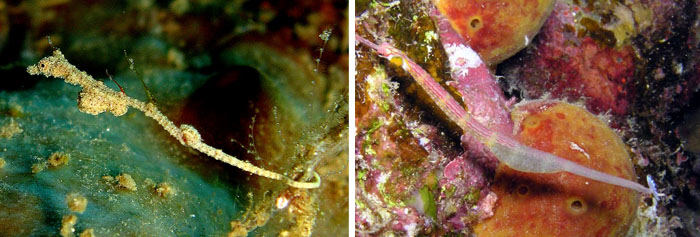 [파이프피시류; pipefishes]. Left/스레드 파이프피시(Thread pipefish; Kyonemichthys rumengani). 렘베 씨드래곤(Lembeh SeaDragon)이라고 부르기도 하는데 공식 명은 아님. 렘베 해협에서 촬영됨. Taken in Lembeh Straits. Inforamal other common name is Lembeh SeaDragon. Author/Steve Childs. Right/블랙브레스트 파이프피시(Blackbreasted Pipefish; Corythoichthys nigripectus). 수컷이며 꼬리쪽 배가 불룩한 것은 알은 지니고 있기 때문이다. Bulged abdomen with carrying eggs. Author/Silke Baron
 [파이프피시류; pipefishes]. Left/퍼그헤드 파이프피시(Pugheaded pipefish; Bulbonaricus brauni). 불보나리쿠스 속(Bulbonaricus)은 예외적으로 주둥이가 길게 나오지 않았다. Bulbonaricus lack tubiform snout. Taken in Ogasawara Japan. Author/orangkucing. ※Pug; 몸이 작고, 납작한 얼굴에 주름이 많은 개. Right/검은목논병아리(Podiceps nigricollis)가 큰 파이프피시(Syngnathus leptorhynchus) 한 마리를 잡았다. Podiceps nigricollis captures and swallows a a large cold-water pipefish Syngnathus leptorhynchus, in Morro Bay, CA. Author/Mike Baird.
 [파이프호스류; pipehorse]. Left/숏파우치 피그미 파이프호스(Short-pouch pygmy pipehorse; Acentronura breviperula). Taken in East Timor. Author/ Nick Hobgood. Right/숏파우치 피그미 파이프호스(Short-pouch pygmy pipehorse; Acentronura breviperula). Author/Steve Childs.
 [파이프호스류; pipehorse]. Left/시드니 피그미 파이프호스(Sydney's pygmy pipehorse; Idiotropiscis lumnitzeri). Author/Taso Viglas Right/일러스트레이션. 사우선 리틀 파이프호스(Southern little pipehorse(Idiotropiscis austral). An illustration of Southern little pipehorse(Idiotropiscis austral). Author/E.R. Waite & H.M. Hale, 1921
 [해룡류; seadragons]. Left/잎사귀 해룡(Leafy seadragon; Phycodurus eques). Author/Joseph C Boone. Right/해룡(Common seadragon; Phyllopteryx taeniolatus). Author/Richard Ling
 [해마류; seahorses]. Left/가시해마(Spiny seahorse;Hippocampus histrix). Author/Nick Hobgood. Center/숏스노우트 씨호스(Short snouted seahorse; Hippocampus hippocampus). Short-snouted seahorse on knotted wrack. Belgian part of the North Sea. Photographer/Hans Hillewaert. Right/데나이스의 피그미 해마(Denise's pygmy seahorse; Hippocampus denise). Author/Reijnen BT, van der Meij SET, van Ofwegen LP
 [해마류; seahorses]. Left/바버스 해마(Barbour's seahorse; Hippocampus barbouri). Author/H. Zell. Center/롱스노트 해마(Long-snouted seahorse; Hippocampus guttulatus). Monterey Bay Aquarium. Author/FASTILY. Right/그뤠이트 해마(Great seahorse; Hippocampus kelloggi). Author/Izuzuki




 검색
