
사이트 로그인
사이트 로그인
|
분류계통/경골상강→조기강→쏨뱅이목→미역치과→미역치 Copyright by Kim In Young. 김인영 그림
|
| image on preparing |
| 미역치 기본 모습. Lateral view of Redfin velvetfish(Paracentropogon rubripinnis) |
쏨뱅이목 미역치과 분포; 서태평양/한국의 동해, 남해, 서남해 및 제주도. 일본 중북부 이남과 미야코 섬(대만 우측의 섬). 베트남에 분포한다. 몸은 작고 옆으로 납작하며 몸 높이는 머리의 뒷부분이 가장 높고 뒤로 갈수록 가늘어진다. 머리도 옆으로 납작하고 머리의 앞쪽 면은 경사가 심하다. 눈은 크고 눈의 앞가장자리를 둘러싸고 있는 골격에 2개의 날카로운 가시가 있다. 전새개골에 4개의 가시가 있는데, 1개는 강하고 나머지 3개는 피부에 묻혀 있다. 주둥이는 짧으며 위턱 뒤끝은 눈의 중앙 아래에 겨우 달한다. 양 턱, 전설골(前舌骨), 구개골(口蓋骨)에 가느다란 솜털 모양의 이빨이 있다. 등지느러미는 눈 위쪽에서 시작하며, 3번째 가시가 가장 길고 5번째 가시까지 가시와 가시 사이를 연결하는 막이 깊게 패어 있지만 이후로는 약간 패어 있다. 등지느러미 극조부는 특히 발달해 있다. 가슴지느러미는 길지만 끝이 뒷지느러미 기부에 달하지 못한다. 배지느러미는 1가시 4연조이며, 꼬리지느러미는 둥글다. 측선은 등쪽으로 치우쳐 직선으로 뻗으며 흰 점으로 나타난다. 작은 비늘이 몸을 덮고 있으나 피부에 묻혀 있다. 몸은 주황색 바탕에 흑갈색 무늬가 흩어져 있거나 회갈색 바탕에 적갈색이 섞여 불규칙한 무늬를 이룬다. 배쪽은 희다. 등지느러미는 어두운 갈색이고 나머지 지느러미는 붉은색이다. 머리에는 눈을 중심으로 방사상의 흰색 부분이 있다. 주로 연안의 암초나 해초지대에서 무리를 이루어 서식하며, 산란기는 7∼8월경이다. 등지느러미에 강한 독성이 있다. 가시가 생각보다 길어서 장갑을 끼고 다뤄도 찔릴 수 있으며 생명에 치명적인 독은 아니지만 극도로 고통스럽기 때문에 낚시에 걸려 올라오면 집게 등 도구로 낚시바늘을 제거하고 조심해서 놔줘야 한다. 찔리면 가까운 병원으로 가는 게 현명한 처사라고 한다. |
Oder Scorpaeniformes Family Tetrarogidae(Wasp fishes) Distribution; Western Pacific/Eastern coasts and South Sea of Korea including Jeju Island. South of central north of Japan including Miyako Island. Reported in Vietnam. Body is small, compressed laterally. Body depth highest at posterior head and tapering towards the back. Head also compressed to the side, and the front side of the head is steeply inclined. Eye large and with two sharp spines on the bone surrounding the anterior margin of eye. 4 spines on preopercle, 1 strong and 3 are buried in the skin. Snout short, and the rear end of upper jaw barely reaches the center of eye. There are thin, fluffy teeth on both jaws, front vomer and palatine bone. Dorsal fin origin at the top of eye, and the 3rd spine is the longest, and the membranes connecting spines from the first to 5th spine are deeply dug, but thereafter slightly digged. The spinous part of the dorsal fin is especially developed. The pectoral fin is long, but the tip does not reach the base of the anal fin. Margin of caudal fin is round. The lateral line is skewed toward the dorsal side and stretched in a straight line, and it appears as white dots. Small scales cover the body, but buried in the skin. The body forms irregular patterns with scattered dark-brown patterns on red orange background or red-brown patterns on gray-brown backgrounds. White ventrally. The dorsal fin is dark brown and the rest fins are red. The head has white areas radially centered on the eye. All fins are red, but only the dorsal fin is dark. It mainly lives in groups in coastal reefs or seagrass areas. The spawning season is around July to August. Has strong toxicity to its dorsal fin. The spines longer than expected, so it can be pierced even when handled with gloves. It is not poisonous to life, but it is extremely painful. It is said that if you are stabbed, it is wise to go to the nearest hospital. |
 미역치 분포도. Distribution map of Redfin velvetfish(Paracentropogon rubripinnis). Derived work from GBIF. Illustrated by fishillust.com |
 미역치. 수족관 사진. Aquarium photo of Redfin velvetfish(Paracentropogon rubripinnis). at Suma aquarium Japan. Author/harum.koh from Kobe city, Japan |
 미역치. 수족관 사진. Aquarium photo of Redfin velvetfish(Paracentropogon rubripinnis). Author/ Unknown. Source/Wikimedia. |
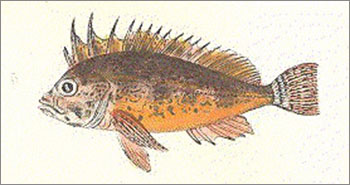
| 미역치 묘사도. Illustration of Redfin velvetfish(Paracentropogon rubripinnis). Author/James Carson Brevoort(1818–1887) |

| 미역치. 채집된 후 시간이 지나서 색상이 손상된 개체. Redfin velvetfish(Paracentropogon rubripinnis). Location/Kashima Port, Japan. 일본의 가시마항(鹿島港). Author/Rakurakuda |
 미역치 묘사도. Illustration of Redfin velvetfish(Paracentropogon rubripinnis). Author/Temminck and Schlegel, 1843 |


|
| Copyright ⓒ FISHILLUST.COM All rights reserved. All contents can not be used without permission of the copyright holder. |


 검색
