
사이트 로그인
사이트 로그인
|
분류계통/경골상강→조기강→쏨뱅이목→황성대과→남방황성대 Copyright by Kim In Young. 김인영 그림
|
| image on preparing |
| 남방황성대 기본 모습. Lateral view of Armoured gurnard(Peristedion liorhynchus) |
쏨뱅이목 성대과Oder Scorpaeniformes Family Peristediidae(Armored searobins or armored gurnards). D1/spine 8, D2/soft rays 21. A/soft rays 21. Pectoral fin/soft rays 13(11+ii). pelvic fin/spine 1, soft ray 5. Gill rakers on first gill arch/5 + 1 + 19. Caudal fin/12. Bony plates in dorsal row 31, Bony plates in upper lateral row 36, Bony plates in lower lateral row 26, Bony plates in ventral row 27, Bony plates before anus 2, Groups of barbels(lip + chin) 3 + 6 분포; 인도-서태평양/한국의 동남부 해역과 제주도, 일본, 타이완, 필리핀, 괌, 인도네시아, 안다만해, 미얀마. 뉴칼레도니아, 오스트레일리아 서북부와 남동부, 항문은 뒷지느러미 기점 바로 앞에서 열린다. 주둥이 좌우 양쪽에 새의 부리처럼 앞으로 튀어나간 골판이 있다. 부리 골판은 위아래로 매우 납작하고 끝은 둥글어 주걱 모양이다. 부리 골판의 표면에는 작은 돌기들이 조밀하게 돋아있어 거칠지만 두드러진 가시는 없다. 부리 골판은 뒤쪽으로는 전새개골 뒤 가장자리까지 연장되어 있으며 표면은 매끄럽다. 부리 골판의 뒤 끝은 각이 지어 있으나 가시 형태는 아니며 또한 전새개골에는 다른 뚜렷한 가시가 없다. 눈은 원형이다. 입은 크며 머리 아래 쪽에 위치한다. 위턱의 뒤 끝은 안구의 앞 가장자리에 이르지 않는다. 위턱, 아래턱, 서골, 구개골에 이빨이 없다. 아래턱 입술에 3쌍의 수염이 있다. 아래턱에는 1쌍의 매우 긴 수염이 있는데 긴 수염에는 많은 가지가 붙어 있다. 배지느러미의 기점은 전새개골의 뒤쪽 가장자리보다 앞에서 시작되며 배지느러미 기저부의 뒤 끝은 가슴지느러미 기부의 아래 끝 위치보다 약간 뒤에 있다. 배지느러미를 몸 쪽으로 접었을 경우 그 끝은 항문에 이른다. 가슴지느러미의 기저부는 몸의 횡축 방향에 대하여 비스듬한 각도를 가진다. 가슴지느러미의 아래 쪽 2 연조는 손가락처럼 본체에서 분리되어 있다. 2개의 분리 연조 중 위쪽 연조는 가슴지느러미 본체의 뒤 끝을 넘어가며, 뒷지느러미 기점 위에 닿으며, 제2등지느러미의 2번째 연조 기점 아래에 이른다. 아래 쪽 분리 연조는 가슴지느러미의 뒤 끝에 이르지 못한다. 제1등지느러미의 기점은 가슴지느러미 기부 뒤에 있고 몸의 등쪽 골판 열의 1번과 2번 골판 사이에 있다. 제2등지느러미 기점은 몸의 등쪽 골판 열의 7번과 8번 골판 사이에 있다. 제2등지느러미 기저부의 뒤 끝은 등쪽 골판 열의 27번 골판 뒤에 있다. 제1등지느러미와 제2등지느러미 사이는 V 각으로 패였다. 제2등지느러미의 기점은 뒷지느러미 기점보다 앞에 있다. 뒷지느러미 기점은 제2등지느러미의 3번째 연조 아래에 있고 복부 골판 열의 1번 골판 바로 뒤에 있다. 뒷지느러미의 마지막 연조 뒤는 막을 통하여 몸체와 연결되어 있다. 꼬리지느러미는 뒤가 절단형이며 위와 아래 변이 직선이다. 신선한 상태에서는 등면과 몸의 상부가 핑크색 바탕에 약간 노란 색조가 나타나 있다. 몸의 하부측면과 복부는 하얗다. 몸의 등면과 체측 상부의 골판비늘들은 뒤쪽 가장자리가 황갈색 테두리를 가진다. 머리의 등과 측면에는 불규칙하고 길쭉한 황갈색 점들이 흩어져 있다. 1,2 등지느러미는 반투명한 백색이며 상단 부분은 검고 그 위 맨 가장자리는 분홍색으로 마감된다. 제1등지느러미의 선행부는 황록갈색이다. 가슴지느러미는 핑크색이며 기부에 좁은 검정 띠가 있고 후단부에 넓게 검은 부분이 있으며 그 바로 뒤의 테두리 부분은 노랗다. 가슴지느러미의 분지된 2 연조는 핑크색이지만 중간 부분은 노랗다. 배지느러미는 반투명하고 핑크색을 띤 백색이며 각 기조들의 중간 부분은 연한 노랑색이다. 뒷지느러미는 반투명한 백색이며 가장자리가 핑크색을 띤다. 꼬리지느러미는 핑크색이며 중앙부는 황록색을 띤다. ※본종은 2010년대 말 제주도에서 채집된 2cm 미만 어린 개체의 유전자 검사를 통해서 한국 미기록종으로 판명된 물고기이다(한국수산과학회지 53권 5호, 장서하, 김진구, 유효재). 또 다른 논문에서는 거제도, 울진, 울산에서도 남방황성대와 동일한 유전자를 가진 어린 새끼나 알을 발견하였다고 주장되었다. |
Oder Scorpaeniformes Family Peristediidae(Armored searobins or armored gurnards). D1/spine 8, D2/soft rays 21. A/soft rays 21. Pectoral fin/soft rays 13(11+ii). pelvic fin/spine 1, soft ray 5. Gill rakers on first gill arch/5 + 1 + 19. Caudal fin/12. Bony plates in dorsal row 31, Bony plates in upper lateral row 36, Bony plates in lower lateral row 26, Bony plates in ventral row 27, Bony plates before anus 2, Groups of barbels(lip + chin) 3 + 6 Distribution; West Pacific/Jeju Island and southeastern sea of Korea, Japan, Taiwan, the Philippines, Guam, Indonesia, New Caledonia, the northwest and southeast coasts of Australia, the Andaman Sea, and Myanmar The body is covered with scales of bony plate. There are 4 rows of bony plates on the side of the body, each with a distinct posterior spine except for the ventral row of the caudal peduncle and the bony plate in front of the anus. The bony plates of the 28th–36th upper row have anterior spines. The bony plates of the left and right lower rows join at the caudal peduncle. The anus opens just before the origin of the anal fin. The snout has a pair of bony plates(rostral process) like bird's beak on left and right. The beak is remarkably flattened and wide, with a rounded tip and a spatulate shape. The surface of the rostral process is densely covered with small bony processes and is rough, but there are no prominent spines. The bony protuberance protrudes laterally from the rostral process to the posterior margin of the anterior operculum, and the lateral surface is smooth. The posterior end of the bony protuberance is angular but does not form spines, and there are no prominent spines on the anterior operculum. The eyes are round. The mouth is large and located low. The posterior end of the maxilla does not extend beyond the anterior margin of the orbit. No maxillary, mandibular, vomer, or palatine teeth. There are 3 pairs of whiskers on the lip of lower jaw and 1 pair of very long whiskers on the lower jaw. The long whiskers on lower jaw(mandibular) are with many branches attached onto the stalk The origin of the pelvic fin is positioned anterior to the posterior margin of the preoperculum, and the posterior end of the pelvic fin base is positioned slightly posterior to the lower end of the pectoral fin base. The posterior ends of the folded pelvic fin reaches the anus. The pectoral fin base is oblique to the body axis. Lower 2 soft rays of pectoral fin are detached like fingers. Of the free soft rays of the pectoral fin, the rear end of the upper free ray reaches behind the rear end of the pectoral fin lobe, just above the anal fin origin and just below the second soft ray origin of the second dorsal fin. The lower free soft ray do not reach the posterior end of the pectoral fin lobe. Origin of 1st dorsal fin is positioned posterior to base of pectoral fin, between 1st and 2nd bony plates of dorsal row. The origin of the 2nd dorsal fin is located between the 7th and 8th bony plates of the dorsal row, and the posterior end of the 2nd dorsal fin base is located behind the 27th bony plate of the dorsal row. There is a notch between the first and second dorsal fins. The origin of the second dorsal fin is located forward of the origin of the anal fin. The anal fin origin is located just below the 3rd soft ray of the 2nd dorsal fin and just behind the 1st bony plate of the ventral row. The last soft ray of the anal fin is connected to the body by the fin membrane. Caudal fin truncated, with almost straight upper, lower and trailing edges. Coloration when fresh: From the dorsal surface to the upper side of body, is pink with a slight yellow tinge, and from the lower side of body to ventral surface, it is white. The posterior margins of scales(bony plates) from dorsal surface of body to upper body side is bordered in yellowish brown. Irregular yellowish-brown linear spots are scattered on dorso-head and side of head. Both the first and second dorsal fins are translucent white, the upper part is black, and the upper edge is bordered in pinkish red. The leading edge of the first dorsal fin is yellow-greenish brown. The pectoral fin is pink, with a narrow black band at the base, a wide black area at the rear part, and the margin just behind it is yellow. Free soft rays of pectoral fin are pink, but the central part is yellowish. The pelvic fins are pinkish white translucent, and the central part of each soft rays is yellowish. Anal fin translucent white, lower part pink. The caudal fin is pink and the central part of the fin is yellowish green ※ Main reference/標本に基づく静岡県初記録のモヨウキホウボウ, (Shizuoka prefecture's first record of Moyoki gurnard based on a specimen). Author/畑 晴陵, 中江雅典, published by the Kagoshima University Museum(April 2021). https://www.museum.kagoshima-u.ac.jp/ichthy/INHFJ_2021_007_007.pdf ※This species was found to be an unrecorded new species in Korea through genetic testing of young individuals less than 2 cm collected in Jeju Island in the late 2010s(Journal of Fisheries Science, Vol. 53, No. 5, Jang Seo-ha, Kim Jin-gu, and Hyo-jae Hyo). In another paper, it was claimed that very young juveniles or eggs with the same genes as Peristedion liorhynchus were found in south eastern seas of Korea(Geoje, Uljin, and Ulsan). |
 남방황성대 분포도. Distribution map of Armoured gurnard(Peristedion liorhynchus). Main ref./GBIF. Date cited/February 2023. Author/fishillust.com |
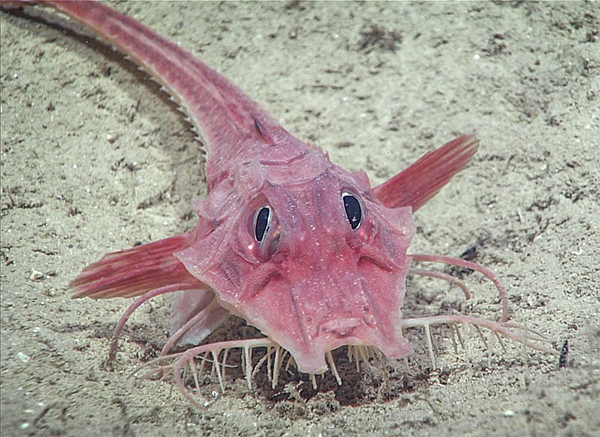 남방황성대. Armoured gurnard(Peristedion liorhynchus). Max length/40.0cm TL. Source/2019 Southeastern U.S. Deep-sea Exploration, NOAA. |
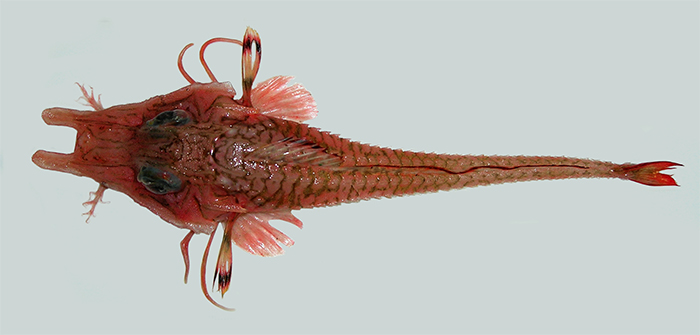 남방황성대. Armoured gurnard(Peristedion liorhynchus). from south of Scott Reef, off north Western Australia, 210 metres. Source: Dianne J. Bray / Museum Victoria. License: CC by Attribution |
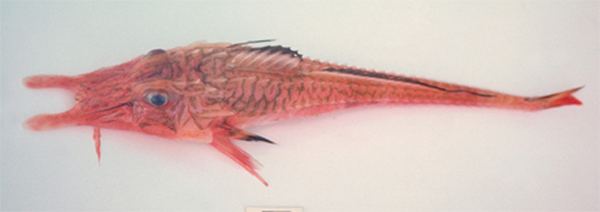 남방황성대. 채집 장소/오스트레일리아 시드니. Armoured gurnard(Peristedion liorhynchus). Location/Sydney Australia, Collected from FRV Kapala demersal trawl: station K77-07-03; depth 380-390 m. Author/Ken Graham |
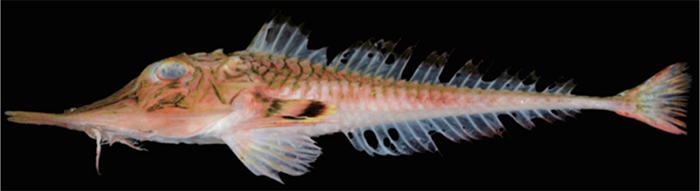 남방황성대 보존 표본. Preserved specimen of Armoured gurnard(Peristedion liorhynchus). off Numazu, Suruga Bay, Shizuoka Prefecture, Japan. Author/畑晴陵, 中江雅典(Harutaka Hata and Masanori Nakae). Source/Ichthy, Natural History of Fishes of Japan. 国立科学博物館分子生物多様性研究資料センター(つくば市) |
 남방황성대 보존 표본. Preserved specimen of Armoured gurnard(Peristedion liorhynchus). Author/Mark Allen, Rights holder Australian Museum |


|
| Copyright ⓒ FISHILLUST.COM All rights reserved. All contents can not be used without permission of the copyright holder. |


 검색
