
사이트 로그인
사이트 로그인
|
분류계통/경골상강→조기강→쏨뱅이목→황성대과→황성대 Copyright by Kim In Young. 김인영 그림
|
| image on preparing |
| 황성대 기본 모습. Lateral view of Oriental sea robin(Peristedion orientale) |
쏨뱅이목 성대과 분포; 서북태평양/한국의 남해, 일본 북부 이남, 타이완, 황해, 동중국해에 분포한다. 사할린 섬 분포도 가능하다. 눈은 크며 둥글며 머리의 등쪽에 거의 닿아 있다. 두 눈 사이는 밑으로 패였다. 입이 크며 머리의 복부 쪽에 위치하고 앞에서 보면 말굽 형이다. 위턱이 아래턱 앞으로 튀어나와 있으며 위턱은 가려져 있어 보이지 않으며 뒤 끝은 눈 아래에 이른다. 윗입술은 가늘고 아래 입술은 두껍다. 양턱, 서골, 구개골에 이빨이 없다. 혀는 넓고 둥글며 고정되어 있다. 아가미 구멍이 넓고 구멍 슬릿은 4번 아가미 궁(새궁;鰓弓) 뒤에 있다. 아가미 뚜껑 막들은 분리되어 있으며 협부와 연결되어 있다. 아가미 뚜껑 막은 7개이다. 아가미 갈퀴는 가늘다. 가짜 아가미를 갖고 있다. 콧구멍에는 피질 편이 없다. 코 가시가 없다. 가슴지느러미 기부 위에 상완 가시(brachial spine)가 없다. 총 8개의 수염을 갖고 있다. 아래턱 바깥 쪽에 1개의 긴 분지된 수염이 있다. 이 긴 수염은 머리 길이의 1/3 보다 약간 짧으며 눈의 앞 가장자리 아래 이르지는 않는다. 아래턱 안쪽에는 작은 입술 술이 조밀하게 있고 턱 수염들이 있다. 수염들은 먹이를 찾아내는 기능을 가진다. 제1등지느러미와 제2등지느러미는 V자 각을 사이에 두고 연결되어 있다. 제1등지느러미(극조부) 기점은 아가미뚜껑 후단 끝 위에 있다. 제1등지느러미 기저부는 길이가 짧고 제2등지느러미(연조부) 기저부는 길이가 길다. 제2등지느러미 기저부 길이는 제1등지느러미 기저부 길이의 2.8배이며 뒤 끝은 꼬리지느러미 기부에 이르지 않는다. 제1등지느러미의 2~4번 가시가 가장 길며 눈 지름의 약 1.5이다. 제1번 가시도 길지만 제2번 가시보다 약간 짧다. 제2등지느러미의 첫 기조는 가시이며 길이는 제1등지느러미의 가장 긴 가시보다 약간 짧다. 제2등지느러미의 1번 가시 기조 길이는 그 다음 자리에 있는 두 번째 기조(연조)와 길이가 거의 같다. 뒷지느러미의 기점은 제2등지느러미의 2번째 기조(앞의 극조 다음에 있는 첫 번째 연조) 아래에 있으며 뒷지느러미의 모양, 크기는 제2등지느러미와 대칭적이다. 가슴지느러미는 상대적으로 짧은 편이며 몸의 아래 쪽에 있고 뒤 끝은 항문 위에 이른다. 가슴지느러미의 맨 아래 하단 2개 기조는 손가락처럼 분리되어 있으며 그 윗부분의 본체는 불분지 기조 1개, 분지 기조 8개, 불분지 기조 2개(도합 11개)의 순서로 되어 있다. 분리된 손가락 기조는 첫 번째 것이 두 번째 것보다 길며 위쪽 본체 지느러미의 연조들보다 약간 더 길거나 같다. 분리 손가락 기조는 걸어가거나 흙을 후벼 팔 수 있는 기능을 가진다. 배지느러미는 좌측과 우측 것의 거리가 멀리 떨어져 있으며 길이는 가슴지느러미와 거의 같다. 배지느러미 가시의 길이는 첫 연조의 0.7 배이다. 꼬리지느러미는 짧고 뒤 가장자리는 안으로 패였고 위쪽 옆이 약간 더 길다. 부레는 크고 둥글다. 몸 색은 황적색이며 배쪽은 희다. 등쪽에 수많은 벌레 같은 줄 무늬가 있다. 등지느러미 극조부와 연조부는 각 기조들의 상부에 암갈색 점들이 있어 이 점들의 열이 선 무늬처럼 보인다. 등지느러미 하단 쪽에도 각 기조에 작은 점들이 1열로 배열되어 있다. 가슴지느러미에 여러 개의 갈색 점이 있다. 뒷지느러미, 배지느러미 꼬리지느러미는 연한 황색이며 무늬는 없다. 냉대와 온대 해역에 서식한다. 중소형 물고기이며 전장은 약 19.0 cm(TL) 이다. 120 - 500m 깊은 수심에 살며 최대 1000m 수심에서 발견된다. 지느러미를 사용하여 느리게 헤엄친다. 주로 갑각류 같은 무척추동물을 먹는다. 난생이다. 멀리 이주해 다니지 않는다. 어획량은 작으며 살 부분도 작아서 상업적 가치는 없다. |
Oder Scorpaeniformes Family Peristediidae(Armored searobins or armored gurnards). Distribution; Northwest Pacific/South Sea of Korea, south of north Japan, Taiwan, Yellow Sea. East China Sea and possible Sakhalin Island distribution. The eyes are large, round and almost reaching the dorsal edge of the head. The interocular space is slightly concave. The mouth is large, located on the ventral side of the head, and has horseshoe shape when viewed from the front. The upper jaw is more protruding than the lower jaw, the upper jaw is not exposed, posterior end reaching below the eyes. The upper lip is thin, the lower lip. Upper and lower jaws, vomer, and palatine bones are toothless. Tongue wide and round, not free. The gill opening is wide; there is a slit behind the fourth branchial arch. The opercle membrane separates and connects with the isthmus. Gill cover strip 7. Gill rakers slender. Has false gills. Nostrils without skin protrusions. No nasal spine. No brachial spine above base of pectoral fin. 8 pairs of barbels. mandibular outer side with 1 long branched mandibular barbel, slightly shorter than 1/3 of head length, not extending below the front edge of the eye, inner side with densely small tufted lip and chin barbels. These barbels can feel food. The first dorsal fin and the second dorsal fin are continuous with a notch in between. The origin of first dorsal fin is above the rear edge of the opercle. The base of the first dorsal fin(spinous rays) is short. Length of the base of second dorsal fin(soft rays) is long about 2.8 times as long as base of first dorsal fin and rear end of soft fin not reaching base of caudal fin. The second to fourth spines of first dorsal fin are the longest, about 1.5 times the eye diameter. First spine is also quite long, but slightly shorter than the second spine. The first ray of the second dorsal fin is a spine, and its length is slightly shorter than the longest spine of the first dorsal fin. The spine ray of second dorsal fin. The first ray(spine) of the second dorsal fin is almost the same length as the second ray(soft rays) located next to it. Origin of anal fin is below the 2nd ray of 2nd dorsal fin(the first soft ray following the previous single spine ray), and the shape and size of the anal fin are symmetrical with the 2nd dorsal fin. The location, shape, and size of the anal fin are symmetrical to that of the second dorsal fin. Pectoral fins are relatively short, located on the lower side, reaching above the anus. The two rays at bottom of pectoral fin are separated like fingers, and the main part above it consists of in the order of 1 unbranched ray, 8 branched ray, and 2 unbranched ray(11 in total). Separate finger rays, first longer than second, slightly longer or equal to those of upper main fin. the free fin rays at the lower part of the pectoral fin can crawl and turn over the soil. The position of the pelvic fin is far apart from the left and right, almost as long as the pectoral fin, the spine is about 0.7 times as long as the first fin ray. The caudal fin is short, the rear edge is concave, forked, and the upper lobe is slightly longer. The swim bladder is large and round. Body yellowish red, ventrally white. There are many worm-like stripes on the back of the body. The spinous and soft rays of the dorsal fin have dark brown dots on the upper part of each ray, and the rows of these dots look like a line pattern. At lower side of the dorsal fin, also small dots are arranged in a row on each ray. 2 rows of small brown spots on rays of second dorsal fin. Several dark brown spots on the pectoral fins. Anal, pelvic, and caudal fins pale yellow without markings. Cold-temperate marine fish. Small and medium-sized, with a body length of about 19.0 cm(TL). Inhabits relatively deep waters, depth range 120 - 500 m, the water depth can reach 1000m. They swim slowly by relying on the action of fins. Feeds on invertebrates such as crustaceans. oviparous. No long-distance migratory habits. The catch is small and the flesh part is small, so it has no commercial value. |
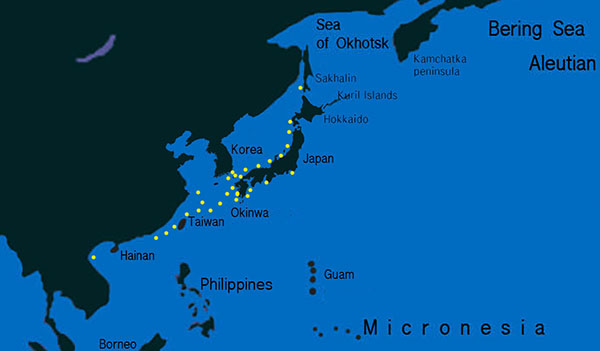 황성대 분포도. Distribution map of Oriental sea robin(Peristedion orientale). Main source/fishbase.org. Cited date/February 2023. Edited by fishillust.com. |
 황성대 묘사도. Illustration of Oriental sea robin(Peristedion orientale). Date/1904. Author/David Starr Jordan(1851–1931) |
| text on preparation |


|
| Copyright ⓒ FISHILLUST.COM All rights reserved. All contents can not be used without permission of the copyright holder. |


 검색
