
사이트 로그인
사이트 로그인
|
분류계통/경골상강→조기강→실고기목→실고기과→루비해룡 Copyright by Kim In Young. 김인영 그림
|
이 종의 세밀 묘사도는 만들지 않을 예정입니다. I do not plan to produce detailed illustration of this species. |
| 루비해룡 기본 모습. Lateral view of Ruby seadragon(Phyllopteryx dewysea) |
실고기목 실고기과 분포; 동인도양/오스트레일리아 서부. 루비해의 꼬리는 물체를 쥐어 잡을 수 있는 기능을 가지고 있는데 다른 2종의 해룡의 꼬리는 이 기능이 없다. 따라서 이 현상은 진화의 한 국면을 나타내는 것일 수 있다. 루비해룡의 “잡는꼬리(prehensile tail)” 기능은 진화의 결과로 생긴 것인지 또는 다른 2종도 “잡는꼬리” 기능이 원래 있었다가 없어진 것인지 과학적으로 규명되지 않았다. 루비해룡의 보존 개체는 황갈색이다. 살아있을 때는 루비 적색 바탕이며 몸통 부분에서는 핑크색 수직 띠가 각 체륜의 복부에서부터 위로 체륜의 중간 융기선 까지 그어져있다. 몸통 부분의 등은 심하게 곱사등 모양을 하고 있다. 몸통 체륜 수는 18이다. 머리 벼슬에는 돌기 부속물이 없고 가슴지느러미가 있는 몸 부분이 확장되어 있다. 몸통의 11 번 체륜은 등쪽으로 가시가 확장되어 있고 가시의 방향은 앞을 향한다. 8번과 17번 체륜에는 복부 쪽으로 큰 가시가 있다. 체고가 가장 높은 위치는 등 가시 뒤의 12번 체륜이다. 몸통의 중심 축 골판 융기선은 꼬리 하부의 융기선과 연결되어 있다. 50-72 m 수심의 깊은 수심에 산다. 표본 2마리는 암초와, 모래밭 등이 혼재된 복잡한 대륙붕 바닥에서 채집되었다. |
Order Syngnathiformes Family Syngnathidae (pipefishes and seahorses) Distribution; Eastern Indian Ocean/Western Australia. The ruby seadragon has a prehensile tail, which means it can use its tail to hold and manipulate objects. Other species of seadragon do not have this type of tail, so this could point to an evolutionary cause. It has not been scientifically determined whether the ruby seadragon's “prehensile tail” function arose as a result of evolution, or whether the other two species originally had the “prehensile tail” function and then lost it. Preserved colour light brown. Live colour ruby red, and pink vertical bars that extend halfway up the body to the lateral trunk ridges and light markings on the snout. Trunk dorsally forming pronounced arch. It has 18 trunk segments; head crest without appendage; enlarged pectoral area; dorsally enlarged spine on trunk ring 11 that is pointed forward; a pair of enlarged ventral spines on rings 8 and 17; the body deepest on ring 12, behind dorsal spine. Lateral median trunk ridges not confluent with lateral but with inferior tail ridges. Occurs more offshore in slightly deeper waters; at 50 - 72 m with complex habitat of a mixed reef and sandy habitat with two paratypes collected from the continental shelf near Pert.. |
 루비해룡의 분포도. Distribution map of Ruby seadragon(Phyllopteryx dewysea). Derived work from/GBIF, as of June, 2024. By fishillust.com. |
 루비해룡. 웨스턴 오스트레일리아 쿨버 곶(Point Culver)의 해변에 쓸려 나온 개체. (사진 A). 표착한 개체이지만 아직 신선한 상태여서 몸의 밝은 적색이 살아 있고 주둥이의 밝은 색 부분도 드러나 있다. (사진 B). 죽은 후에 꼬리 끝이 말려있었던 부분은 없어졌지만 끝에 노란 부분은 남아있다. Ruby seadragon(Phyllopteryx dewysea). Found washed ashore on the cliffs at Point Culver, Western Australia. (A). The specimen appeared to be fresh and still showed the bright red coloration and light snout markings. (B). Although the curling of the tail seems to disappear after death, a yellow tip of the tail was visible(arrow). Photos taken by Zoe Della Vedova. Affiliations/Scripps Institution of Oceanography(Greg W. Rouse, Josefin Stiller & Nerida G. Wilson). Western Australian Museum and University of Western Australia (Nerida G. Wilson) (CC BY NC) |
 루비해룡 보존 개체. Preserved specimen of Ruby Seadragon Phyllopteryx dewyseaAuthor/leonie_rennie. Location/Ravensthorpe, Western Australia, Australia. (CC BY NC) |
 루비해룡 샘플의 하나. A sample of Ruby Seadragon Phyllopteryx dewysea. Author/Stiller, Wilson & Rouse. (CC BY NC) |
 루비해룡 수컷의 정기준표본(holotype)이다. (a)는 채집된 직후 선박 갑판에서 촬영된 것이며 (b)는 보존 후 사진이다. 꼬리의 끝과 알은 떨어져 나갔다. Holotype(male) of the Ruby Seadragon, Phyllopteryx dewysea: (a) on-deck shortly after collection; (b) preserved, with tip of tail and eggs removed. Source: Glenn Moore & Sue Morrison /Western Australian Museum in Stiller, Wilson & Rouse 2015 A spectacular new species of seadragon (Syngnathidae). R. Soc. open sci. 2: 140458. (CC BY NC) |
 Left and right/해변에 쓸려 나온 루비해룡. Stranded ashore Ruby Seadragon(Phyllopteryx dewysea). Place/Albany, Western Australia, AU. Author/k_freemantle. (CC BY NC) |
 루비해룡의 수중 동영상 캡쳐 사진. Ruby Seadragon(Phyllopteryx dewysea). Youtube capture. Source/Scripps Oceanography. (CC BY NC) |
 루비해마의 최초 수중 관찰 동영상에서 만들어 낸 정지 사진. 장소/서오스트레일리아의 러쉐어쉐이 군도(Recherche Archipelago, Western Australia). 러쉐어쉐이(프랑스어 발음). (사진 a). 큰 해면을 뒤에 두고 있는 1번 개체, 몸에 풀잎 같은 피질 돌기가 없음을 보여주고 있다. 꼬리 끝은 말려있지 않고 풀려 있으며 끝이 노랗다(화살표). (사진 b). 1번과 2번 개체가 그들의 전형적인 서식 환경 안에 있는 모습. (사진 c). 2번 개체는 꼬리 끝이 말려있다. 피질 돌기도 없다. 작은 사진은 꼬리가 (물체를) “잡는꼬리(prehensile tail)”임을 보여주고 있다. The first live observations of the ruby seadragon(Phyllopteryx dewysea) in the Recherche Archipelago, Western Australia. (Photo a). The first specimen set against a large sponge, showing the absence of dermal appendages. Arrow points to yellow-tipped tail that is uncoiled. (Photo b). Both individuals in the typical habitat. (Photo c). The second specimen showing the coiling of the tail. Note the lack of dermal appendages. The inset shows a detail of the apparently prehensile tail. Source/Paper; First live records of the ruby seadragon(Marine Biodiversity Records). (CC BY NC) |
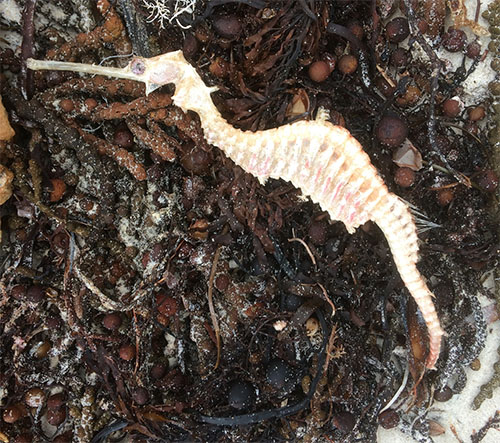 해초 더미와 함께 해변에 쓸려 나온 지 오래되어 해골이 된 루비해룡. 꼬리 끝이 일부 잘려나갔다. 한 아마츄어 비치커머(beach comber)가 큰 관심을 갖고 자랑스럽게 집으로 가져갔다. A Ruby Seadragon, long since washed ashore with a pile of seaweed and turned into a skeleton. It is missing a little bit of tail. Created great interest to a novice beach comber who proudly carried it home. Location/Ravensthorpe, Western Australia, AU. Author/leonie_rennie. (CC BY NC) |
 해룡 3종의 해골 X-ray 사진 비교. (a) 나뭇잎해룡, Leafy seadragon(Phycodurus eques). (b) 풀잎해룡. Weedy seadragon(Phyllopteryx taeniolatus). (c) 루비해룡. Ruby Seadragon(Phyllopteryx dewysea). 스케일 바는 1cm. Comparison of the skeleton of the three species of seadragons. X-ray radiographs of (a) the leafy seadragon Phycodurus eques, (b) the common seadragon Phyllopteryx taeniolatus, (c) Phyllopteryx dewysea n. sp., holotype Scale bars, 1 cm. Source/Image file from Stiller J, Wilson N, Rouse G (2015). "A spectacular new species of seadragon (Syngnathidae)". Royal Society Open Science. Author Stiller J, Wilson N, Rouse G. (CC BY NC) |
루비 해룡의 홀로타입에 대한 컴퓨터 생성 3D 모델을 보여주는 비디오 Click here; |


|
| Copyright ⓒ FISHILLUST.COM All rights reserved. All contents can not be used without permission of the copyright holder. |


 검색
