[marine, brackish, fresh]
Order Mugiliformes Family Mugilidae(mullets)
Largescale mullet
Planiliza macrolepis(Smith, 1846). Max length/60.0cm SL, common length/26.0cm SL
Korean name/keun-bi-neul-sung-eo(큰비늘숭어)
Japanese name/コボラ(Ko-bora)
Chinese name/大鳞鮻
D1/spine 4, D2/soft ray 9. A/spine 3, soft ray 8~9. P1/15-16. Vert/23~24. Longitudinal scale/31~33. Transverse scales/11~13
Distribution; Indo-Pacific/east coast of Africa, including Madagascar, Seychelles, Rodriguez; north to Sri Lanka and India, Andaman and Nicobar Islands, south to north Australia, Marshall and Tuamoto islands, Melanesia and Polynesia, east to Indonesia, the Philippines, China, Taiwan, Japan, South Sea(Busan), including Jeju Island of Korea,
General; Body moderately robust. Head depth equal to or greater than width; head flattened dorsally. Snout length less than or equal to eye diameter, bluntly pointed. The top of the back is nearly straight when viewed from the side while the underside is rounded. Mouth small, posterior tip of maxilla not reaching anterior margin of eye. Upper lip slightly thick, its ventral region smooth. Posterior tip of maxilla beyond posterior tip of mouth angle and exposed when mouth closed. Upper lip with outer row of very close-set, small, peg-like unicuspid teeth, forming fine comb. inner rows well spaced from outer row. Lower lip directed forwards with small villiform teeth present or absent. Vomer toothed, Adipose eyelid slightly developed. Adipose eyefold poorly developed as rim around eye or absent. Interorbital region slightly convex. A single pair of nostrils present between anterior tip of snout and anterior margin of eye. Keel absent in front of dorsal fins. Two dorsal fins completely separated, origin of first dorsal fin is closer to the caudal fin base than to the snout tip. Pelvic fin located in front of middle of body. Posterior tip of pectoral fin not reaching a vertical at origin of 1st dorsal fin. With rudimentary axillary scale. Pectoral fin with small axillary scale. Caudal fin emarginate. Head and body covered ctenoid scales. Lateral line absent. 5 pyloric caeca present.
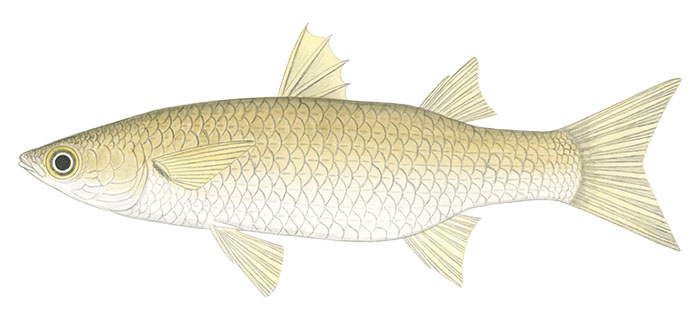
When in natural underwater or immediately coming out of the water, body greenish grey dorsally, and silvery ventrally. All fins light yellowish and semitransparent. Pectoral fin base with yellow base, and perhaps a dark blotch. After alcohol fixation, body is silver white and whitish brown dorsally. First ray base of pectoral fin and posterior margin of caudal fin are slightly darkish. Tiny melanophores on membrane of dorsal and anal fins.
Occur in shallow coastal waters, and from brackish water to freshwater regions of rivers. Form schools; in larger aggregations during spawning, which takes place at sea. Feed on small algae, diatoms, forams, benthic polychaetes, crustaceans, mollusks, organic matter and detritus; fry feed on copepods and floating algae. Oviparous, eggs are pelagic and non-adhesive. Caught mainly during the spawning season and is sold fresh; the roe is highly appreciated.
|

 큰비늘숭어의 분포도. Distribution map of Largescale mullet(Planiliza macrolepis). Derived work. Author/fishillust.com
 암초 구석에 숨어 있는 큰비늘숭어. 장소/대만 Greatscale mullet Largescale mullet(Planiliza macrolepis), hiding in a shelter of reef. observed in Taipei. Author/張智偉(Chang, Jack, Chih-Wei)
 큰비늘숭어 묘사도. Illustration of Largescale mullet(Planiliza macrolepis). Author/George Henry Ford (1808–1876)
 큰비늘숭어 묘사도. Illustration of Largescale mullet(Planiliza macrolepis). observed in South Africa. Author/South African Institute for Aquatic Biodiversity
 큰비늘숭어. Largescale mullet(Planiliza macrolepis). observed in Hong Kong. Author/Tse Chung Yi
 큰비늘숭어. Largescale mullet(Planiliza macrolepis). collected in South Africa. Author/South African Institute for Aquatic Biodiversity
 큰비늘숭어. Largescale mullet(Planiliza macrolepis). collected in South Africa. Author/South African Institute for Aquatic Biodiversity
 큰비늘숭어 새끼의 얼굴 정면. Face of Largescale mullet(Planiliza macrolepis). observed in Hong Kong. Author/Tse Chung Yi
 큰비늘숭어 생선. fresh fish of Largescale mullet(Planiliza macrolepis). observed in Chinese Taipei. Author/tern911




 검색
