[Marine]
Order Mugiliformes Family Mugilidae(mullets)
Hornlip mullet
Plicomugil labiosus(Valenciennes, 1836). 40.0 cm SL, common length : 20.0 cm SL
Korean name/Sol-ip-sung-eo(솔입숭어)
Japanese name/ワニグチボラ(waniguchibora 와니구찌보라)
Chinese name/瘤唇鲻(lyujin zī 류진치)
D/spine 4, soft ray 8-9. A/spine 3, soft ray 8~9. Vert/23~24, lateral line scale/33~36, transverse scale/11~12
Distribution; Indo-Pacific/Mozambique, Comoros and Seychelles of Africa, Red Sea, Maldives, Gulf of Oman, southwestern India, Andaman Sea, Malaysia, the southern tip of Sulawesi in Indonesia, Queensland in Australia, Papua New Guinea, New Caledonia, Vanuatu, Fiji, throughout Micronesia, the Philippines, South China Sea, Taiwan, Southern Jeju Island of Korea, Japan
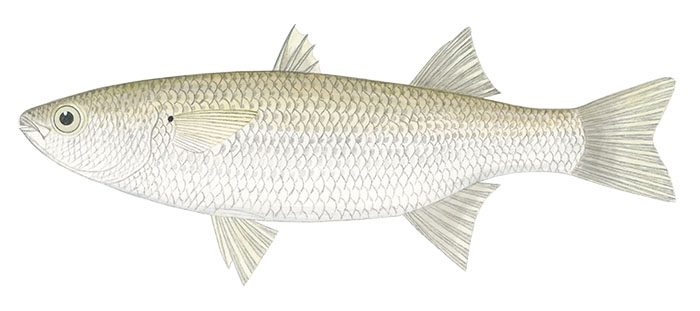
General; Hornlip mullet(Plicomugil labiosus) is the only species in the monospecific genus Plicomugil. Head broad, and depressed dorsally; body deep and compressed posteriorly; mouth terminal; Preorbital containing deep notch and round posterior tip. Posterior margin of preorbital with 5-6 spines. Slender maxilla, slightly curved downward, and with the posterior tip slightly visible when mouth is closed. Posterior tip of maxilla reaches beyond the anterior margin of the eye and beyond mouth angle. Upper lip thick and broad, lower lip thin, lip with file-like margins. Snout short and blunt. 1 or 2 rows of curved conical teeth on each jaw. Teeth on vomer and palatines. Interorbital region slightly convex. Adipose eyelid poorly developed or absent. No spine on the margin of the operculum. 2 dorsal fins completely separated, and origin of 1st dorsal fin located in the middle of the body. Pectoral fin length slightly longer than the head length. Posterior tip of pectoral fin extending beyond the vertical line from the origin of the pelvic fin, and posterior tip of the pelvic fin extending beyond the vertical line from the origin of the 1st dorsal fin. Origin of the anal fin located in front of the vertical line from the origin of the 2nd dorsal fin. Axillary scale small. Caudal fin forked or emarginated. Head and body covered with cycloid scales.
When in natural water olive dorsally and silvery ventrally. When fresh after collected, the head and body are silver-white, darkening dorsally. All fins are semitransparent. Tiny melanophores are present on the membranes of the dorsal, caudal, and anterior region of anal fins, with no melanophores on the pelvic fin. Dorsally, the margin of the pectoral fin is dark. After alcohol fixation, the head and body turned a darker silver–white.
Occur in coastal waters, mainly in reef flats and shallow lagoon reefs; often in silty habitats. Form schools at the surface. Usually swimming in surface waters near freshwater run-offs. Oviparous, eggs are pelagic and non-adhesive. Used as live bait in pole-and-line tuna fishing.
|

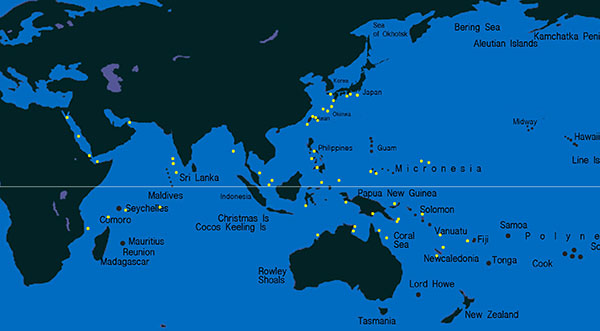 솔잎숭어 분포도. Distribution map of Hornlip mullet(Plicomugil labiosus). Derived work. Author/fishillust.com
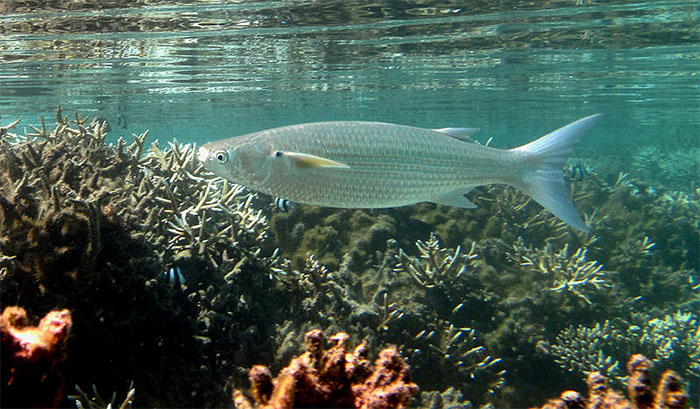 솔잎숭어 산호암초 수중사진. 매우 얕은 수심. Underwater photo at coral reef of Hornlip mullet(Plicomugil labiosus). Just beneath the surface. Author/Philippe Bourjon
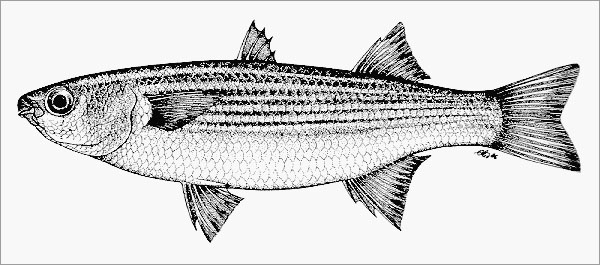 솔잎숭어 묘사도. Illustration of Hornlip mullet(Plicomugil labiosus). Locality:/Sri Lanka Author/FAO
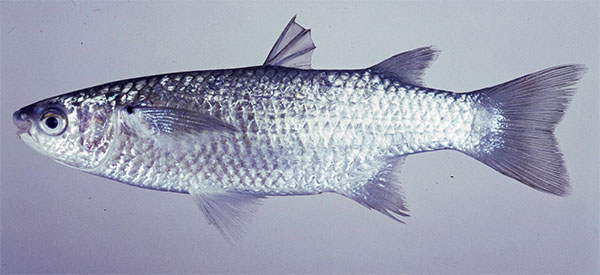 솔잎숭어. Hornlip mullet(Plicomugil labiosus). Photographed during 1997 expedition to Vanuatu. Publisher/Smithsonian Institution. Author/Williams, Jeffrey T.
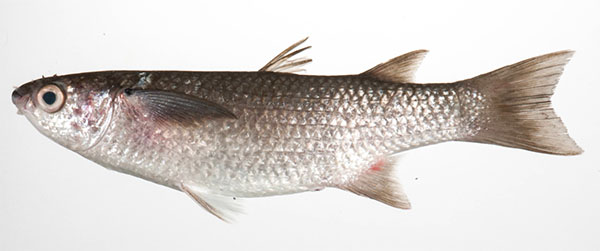 솔잎숭어. Hornlip mullet(Plicomugil labiosus). Collected for 2015 Philippines FDA market survey. Publisher/Smithsonian Institution. Author/Williams, Jeffrey T.
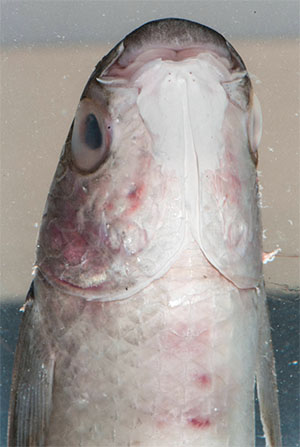 솔잎숭어 머리 부분의 복면. Ventral view of head of Hornlip mullet(Plicomugil labiosus). Collected for 2015 Philippines FDA market survey. Publisher/Smithsonian Institution. Author/Williams, Jeffrey T.




 검색
