
사이트 로그인
사이트 로그인
|
경골상강→조기강→철갑상어목→주걱철갑상어과→중국주걱철갑상어(Chinese paddlefish; Psephurus gladius) |
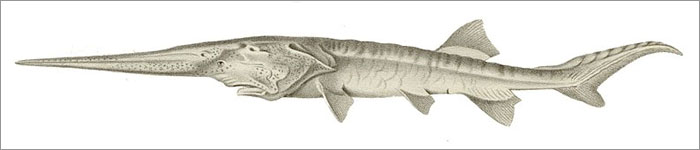 |
| 중국주걱철갑상어 기본 모습. Illustrated Chinese paddlefish(Psephurus gladius). Date/1868 Author/Muséum d'histoire Naturelle |
[Marine; freshwater; brackish] 분포; 아시아/중국 양자강 수계의 고유종 중국 패들피시는 대형 민물고기이며 철갑상어목 주걱철갑상어과의 현생 2종 중 한종이다. 다른 종은 아메리카 패들피시(또는 미시시피 패들피시)이다; American paddlefish 또는 Mississippi paddlefish(Polyodon spathula). 멸종 단계에 있는 종으로 근래 수년간 발견되지 않고 있다. 중국 패들피시는 양자강 수계의 하류와 기수에 살다가 3월과 4월 산란기에 상류의 여러 지류로 올라간다. 평상시에는 큰 강에 살지만 큰 호수에서 발견되는 일도 있다. 머리가 길며 입이 매우 크다. 미시시피 패들피시는 부리가 노처럼 폭이 넓지만 중국 패들피시는 긴 주둥이가 앞쪽이 주걱처럼 넙적하지 아니하고 긴 검처럼 앞이 뾰족하고 뒤로 가면서 폭이 넓은 모양을 가지고 있다. 정확히 말하면 주걱 모양이 아니라 무사의 장검 모양이다. 미시시피 패들피시와 중국 패들피시의 체형 공통점은 입체적으로 볼 때 몸이 방추형이라는 점, 비늘이 없이 매끈하다는 점, 꼬리가 비등미(比等尾/ heterocercal tail; 상엽이 큰 꼬리지느러미)라는 점, 눈이 작고 시력이 약하다는 점이다. 미시시피 패들피시는 플랑크톤 여과섭식자인 반면 중국 패들피시는 주로 물고기를 잡아먹는 육식성 포식자이다. 중국 패들피시는 부리가 더 앞으로 길면서 좁고 뾰족한데 이는 헤엄치면서 입에 들어오는 작은 물고기를 잡아먹으며 가끔 새우나 바닥의 게도 잡아먹는다는 사실을 나타낸다. 복부는 색이 하얗고 등과 머리는 회색이다. 7년 성장 후 성적으로 성숙하며 보통 크기는 길이 2m, 무게 25 kg이다. 입증되지 않은 최대 기록은 7m, 500kg이다. 여러 해 동안 실체가 발견되지 않아 이 종의 크기에 대해서 연구된 자료가 없다. 합리적으로 추론되는 최대어는 3m 길이, 무게 300 kg이다. 멸종의 문제 |
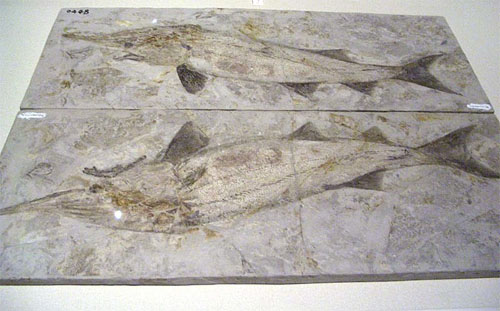 중국 패들피시(중국주걱철갑상어)의 조상 화석. 백악기 초기. 길이 1m. Fossil of extinct Chinese paddlefish; “protopsephurus liui”. Early Cretaceous period. Measured to be up to be one meter in length. Author/lacking author information. |
[Marine; freshwater; brackish] Distribution; Asia: China, endemic to the Yangtze River and its tributaries. Chinese paddlefish is among the largest freshwater fish, although the species is anadromous. It is one of two extant species in the paddlefish family(Polyodontidae), the other being the American paddlefish(Polyodon spathula). The Chinese paddlefish is critically endangered and has not been seen for years, leading to fears that it already may be extinct. Chinese paddlefish spend part of their life in the lower section of the Yangtze (Chang Jiang), including the brackish water of its estuary, but migrate up the river and its major tributaries to spawn, which occur from March and April. It generally stays in large rivers, but sometimes occur in large lakes. Head very long, mouth very large. Paddlefishes have only two small sensory barbels and nonprotrusible mouths. Another major anatomical difference between sturgeons and paddlefishes is in their body coverings. The skin of paddlefishes is largely naked, with patches of minute scales. In contrast, sturgeons are armored with five rows of bony shields along their bodies. The rostrum of a Chinese paddlefish is narrow and sword-like while the rostrum of the American paddlefish is broad and paddle-like. Some common morphological characteristics of paddlefish include a spindle-shaped, smooth skinned scaleless body, heterocercal tail, and small poorly developed eyes. The underbelly of the Chinese paddlefish is white, and its back and head grey. They reach sexual maturity at age seven or eight, with a typical body length of 2m and a weight of 25 kg. Anecdotal reports indicate the Chinese paddlefish can reach 7m in length and weight up to a 500kg or even several thousand pounds. Limited research has been conducted on the species maximum size and weight as a result of its endangered status and lack of sightings over the years. A more generally accepted maximum size is 300 kg in weight and 3m in length, although the specimen caught in 2007 was 3.6m long. Unlike the filter-feeding American paddlefish, Chinese paddlefish are piscivores, and highly predaceous. Their jaws are more forward pointing which suggest they forage primarily on small fishes in the water column, and occasionally on shrimp, benthic fishes, and crabs. Status |


|
| Copyright ⓒ FISHILLUST.COM All rights reserved. All contents can not be used without permission of the copyright holder. |


 검색
