close_btn

눈동자개(Black bullhead).Pseudobagrus koreanus(Uchida, 1990). Family 159


분류계통/경골상강→조기강→메기목→동자개과→눈동자개(Black bullhead; Pseudobagrus koreanus)
Superclass Osteichthyes→Class Actinopterygii→Order Siluriformes→Family Bagridae→Black bullhead(Pseudobagrus koreanus)

Copyright by Kim In Young. 김인영 그림
Pseudobagrus_koreanus_mypainting_700.jpg
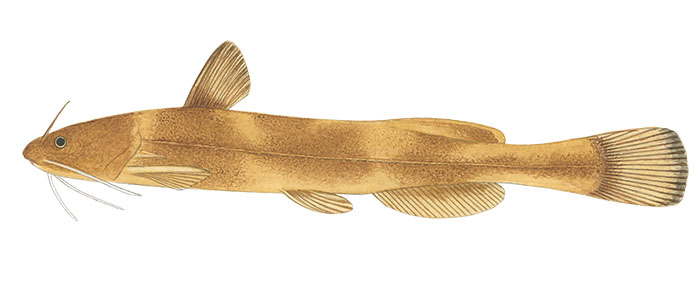
눈동자개 기본 모습. Lateral view of Black bullhead(Pseudobagrus koreanus))

[담수어/Freshwater fish]
메기목 동자개과
Order Siluriformes Family Bagridae(Bagrid catfishes).
눈동자개(Black bullhead)
Pseudobagrus koreanus(Uchida, 1990). Max length: 30 cm TL.
Korean name/nun-dong-ja-gae(눈동자개)
Dorsal spines 2, Dorsal soft rays 7. Anal soft rays 19~24. Vert/44~47. Gr/8~14. 

※ [빠가사리]; 일반인들은 동자개 종류를 종에 구분 없이 모두 빠가사리로 부른다. 동자개과 물고기들은 위협을 느낄 때 모두 가슴지느러미의 가시를 세워 흔들어서 기부의 관절면과 마찰을 일으켜 ‘빠각빠각’ 소리를 낸다. 여기서 ‘빠가사리’라는 별칭이 나왔다. 음식점에서도 ‘빠가사리 매운탕’으로 부른다.

분포; 아시아/한국 고유종. 서해와 서남해로 흐르는 하천(한강, 임진강, 금강, 만경강, 섬진강, 영산강, 탐진강)에 분포하며 낙동강이나 동해안으로 흐르는 하천에서는 발견되지 않는다.
일반개요; 눈이 새까맣고 눈이 크다고 '눈동자개'라는 이름이 붙었다. 최대 몸길이 약 30cm이다. 몸은 가늘고 길다. 동자개보다 몸이 더 길쭉하고 가늘다. 성장함에 따라 몸 길이가 늘어남으로 다 자란 성어의 머리는 상대적으로 작은 편이다. 등지느러미에서 앞쪽은 위아래로 납작하고 그 뒤쪽은 옆으로 납작하다. 몸 높이는 등지느러미 기부가 가장 높다. 주둥이 끝은 다소 둥글고 입은 주둥이의 아래쪽에 열리며 하악이 상악보다 약간 짧다. 입 수염은 4쌍이다. 비늘은 없다. 가슴지느러미 내외 언저리에 톱니가 있는데, 바깥쪽의 톱니는 10개, 안쪽의 톱니는 7개이며 매우 크다. 등지느러미는 배지느러미보다 훨씬 앞쪽에 있다. 꼬리지느러미 뒤는 얕게 파여 있다. 측선(옆줄)은 완전하고 몸의 측면 중앙을 지난다. 몸 빛깔은 살아 있을 때 전체적으로 어두운 황갈색이며 등쪽은 짙고 배쪽은 엷다.
머리와 몸 전체에 걸쳐 3개로 볼 수 있는 큰 반문이 있으며 그러나 경계가 불분명한 경우가 많아 불규칙적으로 검은 부분인 것처럼 보일 수 있다. 등지느러미의 위 가장자리와 꼬리지느러미 뒤 가장자리는 검으며 다른 지느러미들은 밝은 색이다.

서해로 유입하는 하천에만 분포하는 한국 고유종이다. 하천 중•상류의 모래와 진흙바닥에 서식하며, 정체된 수역을 선호하는 동자개와는 달리 어느 정도 물의 흐름이 있는 여울을 선호한다. 수서곤충이나 작은 물고기를 먹고 산다. 산란기는 5∼6월이며, 수컷이 가슴지느러미 가시로 진흙 바닥을 파헤쳐 움푹하게 만들고 암컷들이 그 구덩이에 알을 낳는다. 몸길이가 4cm 내외가 되면 성어와 거의 같은 질을 갖추게 된다.


[Freshwater fish]
Order Siluriformes Family Bagridae(Bagrid catfishes).
Black bullhead
Pseudobagrus koreanus(Uchida, 1990). Max length: 30 cm TL.
Korean name/nun-dong-ja-gae(눈동자개)
Dorsal spines 2, Dorsal soft rays 7. Anal soft rays 19~24. Vert/44~47. Gr/8~14. 

Distribution; Asia/Endemic to Korea. Found in streams flow to west and southwestern coasts of Korea(Han, Im-jin, Geum, Man-gyeong, Seom-jin, Yeong-san, and Tam-jin Rivers). Not found in Nak-dong river and rivers flow to east coasts.
General; The Korean name “nun-dong-ja-gae” means that this fish has large and black eyes. Body elongated and slenderer than Korean bullhead(Pseudobagrus fulvidraco). The body grows longer and slender as it got older, thus the head relatively small in old adults. Head including anterior body portion ahead of dorsal fin is depressed and body compressed posteriorly. Body depth highest at the origin of dorsal fin. Snout tip somewhat rounded. Mouth below snout. Lower jaw slightly shorter than upper jaw. With 4 pairs of barbels. Absent in scales. Have large serrations on both side of pectoral fin spine; 10 at exterior side and 7 at inferior side. Dorsal fin placed far ahead of pelvic fin. Posterior margin of caudal fin slightly emarginated. Lateral line complete and run through middle line of the body side. Dark brown in ground color when alive, darker dorsally and light ventrally. Approximately 3 large blotches on body including the head, but often ambiguous in boundary, as a result, look like irregular dark areas. Upper margin of dorsal fin and posterior margin of caudal fin dark in color, the rest fins bright. 

Endemic to Korea. Found in streams flow to west coasts in south of central Korean peninsula. Inhabit sand and mud bottoms in mid and upper reaches of streams, unlike the Korean bullhead(Pseudobagrus fulvidraco) that prefers stagnant water, this species prefers flowing water. Feed on aquatic insects and small fishes. Spawn in May to June. Male construct egg nest by digging the bottom by using pectoral fin spine. After fertilizing the eggs, male protect the nest until the hatchlings grown up and leave the nest. Reaches adulthood at about 4 cm.


Copyright ⓒ FISHILLUST.COM  All rights reserved. All contents can not be used without permission of the copyright holder.