Oder Scorpaeniformes Family Scorpaenidae(Scorpionfishes or rockfishes)
Red lionfish
Pterois volitans(Linnaeus, 1758) 45.7 cm TL
Korean name/jeom-ssol-bae-gam-peng(점쏠배감펭)
Japanese name/Ominokasago
Chinese name/翱翔蓑鮋
Taiwanese name/石狗公
D/spine 13, soft ray 9~12(usually 11), A/spine 3, soft ray 6~7. P1/14~15. P2/spine 1, soft ray 5. LLp/27-30. Scales in lateral series/90-120. Vert/24. Gill rakers/15-17. Caudal fin/soft ray 13.
Distribution; Western and Southern Pacific Ocean/the Marquesas and Oeno(Pitcairn group), south to Lord Howe Island, northern New Zealand, and the Austral Islands, north to Southeast Asia, Philippines, China, Taiwan, southern Japan and southern Korea. Eastern Indian Ocean/Cocos-Keeling Islands and Western Australia. Invaded into Western Atlantic/Caribbean Sea, East Coast of the United States, northern Gulf of Mexico. Also Invaded into East Mediterranean.
General; One of the largest species of lionfish in the ocean. It is mainly native to the Indo-Pacific region, but has been accidentally introduced into the Western Atlantic, becoming an invasive species there in the Caribbean Sea, along the East Coast of the United States, northern Gulf of Mexico and as well as East Mediterranean.
The appearance of Red lionfish is diverse, and the length of the pectoral fins varies greatly among individuals. Red lionfish is described as having very long pectoral fin that extends beyond the rear end of the caudal fin. However, many photos of specimens with short pectoral fins are found and this cause confusion. The rays of pectoral fin are all unbranched. Two pairs of whiskers on its snout. The presence of a single tentacle(protuberance) above each eye, much longer than the diameter of the eye, is described as one of the characteristic features of this species, but many photographs show very short or barely visible tentacle above the eyes. I wonder if this is the result of misidentification error.
Coloration varies depending on age, habitat environment, and the genetic traits of the population. Coastal species generally darker, sometimes almost black in estuaries. The basic coloration is a red and white zebra pattern on the head and body. There are about 20 reddish-brown vertical stripes on the body, each of varying widths. Darker crossing bands or spots on the dorsal spines and on pectoral fin rays. Numerous black spots along the dorsal soft rays, anal fin rays, and caudal fin rays. There are Pterois species with and without black spots on these fins, and the black spots on Pterois volitans tend to be slightly larger than those of other species. A white spot on the dark area just above of the pectoral fin origin.
Inhabit lagoon and seaward reefs from turbid inshore areas to depths of 50 m. Often solitary, they hide in unexposed places at daytime often with head down and practically immobile. Pelagic juveniles expatriate over great distances and the reason for their broad geographical range.
As with many species within the family Scopaenidae, it has venomous in fin spines. The bold colored stripes on their bodies advertise their toxicity). 18 poisonous spines in total: 13 on the dorsal fin, 2 on the left and right pelvic fins, and 3 on the anal fin. The venomous spines make the fish inedible or deter most potential predators. When threatened, the fish often faces its attacker in an upside-down posture which brings its spines to bear. Hunt small fishes, shrimps, and crabs at night, using its widespread pectorals trapping prey into a corner, stunning it and then swallowing it in one sweep. It cannot swim quickly, but it is very beautiful and elegant when it swims with its long fins spread, so it is widely accepted as an aquarium fish. A popular table fish. The sting by venomous dorsal spines are can be treated by heating the afflicted part and application of corticoids. The puncture is very painful, and the puncture site usually builds up pus.
Reproduction
They are mainly a solitary species and courting is the only time they aggregate, generally one male with several females. Both P. volitans and P. miles are gonochoristic, only showing sexual dimorphism during reproduction. Similar courtship behaviors are observed in all Pterois species, including circling, sidewinding, following, and leading. After courtship, the female releases two egg masses and fertilized by the male. The embryos secrete an adhesive mucous allowing them to attach to nearby intertidal rocks and corals before hatching. Larvae hatch 36 hours after fertilization. They are good swimmers and can eat small ciliates just four days after. The larval stage is the shortest stage of the lionfish's life, with a duration of about one month.
Invasive Lion fish species in western Atlantic.
Two of the 15 species of Pterois, P. volitans and P. miles, have established themselves as significant invasive species off the East Coast of the United States and in the Caribbean. About 93% of the invasive lionfish population is the red lionfish. The red lionfish was likely first introduced off the Florida coast in the early to mid-1980s, almost certainly from the aquarium trade. The lionfish themselves are voracious feeders. As the fish become more abundant, they are becoming a threat to the fragile ecosystems they have invaded. Between outcompeting similar fish and having a varied diet, the lionfish is drastically changing and disrupting the food chains holding the marine ecosystems together. As these chains are disrupted, declining densities of other fish populations are found, as well as declines in the overall diversity of coral reef areas.
Usefulness
Although the red lionfish is valued as a food fish in many parts of its native range, its value as an aquarium animal or as a source of attraction to divers far exceeds its economic value as table fare.
|


 [map 1]. 점쏠배감펭 분포도.
 [map 2]. 점쏠배감펭(Red lionfish/Pterois volitans)의 분포도로 발표되어 널리 인용되어 있다. 그러나 악마쏠배감펭(Devil firefish/Pterois miles)의 분포와 중복된 것으로 밝혀졌다. 홍해, 동인도양 분포 개체들은 모두 악마쏠배감펭이었으며 대서양과 지중해 칩입종도 2종도 중복되어 있다. 이 지도에서 악마쏠배감펭을 삭제해야 점쏠배감펭의 분포도가 된다. 이 지도는 현재(2024년 12월) fishbase와 GBIF 및 OBIS에 게재되어 있으나 재검토 수정되지 않는 자료라는 글을 첨부해 놓고 있다.
 [map 3].악마쏠배감펭 분포도. [map 2]에서 이 데이터를 삭제하면 점쏠배감펭 분포도가 된다.
 점쏠배감펭. 가슴지느러미 길이가 꼬리지느러미 끝 부분에 이르거나 넘는 경우. Red lionfish(Pterois volitans). When the pectoral fin length reaches or exceeds the tip of the caudal fin. Location/New Caledonia. Author/Joëlle VINCENT. (CC BY NC)
 점쏠배감펭. 가슴지느러미 길이가 꼬리지느러미 끝 부분에 이르거나 넘는 경우. Red lionfish(Pterois volitans). When the pectoral fin length reaches or exceeds the tip of the caudal fin. Location/Zagreb Zoo in Croatia. Author/Janjko. (CC BY NC)
 점쏠배감펭. 가슴지느러미 길이가 꼬리지느러미 끝 부분에 이르거나 넘는 경우. Red lionfish(Pterois volitans). When the pectoral fin length reaches or exceeds the tip of the caudal fin. Location/Virgin Islands(U.S.). Author/Hemomomomomo. (CC BY NC)
 점쏠배감펭. 가슴지느러미 길이가 꼬리지느러미 끝 부분에 이르거나 넘는 경우. Red lionfish(Pterois volitans). When the pectoral fin length reaches or exceeds the tip of the caudal fin. Location/Anilao, Philippines. Author/Diego Delso(1974–). (CC BY NC)
 점쏠배감펭. 전체 정면 사진. Red lionfish(Pterois volitans). Full frontal view. Location/Tasik Ria, Manado, Indonesia. Author/Jens Petersen. (CC BY NC)
 점쏠배감펭. 편집자의 추측; 유어의 경우?. Red lionfish(Pterois volitans). Just a guess of editor; juvenile?. Location/Cuba. Author/Robin White. (CC BY NC)
 점쏠배감펭. 흑색 국면. Red lionfish(Pterois volitans). Black phase. Location/Cebu, Philippines. Author/Sylvain Le Bris. (CC BY NC)
 점쏠배감펭. Red lionfish(Pterois volitans). Location/?. Author/Kazuhiro Tsugita. (CC BY NC)
 점쏠배감펭. 가슴지느러미가 짧은 경우. Red lionfish(Pterois volitans). Case with short pectoral fins. Location/?. Author/Lewis Hulbert. (CC BY NC)
 점쏠배감펭. 가슴지느러미가 짧은 경우. Red lionfish(Pterois volitans). Case with short pectoral fins. Location/Wilhelma Zoo, Stuttgart, Baden-Württemberg, Germany. Author/H. Zell. (CC BY NC)
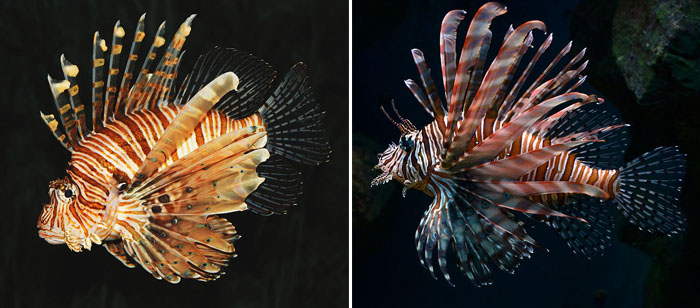 점쏠배감펭. Red lionfish(Pterois volitans). Left/Aquarium in Austria. Author; Michael Gäbler. Right/Cologne Zoo, Germany. Author; Vassil. (CC BY NC)
 점쏠배감펭. Red lionfish(Pterois volitans). Left/Aquarium in France. Author; Dinkum Right/Japan. Author; Izuzuki. (CC BY NC)
 점쏠배감펭. Red lionfish(Pterois volitans). Left/Pacific coast of western Japan. Author; hitomi. Right/ Caribbean invasive. Author; Nick Hobgood. (CC BY NC)
 점쏠배감펭의 머리 정면. Head front view. Red lionfish(Pterois volitans). Left/Author; Brian Gratwicke. Center/national aquarium in Washington DC, Author; Bachrach.Right/Aquarium in the Pittsburgh Zoo. Author; Derek Ramsey. (CC BY NC)
 점쏠배감펭. 보존개체. Red lionfish(Pterois volitans). Preserved specimen. Size(cm)/10.5(SL), 15(TL). Location/Marshall Islands, Eniwetok. Author/Randall, J.E. (CC BY NC)
 점쏠배감펭. Red lionfish(Pterois volitans). Left/Location; Gulf of Mexico. Author; Jon McIntyre. Right/Location/United States of America. Author/Drew. (CC BY NC)
 그림으로 묘사된 점쏠배감펭. Illustrated Red lionfish(Pterois volitans). Left/Author; CAFS(Chinese Academy of Fishery Sciences). Right/Author; Randall, J.E. (CC BY NC)
 점쏠배감펭은 대서양으로 침입된 종이며 식욕은 왕성하고 대서양에는 천적이 없어서 산호초의 생태계와 여러 해양 보호구역의 생태계 건강을 해치고 있다. 해양보호구역의 과학자들은 이 탐욕스러운 침입자를 열심히 잡아 없애고 그 퇴치 문제를 연구하고 있다. With voracious appetites and no natural predators in the Atlantic, invasive lionfish are seriously threatening coral reef biodiversity and health in several national marine sanctuaries. So researchers in sanctuaries are hard at work removing and studying these ravenous fish! Author/GP Schmahl/NOAA. (CC BY NC)




 검색
