
사이트 로그인
사이트 로그인
|
분류계통/분류계통/경골상강→조기강→쏨뱅이목→성대과→밑성대 Copyright by Kim In Young. 김인영 그림
|
| image on preparing |
| 밑성대 기본 모습. Lateral view of Blackspotted gurnard(Pterygotrigla hemisticta) |
쏨뱅이목 성대과 D1/spine 7~9, D2/soft rays 11~12. A/soft rays 11~12. Pectoral fin/soft rays 15(12+iii). Gill rakers/1~2+10~12, LL/62~72. Vert/25. Caudal fin/13 분포; 인도-서태평양/한국의 남해(제주도), 일본 남부, 동중국해, 타이완, 중국 남부, 필리핀, 오스트레일리아 북서부, 아라푸라해, 티모르해, 미얀마, 방글라데시, 인도 북동부, 스리랑카 북부, 오만, 아프리카의 마다가스카르. 등지느러미는 2개로 분리되어 있으며 제1등지느러미 기저에는 방패 모양의 골판 9-10 개가 열 지어있으나, 제2등지느러미 기저에는 방패 골판이 없다. 가슴지느러미는 길어서 뒤끝이 뒷지느러미의 기점을 지난다. 가슴지느러미 아래쪽 3개의 연조는 손가락처럼 분리되어 있다. 꼬리지느러미 뒤 가장자리는 부드럽게 안으로 들어가 있다. 몸은 작은 원형비늘로 덮여 있으며 가슴에는 비늘이 있고 목덜미에는 비늘이 없다. 몸의 상반부는 선홍색 바탕에 동공보다 작은 타원형의 짙은 암녹색 점이 수평 방향으로 3∼4줄 있고, 몸의 중앙 층은 연한 푸른색을 띠며 배쪽은 희다. 제1등지느러미의 4번째 가시에서 6번째 가시 사이에 눈 크기만한 검은색 반점이 있다. 제2등지느러미의 각 기조에 작고 짙은 갈색 점이 1개씩 있으며 이 점들이 제2등지느러미에 수평으로 전개된 줄 무늬처럼 보이게 한다. 가슴지느러미 안쪽(반대쪽)은 검은색을 띠며 기부 쪽에는 진한 흑색 반점이 있다. 기저부의 짙게 검은 바탕 위에는 작은 타원형의 흰색 점 약 7개가 가슴지느러미를 가로지르는 방향으로 열 지어 있다. 나머지 지느러미는 연한 노란색을 띤다. 저서성 어류로 수심 10∼420m의 바닥이 모래나 진흙으로 된 대륙붕에서 주로 서식하며 무리를 이루지 않고 흩어져 지낸다. 산란은 봄과 여름에 먼 바다에서 일어난다. 먹이로는 단각류, 갑각류, 연체동물, 극피동물 등 저서생물을 주로 먹는다. ※ 이름 “밑성대”의 어원은 바다 바닥에 살기 때문에 붙여진 이름일 것이라고 하는데 모든 성대류가 바닥에 서식함으로 타당성이 없다. 다른 성대류에 비해 더 깊은 수심에서 발견된다? 는 특성에 근거를 둔 것인지도 모르지만 이것도 합리적이지 아니하다. |
Oder Scorpaeniformes Family Triglidae(Searobins) D1/spine 7~9, D2/soft rays 11~12. A/soft rays 11~12. Pectoral fin/soft rays 15(12+iii). Gill rakers/1~2+10~12, LL/62~72. Vert/25. Caudal fin/13 Distribution; Indo-West Pacific/South Sea(Jeju Island) of Korea, southern Japan, East China Sea, Taiwan, southern China, Philippines, northwestern Australia, Arafura Sea, Timor Sea, Myanmar, Bangladesh, northeastern India, northern Sri Lanka, Oman, Madagascar in Africa. The dorsal fin is separated into two. Base of first dorsal fin with 9-10 shield-shaped plates. but no plates along base of second dorsal fin. The pectoral fins are long and the back end passes the origin of the anal fin. The three soft rays at the bottom of the pectoral fin are separated like fingers, the rest 12 rays are connected by mambraines. The margin of the caudal fin is gently concaved. Body with minute cycloid scales, nape naked, breast with scales. The upper half of the body has bright red background with 3 to 4 horizontal lines of oval dark green dots smaller than the pupil. The middle layer of the body is light blue and the ventral side is white. First dorsal fin with a black blotch in size of eye on membranes between the 4th and 6th spines. Each rays of second dorsal fin has one small dark brown dot, these forms a lateral stripe across the fin. The inner side(opposite side) of the pectoral fin black pigmented and intense black blotch near base. About 7 small oval white spots in a row across the base area of deep black inner side of pectoral fin. The ground color of rest fins are pale yellow. As a benthic fish, it mainly lives on the continental shelf with sandy or mud bottom at a depth of 10 ~ 420m and lives scattered without forming group. Spawning takes place in spring and summer in distant waters. It mainly eats benthic organisms such as amphipods, crustaceans, mollusks, and echinoderms. |
 밑성대 분포도. Distribution map of Blackspotted gurnard(Pterygotrigla hemisticta). Main reference/GBIF. Author/fishillust.com/ |
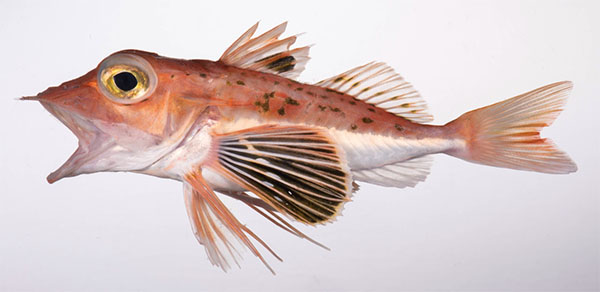 밑성대, Blackspotted gurnard(Pterygotrigla hemisticta). SL/126 mm. Location/Philippines market(2017). Publisher/Smithsonian Institution. Author/Williams, Jeffrey T. |
 밑성대, Blackspotted gurnard(Pterygotrigla hemisticta). SL/238 mm. Location/Philippines market(2016). Publisher/Smithsonian Institution. Author/Williams, Jeffrey T. |
 밑성대, Blackspotted gurnard(Pterygotrigla hemisticta). SL/238 mm. Location/Philippines market(2016). Publisher/Smithsonian Institution. Author/Williams, Jeffrey T. |


|
| Copyright ⓒ FISHILLUST.COM All rights reserved. All contents can not be used without permission of the copyright holder. |


 검색
