close_btn

산갈치(Oarfifsh). Regalecus russelii(Cuvier, 1816) → Family 207


경골상강→조기강→이악어목→산갈치과→산갈치(Oarfish; Regalecus russelii)
Superclass Osteichthyes→Class Actinopterygii→Order Lampriformes→Family Regalecidae→ Oarfish(Regalecus russelii)

Copyright by Kim In Young. 김인영 그림
Regalecus_russelii_mypainting_.jpg
산갈치 기본 모습. Lateral view of Oarfish(Regalecus russelii)

이악어목 산갈치과 Order Lampriformes Family Regalecidae(Oarfishes)
산갈치(Oarfish/오어피시;노고기)
Regalecus russelii(Cuvier, 1816). 800cmTL(불확실 정보임)
Korean name/san-gal-chi(산갈치)
D/spines 0, soft rays 333-371, A/spines 0, soft rays 0, Vertebrae/113 - 122.

분포; 태평양/한국, 일본, 대만, 마리아나 제도, 미국 캘리포니아, 멕시코의 바하 캘리포니아 등에서 뱔견된다.
일반개요; 영명 “Oarfish” Oar는 배 젓는 “노”를 말한다. “노고기”라고 직역할 수 있다. Oarfish는 기네스 북에 세계에서 가장 긴 경골어류로 등재되어 있다고 하는데 어떤 종을 말하는지 혼성이 일어나 있다. 자료들을 정리해보면 산갈치(학명; Regalecus russelii)가 아니고 왕산갈치(Giant oarfish/학명; Regalecus glesne)인 것으로 판단된다.

심해성 어류이다.  등지느러미는 2개이며 몸은 최대 8m 라는 주장과 약 5m 라는 주장이 엇갈려 있다. 심하게 옆으로 납작한 리본 형이다. 등지느러미는 연한 홍색이며 앞 등지느러미는 벼슬처럼 머리 위에 있고 그 기조들은 1m 길이로 높다. 배지느러미는 1개인데 매우 길며 3개 이상의 피질 부속지가 장식처럼 달려있다. 꼬리지느러미는 매우 작게 위축되어 있다. 꼬리지느러미 기조 수는 기본적으로는 4개(3-4)이며 어릴 때는 이 기조가 길지만 아주 큰 개체들은 꼬리지느러미가 없어진다. 머리에 크리스토포어(Cristophore/신조어임)가 있으며 이것이 제1등지느러미 볏을 지주해 준다. 가슴지느러미 기조는 11-14 개인데 그 기부가 수평이어서 가슴지느러미를 체벽에 붙이면 수직으로 놓인다. 뒷지느러미는 없다. 몸 빛깔은 은색 바탕이며 검은색 무늬가 흩어져 있다.

산갈치는 외해 맑은 물이나 연안에서 머리를 위로 하여 수직으로 서서 헤엄친다. 등지느러미만 물결치면서 헤엄치며 발광포(胞)들은 빛을 낸다. 이때 등지느러미의 앞쪽 볏 긴 기조들은 수직으로 뜨며 배지느러미는 수평으로 길게 뜬다. 이 자세는 먹이를 사냥할 때의 모습이다. 먹이가 수면 쪽의 밝은 빛을 등지고 실루엣으로 잘 보이기 때문이다. 크릴새우류 같은 갑각류와 작은 물고기, 오징어를 잡아먹는다. 턱에는 이빨이 없으며 턱을 앞으로 튀어나가게 하여 흡착력으로 크릴새우가 든 물을 빨아들이면 가시와 섬모가 많은 아가미 갈퀴에 먹이가 걸러지게 된다. 가끔 두 마리가 함께 있는 것이 발견되지만 3마리 이상이 무리를 짓는 경우는 없다. 두 마리 경우에도 이것들이 암수가 짝을 지은 것인지는 확인되지 않았다. 산란기는 7월과 12월 사이이며 부화 새끼들은 수면 층에서 발견된다. 산란지는 북태평양 마리아나 제도이며 남아프리카 더반 근해에서도 산란하는 것으로 추측된다. 산갈치는 점액질이 많이 분비되어서 맛이 아주 없는 것으로 알려져 있다.

산갈치류의 자절(自切) 생태
산갈치류의 큰 성어들은 이따금 해변 육지로 좌초되어 자살하며 이 현상은 어떤 특정 장소나 계절과 관계되어 반복되는 것 같다. 산갈치는 도마뱀처럼 자기 몸을 자절(自切)한다. 항문 뒤쪽 몸을 자절시키는데 꼬리 부분만 자절시킬 수도 있고 복부를 포함해 큰 면적을 자절시킬 수도 있다. 평생에 걸쳐 너 댓 번 자절하는 것으로 보인다. 중요 기관은 버리지 않고 자절하며 자절 해도 죽지 않는다. 몸의 근육조직은 칸으로 분할되어있고 이 칸들은 복잡한 격막 시스템으로 연결되어있다. 등쪽과 배쪽에 각각 3개의 칸이 수평으로 나뉘어져 있고 여기에 경골어들이 다 가지고 있는 수직 격벽이 추가되어있다. 길이가 1.5 m 이상인 것들은 거의 모두 자절한 흔적을 가지고 있으며 끊어진 그루터기에서 몸이 자라난 모양을 가지고 있다. 그러나 자절을 하지 않은 것들도 많이 발견되는데 이것들은 자절을 불완전하게 해서 뒷몸이 누더기가 된 모습을 나타낸다. 상어에게 물린 자국과는 다르다. 자절로 떨어져나간 몸은 재생되지 않는다.

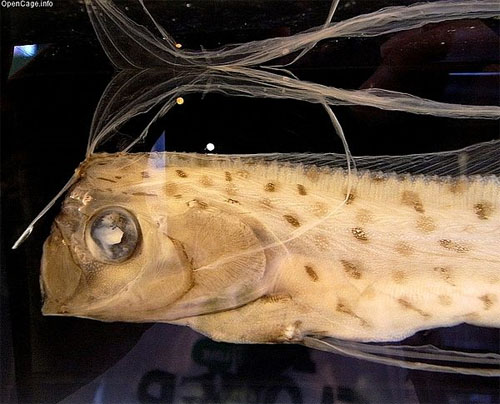
Regalecus_russelii_opencage_crop500.jpg 산갈치 머리 부분(죽은 개체). Head part of Oarfish(Regalecus russelii). Author/Opencage


Order Lampriformes Family Regalecidae(Oarfishes)
Oarfish
Regalecus russelii(Cuvier, 1816). 800cmTL
Korean name/san-gal-chi(산갈치)
D/spines 0, soft rays 333-371, A/spines 0, soft rays 0, Vertebrae/113 - 122.

Distribution; Pacific Ocean/Found in Korea, Japan, Taiwan, Mariana Islands, USA(California) and Mexico(Baja California).
General; Deep sea fish. With two red dorsal fin crests up to 1 meter high and ribbon-like silvery body up to 8 meters in length. Other diagnostic characters: pelvic fin with a single extremely elongated ray and ornamented with more than 3 membranous appendages; caudal fin small, reduced. Cristophore(new term) present and supports the first dorsal fin crest; 11-14 pectoral-fin rays, with a horizontally-oriented base, allowing the fin to be vertically-oriented when adpressed against the body;  all large fish lacking a caudal fin, but in the young, principal rays number 3-4(usually 4), may be extremely elongate, and the tip rarely with ornament; lacking procurrent rays; highly elongate body, with no anal fin;

Oftentimes sighted vertically suspended head-up in clear oceanic or inshore waters with the rays of the dorsal fin crests usually extended vertically upward while the pelvic fin rays may be horizontally spread outward and away from the body, only undulating the dorsal fin, and with photophores on their appendages. This is hypothesized to be a feeding stance that visually allows the fish to spot the silhouette of its potential prey against the skylight. Feed on euphausiid crustaceans, small fishes and squid. Toothless protrusile jaws work to suction krill-laden water into its oro-branchial cavity and retained in the gullet by the long, spiny and bristly gill rakers. Occassionally associate in pairs(gender undocumented) but no record of group larger than three or of schooling behavior. Spawning occurs between July and December and larvae are encountered near the surface. Spawns in the North Pacific Ocean, in an area west of the Marianas Islands; also possibly in South Africa near Durban. Reputed to be unpalatable because the flesh is tasteless or otherwise unappetizing. 

Self-amputation(autotomy) of Oarfishes
Large adults sometimes kill themselves by swimming out of the water onto beaches; occurrence of such strandings may be linked to certain areas, seasons or months and often in spates. Muscle masses compartmentalized by a complex system of connected intermuscular septa; with up to three dorsal horizontal septa and three ventral horizontal septa in addition to the horizontal, vertical, and transverse septa common to most teleosts; With a unique adaptation of self-amputation(autotomy) of the posterior part of the body past the vent which may involve only the caudal fin (or one to a few small adjacent vertebrae) or as far anterior as just before the abdomen; apparently occurs several times during its lifetime(serial autotomy) but do not damage any vital organs and are usually survived except in strandings. All records over 1.5 m long have bodies shortened by autotomy and may exhibit a healed-over stump or "terminus"; still, many specimens found with fresh(with a ragged appearance very different from a healed termini) incomplete self-amputations of the posterior part of the body, notably not consistent with shark bites; the lost part is never regenerated.

Regalecus_russelii_Jordan_crop700.jpg 산갈치(Oarfish). 해변에 좌초된 산갈치(Oarfifsh, 학명; Regalecus russelii)와 주민들의 기념 촬영 사진. 년도는 1907년. 장소는 미국 캘리포니아 오렌지 카운티 해변. Oarfish, Regalecus russelli, on the beach at Newport, Orange Co., Cal. Authors/Jordan, David Starr(1851-1931). 소장/Contributing/Smithsonian Libraries.


Copyright ⓒ FISHILLUST.COM  All rights reserved. All contents can not be used without permission of the copyright holder.