Order Clupeiformes Family Clupeidae(Herrings, shads, sardine, menhadens)
European pilchard
Sardina pilchardus(Walbaum, 1792). Max length/27.5 cm SL
Korean name/yu-reob-jeon-eo-ri(유럽정어리)
Chinese name/沙丁魚
D/spines 0, soft ray 13-21. A/spines 0, soft rays 12-23.
Distribution; Northeast Atlantic/from Iceland and the southern part of Norway and Sweden southwards to Senegal in West Africa. Mediterranean Sea/common in the western half and the Adriatic Sea, but uncommon in the eastern half. Black Sea.
General; The European pilchard(Sardina pilchardus) is a species in the monotypic genus Sardina. The young of the species are among the many fish that are sometimes called sardines. The European pilchard is a small to medium-sized, somewhat elongated, herring-like fish. Body sub-cylindrical, belly rather rounded(but more compressed in juveniles). Hind margin of gill opening smoothly rounded(without fleshy outgrowths). 3 to 5 distinct body striae radiating downward on lower part of operculum. Lower gill rakers not becoming shorter at angle of first gill arch, the upper series not overlapping the lower. The origin of the pelvic fins is well behind that of the dorsal fin, and the last two soft rays on the anal fin are larger than the remainder.
The explanations of body color is not clear. In many photos and drawings, the dorsal side is dark blue, the belly side is white, and there is no pattern. However, there is one explanation that It has a series of dark spots along upper flanks of its body(source/https://thisfish.info/fishery/species/european-pilchard/), In one source, its’ dorsal side is green or olive-colored, the flanks are golden, and the belly is silver-white(Wikipedia; source; Fishes of the NE Atlantic and the Mediterranean. Marine Species Identification Portal. Retrieved 20 August 2018). An underwater photograph matching to the latter source is found, which also has black spot series on its body. Most of the images and descriptions have no body markings and no description of green and gold body colors. So I feel confused. This is something that needs to be checked later.
It is a migratory, schooling, largely coastal species but sometimes travels as far as 100 km out to sea. During the day it is mostly in the depth range 25 to 55 m but can go as deep as 100 m. At night it is generally from 10 to 35 m beneath the surface. In the Mediterranean, the European pilchard moves offshore in the autumn, preferring the deeper cooler waters and constant salinity out at sea to the variable temperatures and salinities of inshore waters. Spawning starts to take place in winter, and in early spring, juveniles, larvae and some adults move towards the coast, while other adults migrate inshore later in the year. Multiple batches of eggs are produced over a long breeding period, total fecundity being 50,000 to 60,000. Most juveniles become sexually mature at about a year old and a length of 13 to 14 cm, pilchards are fully grown at about 21 cm when aged about eight years. The diet consists of both zooplankton and phytoplankton. The zooplankton is largely copepods and their larvae, which make daily vertical migrations to feed near the surface at night, and this is when the adult pilchards feed on them; juveniles feed during the day as well.
Along with the European anchovy(Engraulis encrasicolus), the European pilchard plays an important intermediate role in the Mediterranean ecosystem as a consumer of plankton and as a food for larger demersal predators such as the European hake(Merluccius merluccius) and the European conger eel(Conger conger). This role is particularly noticeable in the Adriatic Sea where the water is shallow, the food chain is shorter and energy is retained within the basin; overfishing of pilchard and anchovy can thus cause dramatic changes in the ecosystem.
|


 유럽정어리 분포도. Distribution map of European pilchard(Sardina pilchardus). Author/Kim in young(fishillust.com)
 유럽정어리 묘사도. Date/1877. Illustration of European pilchard(Sardina pilchardus). Author/Gervais et Boulart
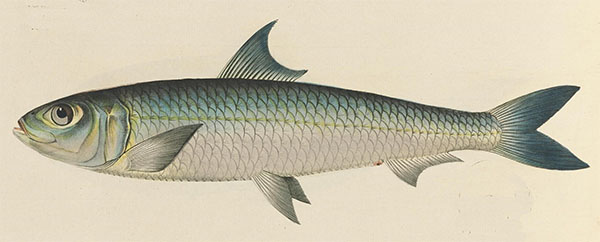 유럽정어리 묘사도. Date/1877. Illustration of European pilchard(Sardina pilchardus). Author/Gervais et Boulart
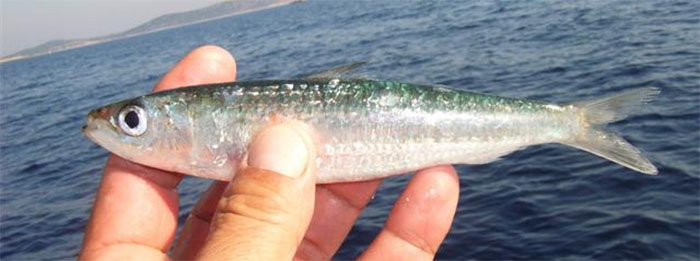 유럽정어리. • European pilchard(Sardina pilchardus). Country/Croatia. Author/Christoph Huebner
 유럽정어리 수중사진. 아가미뚜껑 뒤 체측에 검은 점들의 열 하나가 분명하게 나타나 있다. 이 사진은 “등쪽은 녹색이거나 올리브 색이며 옆구리는 금빛이 나고 배쪽은 은백색”이라는 설명과 부합하는 사진이다. 그러나 인터넷에서 검색되는 다른 모든 이미지들과 해설과는 일치하지 않아 혼란을 일으킨다. • European pilchard(Sardina pilchardus). Country/Italy. A row of black dots behind the operculum is distinctly visible. This photo is consistent with the description, "The back is green or olive-colored, the sides are golden, and the belly is silver-white." However, it does not match all the other images and descriptions found on the Internet, causing confusion. Author/Roberto Pillon
 유럽정어리 수족관 사진. 체측의 검은 점 열이 확대해서 자세히 보면 희미하게 나타나 있다. • European pilchard(Sardina pilchardus). in captivity. A row of black dots behind the operculum is faintly visible when enlarge the image. Author/Citron

 프랑스 도시 콩카르노(Concarneau)의 정어리 통조림 공장에서 작업하는 여인들. 1913년 신문에 보도된 사진. •Women working at a sardine cannery in the French city of Concarneau. Photo published in a newspaper in 1913. Author/Agence Rol
 Left/1946년의 모로코 남서부의 도시 아가디르(Agadir)의 항구 풍경. .모로코 해안은 정어리와 다른 어류 자원이 풍부하다. • A view of the harbor of the city of Agadir in southwestern Morocco in 1946. .The Moroccan coast is rich in sardines and other fish stocks. Authors/U. S. Fish and Wildlife Service. Right/투망을 해변에 올려 놓고 잡힌 정어리를 확인해 보는 아프리카의 어부와 아이들. 1962년 풍경. • A group of half naked fishermen and boys are inspecting a net with small fish(European pilchard) on the beach. Date/February 1962. Photographer/L. A. van Es.
 우편 엽서의 그림. 포르투갈 북서부 레이숑스(Leixões) 항구 풍경. 어선들이 잡아온 정어리를 우마차에 옮겨 싣고 있다. 배경에는 철교가 있고 증기 기관차가 끄는 열차가 보인다. 시대는 1880년~ 1920년 사이이다. •Illustrated postcard showing fishing boats in Leixões(Matosinhos, Portugal) unloading sardines on the beach to an ox cart. In the background a railway bridge and a train pulled by a steam locomotive over it. Date/between circa 1880 and circa 1920. Author/Unknown




 검색
