Oder Scorpaeniformes Family Peristediidae(Armored searobins or armored gurnards).
Robust armoured-gurnard
Satyrichthys welchi(Herre, 1925). max lengt/50.0 cm TL
Korean name/gi-jeom-byeol-seong-dae(별성대)
Japanese name/ホンオキキホウボウ(Hon'okikihoubou); Honokiki gurnard
Chinese name/林氏紅魴鮄(림씨홍방불) 遠岸紅魴鮄(원안홍방불)
D/spine 7, soft rays 17. A/soft rays 17. Pectoral fin/soft rays 12(including 2 free rays). pelvic fin/spine 1, soft ray 5. Lateral line scales/31. Body plate/dorsal 27, upper lateral 32 lower lateral 22, ventral 22, before anus 2. Barbel/Lip barbel 4, Chin barbel 3.
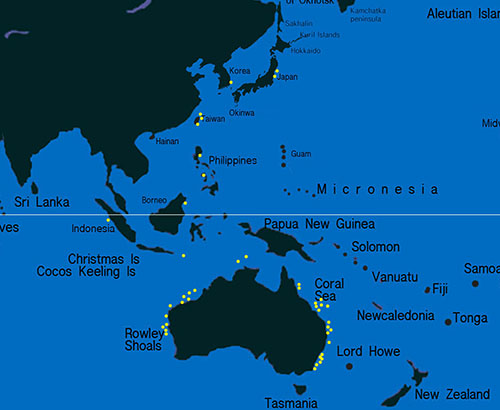
Distribution; West Pacific/South east sea of Korea, Japan, China, Philippines, Borneo Island, Australia.
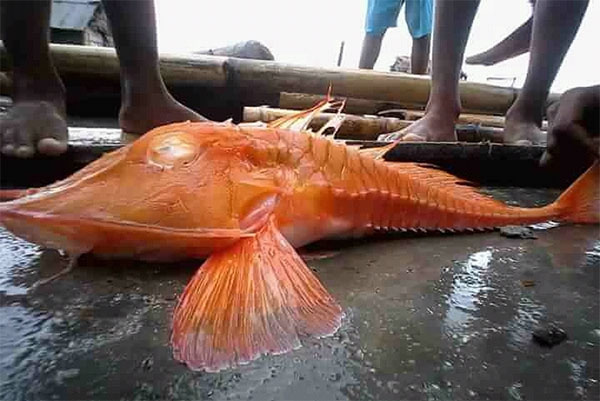
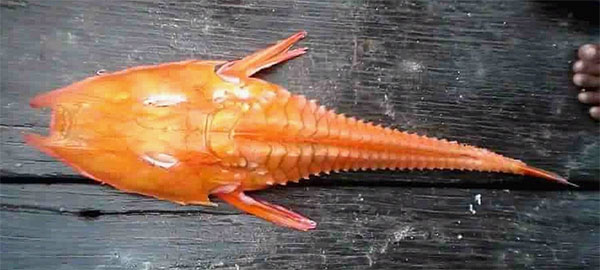
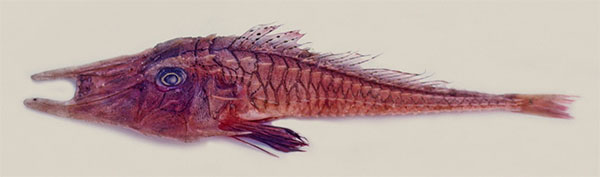
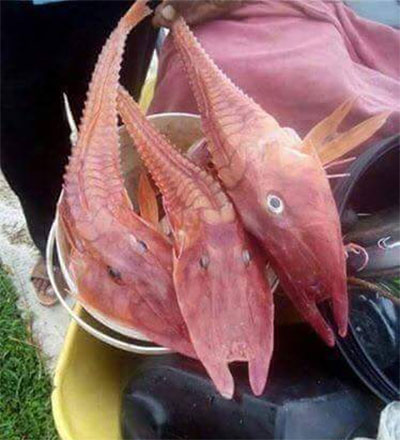
General; The body is cylindrical, elongated, slightly compressed laterally, and tapered toward the back. The head is very large, flattened up and down, and viewed from the side, triangular, and its’ dorsal margin is almost straight. Snout short, slightly longer than eye diameter. A pair of beak like protrusions(rostrum) that extends forward from both sides of the snout. The eye diameter is slightly larger than the interocular distance. The upper jaw has no teeth and the lower jaw has teeth. The front central part of the upper jaw is concave. There are 4 pairs of barbels on the side of the lower jaw, and the last one is remarkably long and reaches the front edge of the eyes when laid down. 3 pairs of short barbels behind the lower jaw in the ventral area. 3 small triangular spines in the middle of snout and 1 small, hard, sharp spine in front part of both eyes. A sharp and hard spine on preopercular bone, and its’ length is longer than that of the opercle. The opercle has two spines of different lengths. A pair of nostrils on snout between rostrum.
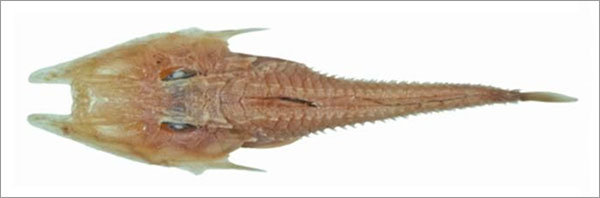
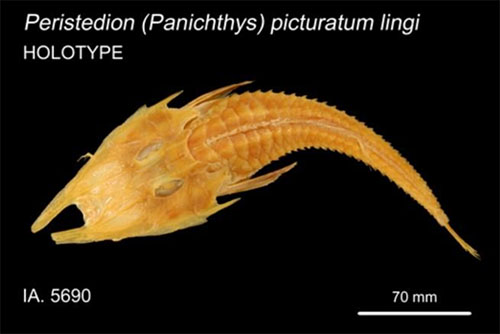
Covered with bony plate like scales all over the body. 4 parietal plates in the head, and the plates starting from the back of head are arranged in total of 4 rows. The number of dorsal plates is 27, the number of upper lateral plates is 32, the number of lower lateral plates is 22, the number of retro-anal plates is 22, and the number of pre-anal plates is 2(which is larger than the other plates). There are three rows of sharp spines facing backwards, one on the back, one on top of the body side, and one on bottom of body side. These spines are located on middle of each plate scales..
The dorsal fin with a V notch between spinous part and soft rays part, but continuous. The pectoral fin is located behind the preopercule, the base is narrow, the posterior edge is wide, and the lower two rays are separate like finger. The second separate ray slightly longer than first ray, and the separate rays thicker and harder than other non-divided pectoral fin rays. The pelvic fin originates below the base of the first separate soft ray and is shorter than the pectoral fin. The back of the caudal fin is slightly emarginated. The body color is uniform yellowish red, and after fixation, the body color is overall brown. There are black spots on dorsal fin. The Korean name "gi-jeom-byeol-seong-dae" means "spotted fin gurnard" in English and it is said that the name was made by taking advantage of the black spots on dorsal fin. Robust armoured-gurnard inhabits on bottom of the continental shelf and continental slope.
|

 text on preparation
 text on preparation
 text on preparation
 text on preparation
 text on preparation
 text on preparation
 text on preparation




 검색
