
사이트 로그인
사이트 로그인
|
분류계통/분류계보/경골상강→조기강→홍메치목→매퉁이과→매퉁이 Copyright by Kim In Young. 김인영 그림
|
 |
| 매퉁이 기본 모습. Lateral view of Mae-tung-i(Saurida macrolepis) |
홍메치목 매퉁이과 분포; 인도-태평양/한국의 서해와 남해, 북한, 일본, 홍콩, 타이완, 중국, 필리핀, 말레이시아, 타일랜드, 베트남. 캄보디아, 인도네시아, 티모르, 부르나이, 스리랑카, 오스트레일리아, 페르시아 만, 아라비아해, 홍해, 동아프리카의 잔지바르와 잠베이지 강 연해에 분포. 지중해에도 이입되었다는 보도가 있으나 확인이 요망됨. ※ 학명이 Saurida undosquamis인 개체는 영명으로 브러시투스 리자드피시(Brushtooth lizardfish)로 부르며 매퉁이는 학명이 Saurida macrolepis이며 널리 쓰이는 영명은 없으며 오스트랄리아에서는 largescale saury(큰비늘 사우리)라고 부른다. 매퉁이와 브러시투스 리자드피시의 차이점을 말하면 브러시투스 리자드피시는 ①등지느러미의 맨 앞면 가장자리와 ②꼬리지느러미의 윗면 가장자리에 여러 개의 작은 흑색 점들이 일정 간격으로 찍혀 있고 ③꼬리지느러미의 아랫면 가장자리가 검은색이다. ④몸의 배쪽 부분은 백색이 아니고 어둡다. 반면에 매퉁이는 이 4가지 특징 중에서 등지느러미의 맨 앞면 가장자리에는 검은 점의 열이 없고 꼬리지느러미의 윗면 가장자리에만 검은 점 열이 있는데 검은 선인지 검은 점들의 열인지 모양은 불분명할 수가 있다. 그리고 복부와 꼬리지느러미의 아랫면 가장자리는 백색이다.
================= 몸은 가늘고 긴 원통 모양이다. 머리는 약간 위아래로 납작하다. 눈에 기름눈꺼풀이 있다. 주둥이는 뾰족하고 입은 크며 양 턱에 여러 줄의 예리한 이빨이 있다. 입의 뒤 끝은 눈을 훨씬 지난다. 등지느러미는 몸 중앙보다 앞쪽에 위치하고, 앞쪽의 연조 길이가 뒤로 가면서 급히 줄어들어서 맨 앞 연조의 길이는 마지막 연조 길이는 약 5배가 된다. 가슴지느러미의 끝은 배지느러미 기부를 넘어간다. 등지느러미 뒤쪽에는 기름지느러미가 있다. 측선은 완전하고, 등지느러미 앞 비늘 수는 17~20개이다. 몸빛깔은 등쪽이 황갈색이고 배쪽이 은백색을 띠는데, 옆면의 가운데를 따라서 어두운 색의 뚜렷한 점이 8∼10개 줄지어 있다. 비늘은 큰 둥근비늘로 떨어지기 쉬운 비늘이다. 꼬리지느러미 위쪽 가장자리에 일렬의 흑점이 있다. 아래쪽 가장자리는 백색이다. 수심 1∼290m의 바닥이 모래나 진흙으로 된 연안지대에 서식한다. 겨울에는 근해로 여름에는 내만으로 이동하는 계절회유를 한다. 새우•게 등의 갑각류와 다른 무척추동물, 작은 물고기 등을 먹으며, 때로는 서로 잡아먹는다. 여름철에 가장 왕성한 식욕을 보이며 성장속도도 겨울보다 여름에 빠르다. 4∼5월에 수온 17~22℃ 전후인 연안의 얕은 바다에서 산란한다. 정치망, 자망, 안강망 등 다양한 방법으로 포획된다. 우리나라에는 주로 남해와 서해에서 어획되며 어묵의 원료로 주로 사용된다. 여수에서는 '매투미', 전북에서는 '매테비', 완도 지역에서는 '매퉁이'라 부르며 제주도에서는 '애리'또는 '아에리'라 한다. |
Order Aulopiformes(Grinners). Family Synodontidae(Lizardfishes). Distribution; Indo-West Pacific/south and west coasts of Korea, Japan, Taiwan, Hong Kong, China, Philippines, Malaysia, Thailand, Cambodia, Viet Nam, Indonesia, Brunei, Timor-Leste, Sri Lanka, Australia, Arabian Sea, Persian Gulf, Red Sea, Gulf of Suez, Zanzibar, and off Zambezi River, Eastern Africa.Reports of Introduction in the Mediterranean are questionable. Speaking of the difference between the Saurida undosquamis(English name; Brush-tooth lizardfish) and the Saurida macrolepis(no global English name, called as Largescale saury in Australia); the Saurida undosquamis has several small black dots stamped at regular intervals on ① the front edge of the dorsal fin and ② the upper edge of the caudal fin. ③The lower margin of the caudal fin is black. ④The ventral side of body is darkish, not white. On the other hand, the Saurida macrolepis has no row of black dots on the front edge of the dorsal fin, but only on the upper margin of the caudal fin. And the ventral side of body and lower margin of caudal fin is white. Body elongated and cylindrical. Head slightly flattened. Eye with adipose eyelid. Snout pointed, mouth is large, and the jaws have several rows of sharp teeth. Posterior end of mouth reaches far beyond the eye. The dorsal fin is located in front of the center of the body, and the lengths of rays decreases rapidly as it goes posterior, so the length of the first soft ray is about 5 times longer than the last soft ray. The tip of the pectoral fin goes beyond the base of the pelvic fin. With an adipose fin behind the dorsal fin. Lateral line complete, the number of scales in front of dorsal fin is 17-20. The body color is yellowish brown dorsally and silvery white ventrally, and 8-10 distinct dark spots along the middle of the side. The scales are large and cycloid and deciduous. A row of dark spots on upper edge of caudal fin, lower edge is white. Inhabits coastal areas with sandy or muddy bottoms at depths of 1 to 290 m. They do seasonal migrations, in winter move to offshore and in summer to inland bays. Feed on crustaceans such as shrimp, crabs, other invertebrates, small fish, and sometimes eat each other. It shows the most vigorous appetite in summer and the growth rate is faster in summer than in winter. Spawns in shallow water along the coasts with water temperature of around 17-22℃ in April-May. Caught by various methods such as fixed shore net, gill nets, and stow net. In Korea, it is mainly caught in the southern and western seas and is mainly used as a raw material for fish cakes. |
 매퉁이 분포도. Distribution map of Saurida macrolepis. Main reference/AquaMaps(2019, October). Author/Kim in young(fishillust.com) |
 매퉁이. Saurida macrolepis. Korean/Mae-tung-I, Japanese/Ma-eso. Author/Izuzuki(izuzuki.com) |


|
| Copyright ⓒ FISHILLUST.COM All rights reserved. All contents can not be used without permission of the copyright holder. |


 검색
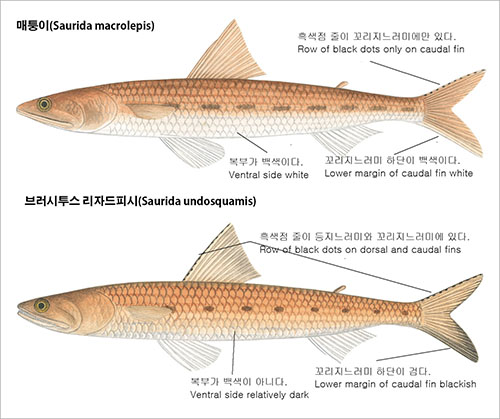 매퉁이와 브러시투스 리자드피시의 외관 차이 Differences between Saurida macrolepis and Saurida undosquamis. Author/Kim in young(fishillust.com
