
사이트 로그인
사이트 로그인
|
분류계통/분류계통/분류계보/경골상강→조기강→홍메치목→매퉁이과→툼빌매퉁이 Copyright by Kim In Young. 김인영 그림
|
 |
| 툼빌매퉁이 수컷의 기본 모습. 수컷은 등지느러미의 2번 연조가 실처럼 길게 연장되어 있고 암컷은 연장되어 있지 않다. Lateral view of male Wanieso lizardfish(Saurida wanieso). In males, the 2nd soft rays of dorsal fin is extended like a thread, and in females, they are not. |
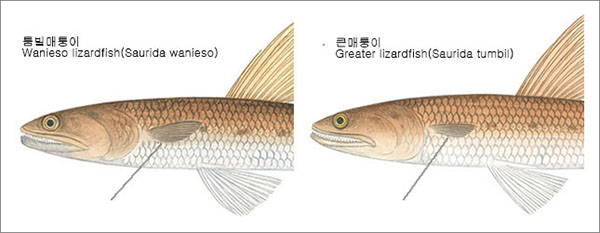 한국명 툼빌매퉁이(tum-bil-mae-tung-i=equivalent to tumbil lizardfish)는 학명이 Saurida wanieso인 종을 지칭하는데 “툼빌”이란 학명(Saurida tumbil/Greater lizardfish)을 가진 종이 따로 있어서 혼동이 일어나 있다. 툼빌매퉁이(좌)와 큰매퉁이(우/임시한글명)의 외관상 차이는 가슴지느러미의 크기뿐이다(본문의 설명 참조). The Korean common name “tum-bil-mae-tung-I”(equivalent to tumbil lizardfish) refers to the species with the scientific name of Saurida wanieso, but there is confusion because there is a separate species with the scientific name of “Saurida tumbil(Greater lizardfish)”. The external difference between Saurida wanieso(left) and Saurida tumbil(right) is in only the size of the pectoral fin(read description in text). |
홍메치목 매퉁이과 분포; 인도-서태평양/인도양 동부, 인도네시아 남부, 오스트레일리아, 남중국해, 동중국해, 타이완, 한국 남부 제주도, 일본 중부 이남, 등 온대 및 열대 해역에 분포한다. 등지느러미는 몸의 중간보다 앞에 위치하며, 수컷 성어는 등지느러미 제2연조가 실같이 길어진다.등지느러미 기저부의 길이는 뒷지느러미 기저부의 길이보다 길다. 가슴지느러미 뒤끝은 배지느러미 기부를 지난다. 배지느러미 내•외연의 길이는 비슷하며, 가슴지느러미와 배지느러미는 보조비늘을 가진다. 등지느러미는 배지느러미보다 조금 뒤쪽에서 시작되고, 등지느러미 뒤쪽에 1개의 기름지느러미가 있다. 꼬리지느러미는 깊게 파인 가랑이형이며, 상 엽이 하엽 보다 조금 더 길다. 측선은 약간 튀어나와 분명히 구분된다. 비늘은 둥근비늘로 크고 쉽게 탈락된다. 뺨에 비늘이 있다. 측선비늘 수는 54~60개이다. 비늘은 아가미뚜껑을 포함하여 몸 전체에 분포한다. 신선한 개체는 몸의 등쪽은 암갈색, 배쪽은 은빛을 띠며 머리꼭대기 부분, 가슴지느러미, 눈앞 부위, 꼬리지느러미 하엽의 아래 가장자리가 검다. 등지느러미는 연한 갈색이며 배지느러미와 뒷지느러미는 희다. 알코올 보존 개체는 전체적으로 짙은 갈색이며 배쪽으로 연해진다. 배지느러미와 뒷지느러미는 연한 황색을 띤다. 성장이 빨라 1년생이 체장 20cm 에 달하며, 2년생 31cm, 3년생 40cm, 최대로 체장 65cm 까지 성장한다. 연안성 어류로 수심 100m 이내의 모래 바닥에서 서식한다. 산란기는 4∼6월이며, 산란기간 중 여러 번에 걸쳐 산란한다. 육식성 어류로 먹이는 주로 어류이며, 다음으로 갑각류, 오징어류를 먹는다. 저층 트롤어업에 의하여 어획되며 어육 가공품의 원료로 이용된다. ※ 학명의 종소명이 툼빌(tumbil)인 종(Saurida tumbil)이 따로 있는데 왜 “Saurida wanieso”의 한국명이 툼빌매퉁이인가? 처음에 한국에 분포하는 종의 학명이 Saurida tumbil인 것으로 알고 한국명을 “툼빌매퉁이”로 정하였는데 나중에 다시 확인해보니 이 한국 분포종의 옳은 학명은 “Saurida wanieso”이었다는 것이다. 그래서 종의 학명은 수정하였으나 한국명은 수정되지 않아 학명과 국명 사이에 혼란이 일어나 있다. 불편하게 왜 한국명은 수정하지 않았는지 학자가 아닌 필자는 알 수가 없다. Saurida tumbil은 영명이 Greater lizardfish(번역을 하자면 큰매퉁이)이며 아프리카 동부에서부터 오스트레일리아를 포함해 동중국해와 일본에 이르기 까지 Saurida wanieso 보다 더 널리 분포한다. 그 북방 한계가 한국과 그리 멀지 않다. 제주도 근처에 나타날 확률도 배제할 수 없다. 만약 한국 해역에 Saurida tumbil이 나타난다면 이때는 한국명을 어찌해야 할 것인지 궁금해진다(2021년말 현재 기준). ※참고문헌. “한국산 매퉁이속(홍메치목, 매퉁이과) 어류의 분류학적 재검토”. 여민유 •김진구* 부경대학교 자원생물학과. Date/October 17, 2018 |
Order Aulopiformes(Grinners). Family Synodontidae(Lizardfishes). Distribution; Indo-West Pacific/eastern Indian Ocean, south of Indonesia, north and west Australia, South China Sea, East China Sea, Taiwan, southern sea of Korea including Jeju Island, south of central Japan. Dorsal fin placed ahead of middle of body center. The second soft ray of the dorsal fin extended long as a thread in male adult fish. Dorsal fin starts at a little behind the pelvic fin, and one adipose fin behind the dorsal fin. Base of dorsal fin longer than anal fin. The rear end of the pectoral fin passes the base of the pelvic fin. The length of inner and outer ray of pelvic fin similar. Pectoral and pelvic fins with auxiliary scales. The caudal fin is forked and upper lobe slightly longer than lower lobe. The lateral line is slightly protruded and clearly distinguished. The number of lateral line scales is 54 to 60. Scales are distributed all over the body including the operculum. The scales are relatively large and deciduous. When fresh, the dorsal side of the body is dark brown and the belly side is silvery, and the top of the head, pectoral fins, front part of eye, and the lower lobe of caudal fin dark. The dorsal fin is light brown. Pelvic and anal fins are white. Preserved specimen, uniformly dark brown with lesser dark belly, pelvic and anal fin with pale yellow. It grows quickly, reaching 20cm in length at first year, 31cm at second year, 40cm at third year, and up to 65cm in length. It is a coastal fish that inhabits sandy bottoms within 100 m depth. The spawning season is from April to June, and they spawn multiple times during the spawning period. As carnivorous fish, it feeds mainly on fish, followed by crustaceans and squid. It is caught by low-floor trawl fishing and is used as a raw material for processed fish meat products. ※ The official Korean name of “Saurida wanieso” is "tum-bil-mae-tung-i", which translated as “tumbil lizardfish”. This Korean name causes confusion with the other species’ scientific name “Saurida tumbil”. Why is the Korean name of “Saurida wanieso” is Tumbil lizardfish? At first, this species was misidentified as Saurida tumbil, so named as "tum-bil-mae-tung-i", later the scientists found that the right scientific name is “Saurida wanieso”. However the official Korean name not changed, the why I(nonscientist) don’t know. Saurida tumbil, of which English name is Greater lizardfish, is more widespread than Saurida wanieso from eastern Africa, including Australia, to the East China Sea and Japan. The northern limit is not far from Korea. The possibility of appearing near Jeju Island of Korea cannot be ruled out. If Saurida tumbil appears in Korean waters, I wonder the Korean scientists what to do with the Korean name(as of the end of 2021). ※Main reference/Taxonomic Review of the Genus Saurida(Aulopiformes: Synodontidae) from Korea by Minyu Yeo and JinKoo Kim*(Department of Marine Biology, Pukyong National University, Busan 48513, Republic of Korea). Date/October 17, 2018 |
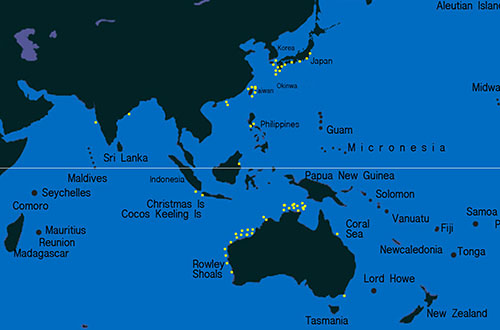 툼빌매퉁이 분포도. Distribution map of Wanieso lizardfish)Saurida wanieso). Author/Kim In Young(fishillust.com) |
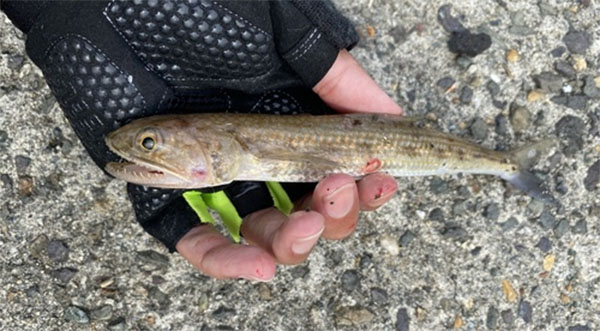 툼빌매퉁이(Wanieso lizardfish;Saurida wanieso). 낚시인에게 잡혀 나온 후 시간이 많이 지나지 않은 순간의 모습. 측선을 따라 여러 개의 어두운 점들이 배열되어 있다. 인터넷 검색에서 뜨는 다른 여러 사진들은 죽은 지 오래된 개체들의 사진이어서 이 무늬가 나타나 있지 않다. 또는 크게 성장하면 이 무늬가 사라지는 것일지도 모른다. Wanieso lizardfish(Saurida wanieso). The appearance of a moment not long after being caught by a fisherman. Several dark spots are arranged along the lateral line. Several other photos that appear on Internet searches do not show this pattern as they are photos of long-dead individuals. Or, it may be that this pattern disappears when it grows large. Author/りなべる(Rinaberu). Source/iNaturalist |
 툼빌매퉁이의 기본 모습, 죽은 개체. Dead specimen of Wanieso lizardfish(Saurida wanieso). Location/ Quezon, Philippines. Author/Rodolpho B. Reyes |
 툼빌매퉁이의 머리와 입 구조의 표현. Head of Wanieso lizardfish(Saurida wanieso). Note the mouth structure and teeth.. location/ Quezon, Philippines. Author/Rodolpho B. Reyes |


|
| Copyright ⓒ FISHILLUST.COM All rights reserved. All contents can not be used without permission of the copyright holder. |


 검색
