
사이트 로그인
사이트 로그인
|
도움말 순서(Contents)
[1] 분류학 체계의 기본 단위 The basics of Classifying Fishes |
|
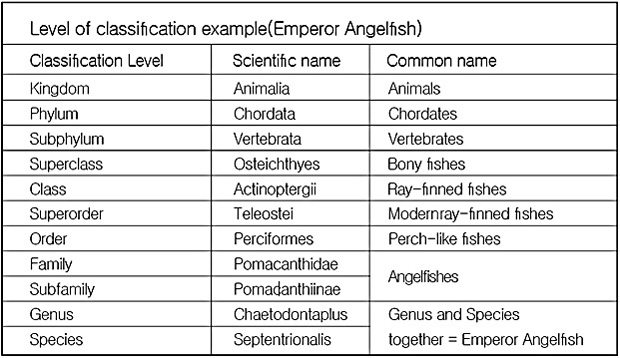
[1] 분류학 체계의 기본 단위(분류 방식은 학자의 견해와 시기에 따라 업데이트되면서 변함) 지구상에 존재하는 수많은 생물들을 이해하고 그 상관 관계를 나타내기 위하여 과학자들은 공동 조상과 그로부터 진화한 경로를 추적하여 유(類)를 나누고 계통을 정리하여 생물들을 분류한다. 분류 단위나 학명은 혼란을 막기 위하여 세계 공통으로 라틴어 또는 라틴어화한 언어를 사용한다. 분류군의 첫 단계는 계(界)이며 예를 들면 동물계와 식물계가 있다. 기본 7단계
1. 계(界): Kingdom(일반적 기본은 동물계, 식물계 2가지임) 위 기본 분야를 필요에 따라 세분하여 하위 단계를 만들며 또 아래에 하위 단계를 만들며 사이 사이에 중간 단계를 설정하여 계통도(거꾸로 세운 나무 형)를 만든다. 예를 들면 다음과 같이 하위 단계를 만들어 나간다.
아계(亞界: Subkingdom), ■ 분류학 체계에서 어류 위치 척색동물문은 3개의 아문으로 갈라지는데 그것들은 아래와 같다. 두색동물아문(頭索動物亞門 Subphylum Cephalochordata), (※ 두색동물의 예는 창고기류(lancelets, Branchiostoma)이다. 뱀장어의 치어처럼 보이지만 몸이 투명하고 눈과 턱이 없는 원시동물이며 모래진흙 속에 산다. 미색동물의 예는 멍게, 우렁쉥이 또는 살파류이다.) 현생 척추동물(척색동물아문)은 다음 5개의 강으로 나눈다.
① 먹장어강(Class Myxini)
※ 인간의 기원은 육기어류(육기강)에 있다고 본다.
※ 분류학체계는 완벽하게 확정적이지 아니하다. 다른 분류체계에서 보면 모든 척추동물은 먼저 턱이 없는 무악류(無顎類, Agnatha)와 턱이 있는 악구류(顎口類, Gnathostomata) 두 가지로 나누었다(상강 개념). 여기서 먹장어강과 두갑강은 무악류이다. 악구류에는 육상 척추동물과 해양포유동물, 연골어류, 조기어류, 육기어류 모두가 해당된다. 무악류가 턱이 없다는 특징보다는 입이 둥글다는 특징을 살려 이들을 원구류(圓口類, Cyclostomata)라고 칭하기도 한다. 보통 경골어류라고 하는 것은 악구류 중에 조기어류와 육기어류를 합한 것이다.
먹장어강(Class Myxini)과 두갑강(頭甲綱 Class Cephalaspidomorphi) 먹장어강에는 먹장어목(order Myxiniformes) 하나만 있고 두갑강에는 칠성장어목(order Petromyzontiformes) 하나만 있다. 이들은 턱이 없는 무악어류이다. 이들 턱이 없는 어류가 턱이 있는 악구류(척추동물)를 발생시킨 것으로 해석되고 있으며 특히 칠성장어가 그 원류일 것이라고 추정된다. 무악어류는 몸에 점액이 아주 많고 뱀장어처럼 생겼다. 그러나 가슴지느러미와 배지느러미 등 쌍을 이루는 지느러미가 없고 지탱해 주는 외골격도 없다. 먹장어와 칠성장어는 원시적인 점에서는 비슷한 데가 많지만 실제로는 특징이 매우 다르다. 먹장어류가 훨씬 더 원시적이어서 먹장어를 척추동물에서 제외시켜야 한다는 주장이 있을 정도이다.
※ 꼼장어는 먹장어를 말한다; 학술적 정식 명칭은 먹장어이며 흔히 꼼장어라고 부르는 것은 국어 표준어 ‘곰장어’에서 나왔다. 해저 바닥에서 살다보니 눈이 멀었다 해서 먹장어라고 부르게 되었다. 학술적으로 말하면 꾀장어과의 여러 종들 중 하나가 먹장어이다. 연골어강(軟骨魚綱 Class Chondrichthyes) 연골어강에 드는 어류는 키메라류(은상어류), 상어류, 홍어류 3가지가 있다. 그러나 연골어강은 실질적인 내용 때문에 강(綱) 보다는그 다음 분류 단계인 두 개의 아강을 대표적인 분류 명칭으로 사용한다. 그 두 아강은 전두아강(全頭亞綱, Holocephali)과
판새아강(板鰓亞綱, Elasmobranchii) 이다. 전두류의 현존 어류는 은상어들이며 일반적으로 키메라(Chimaera, 그리스 신화의 괴물)라고 부른다. 은상어는 분류학상으로 상어가 아니며 우리말에서 상어가 되었다.
판새아강에는 상어류와 홍어류 가오리류가 묶어진다. 2006년 이전에는 모두 9개의 목으로 나누고 이중 1개목이 홍어목(order Rajiformes)이며 가오리류도 홍어목에 포함되어 있었다. 나머지 8개의 목을 모두 상어들이 차지하고 있었다. 그러나 이 분류는 구식이다. 이 분류는 어류학자 J.S 넬슨(Joseph S. Nelson/1937–2011)의 어류분류학 저서 'The Fishes of the World' 를 기준한 것인데 이 저서는 1976년에 초판이 나왔다. 한국과 세계 여러나라들이 넬슨의 분류를 따르고 있었는데 현재 한국 학계에서 사용하고 있는 것은 1994년에 나온 제3판을 기준한 것이다. 넬슨은 2006년에 제4판을 발행하여 이전 연골어류 분류에 큰 수정을 가했다. 상어류는 8개목에서 9개목이 되었고 홍어목은 4개의 목으로 늘어났다. 현재(2015년 3월) 한국의 분류체계가 제4판으로 업데이트되었다는 자료가 발견되지 않는다. 본 사이트에서는 제4판을 기준하고 있다. 조기강(條鰭綱) Class Actinopterygii 지구상의 모든 척추동물 종(種) 수에서 거의 반은 줄기지느러미를 가진 경골어류, 즉 조기어류에 속하는 종들이 차지하며 약 26,890 종(J.S.Nelson, 2006)이 알려져 있다. 아직 알려지지 않은 종들이 또 2만 종은 될 것이라고 추측된다. 알려진 종 수에서 약 44%가 담수에 사는 종이다. 조기어류는 헤엄쳐야 하는 물고기임으로 몸의 형태가 입체적인 유선형으로 생기는 것이 원칙이겠으나 원칙에서 벗어난 형태가 많다. 나비고기와 가자미류는 좌우로 아주 납작하지만 나비고기는 좁은 틈으로 돌아다니는데 그 특징을 이용하고 가자미류는 바닥에 밀착하는데 특징을 이용한다. 일부 메기류와 아귀류는 몸이 아래 위로 납작하여 바닥에 숨기에 유리하다. 어떤 물고기는 몸이 경직성이지만 뱀장어처럼 유연한 것도 있다. 복어는 가시돋은 큰 공으로 변하여 적을 물리친다. 물고기들이 모두 꼬리지느러미 힘으로 헤엄치는데 반하여 해마류는 수직으로 서서 등지느러미 힘으로 헤엄치고 꼬리지느러미는 해초를 꽉 붙잡는데 사용한다. 해마류는 진공청소기처럼 흡입력을 가진 입으로 먹이를 삼키며 수컷이 배에 육아낭을 가지고 있다. 해마류의 이런 특수한 구조는 판타지 소설가도 상상해내기 어려운 것이다. 조기어류 중에는 몸에 각종 형태의 장식 술들이 많이 달린 것들이 많은데 물 속의 무중력성 때문에 자유스럽게 펼쳐진다. 그 대표적인 것이 드래곤 피쉬(Dragon fish)이다. 조기어류의 색깔과 무늬 패턴들은 이해할 수 없는 점이 많다. 산호암초에 사는 조기어류들은 그 색상이 모두 화려하고 빛나는데 자신을 광고해대는 것인지 아니면 눈을 속이려는 것인지 알 수가 없다. 크기도 매우 다양하다. 척추동물 중에서 가장 작은 기록은 망둑어류가 가지고 있는데 길이가 7.5 미리미터 무게는 5미리그램이다. 반면에 아드리아해, 흑해, 카스피해에 살다가 산란은 볼가강과 다뉴브강에서 하는 흰철갑상어(Beluga, Acipenser huso)는 체장이 4m가 넘고 체중이 거의 1톤에 이른다. 개복치(Ocean sunfish)도 보통 2m 크기에 1톤을 넘는다. 위를 계산해보면 조기어류 중 가장 작은 망둑어의 무게는 가장 큰 어류의 2억분의 1 밖에 안된다. 조기어류는 너무 많고 다양해서 전문가들이 통일된 계보를 만들어내기가 거의 불가능할 정도이며 따라서 항상 논쟁이 진행형이다. 연어와 송어는 연구가 가장 많았던 어류인데도 아직 그 계통학이 일치된 견해에 이르지 못하고 있다. 육기강(肉鰭綱 Class Sarcopterygii) 육기강(肉鰭綱, Sarcopterygii)에 드는 어류는 지느러미가 육질(肉質)이다. 육기강에 현존하는 어류로는 공극류(空棘類, Coelacanthiformes)와 폐어류(肺魚類, Dipnoi)가 있다. 폐어류는 담수에만 살며 공극류인 실라칸스는 해수에 산다. 실라칸스는 6천 5백만 년 전의 화석으로만 알려진 어류였다가 1938년에 남아프리카 챠룸나(Chalumna) 강하구에서 처음으로 포획되어 화제를 낳았다. 실라칸스의 지느러미 가시는 속이 비어 있는데 실라칸스라는 라틴어 이름도 속이 빈 가시라는 뜻이며 한자말인 공극(空棘)도 같은 뜻이다.
방사상의 줄기 지느러미를 가졌다는 뜻의 조기류(條魚耆類, ray-finned fishes)는 그 종 수가 지구상의 모든 척추동물의 반을 차지할 정도로 지배적이다. 보통 2만 종 또는 2만 5천 종의 조기 어류가 존재한다고 하지만 미답지를 다 조사한다면 실제로는 4만 종 이상이 있을 것이라고 주장된다(※ 육기강과 조기강은 합해서 경골어강으로 묶여지고 자신들은 아강으로 내려가는 분류법도 있다). 단순하게 말한다면 현세 어류는 턱 없는 어류(무악어류) 계보와 턱 있는 어류(악구류)들인 연골어류와 경골어류 및 유기어류 이 4 계보로 이루어져 있다. |
|
Fishes in classification system In order to prevent chaos, all levels of classification use Latin and Greek names universally.
Within the animal kingdom, scientific specialists have grouped, or classified, various species according to the following hierarchy.
Phylum (※ There are also additional categories known as subkingdom, subphyla, subclass(or superclass), suborder(or superorder), subfamily(or superfamily), tribe, subgenera(or supergenera), and subspecies) Cephalochordata is best known as ‘lancelets’ which are jawless, eyeless, transparent slips of creatures superficially like larval eels. Urochordata comprises sea squirts or tunicates and salps. The living subphylum Vertebrata consists of five classes as of Myxini, Cephalaspidomorphi, Chondrichthyes, Actinopterygii, Sarcopterygii. The living agnathans are the hagfishes and the lampreys, the Myxiniformes and Petromyzontiformes. Agnathans are much slippery, eel-like forms, lack paired fins and supporting limb girdles. While they clearly possess many similar ancestral features, hagfishes and lampreys are in fact extremly different. The differences are so pronounced that arguments can be made to exclude the hagfishes from the vertebrates. These jawless forms represent the line that did give rise to the jawed vertebrates(Gnathostomata).
The class Chondrichthyes includes the chimaeras, rays and sharks. Although zoologists partition the class Chondrichthyes into three categories as above, in fact only two major divisions valid taxon; the subclass Holocephali(chimaeras) and the subclass Elasmobranchii (sharks and rays). Out of nine living elasmobranch orders, the one order Rajiformes includes all rays. And all sharks are distributed in the rest eight orders. The relict bony fishes(superclass Osteichthyes) divides into two classes of Sarcopterygii(fleshy-finned fishes or lobe-finned fishes) and Actinopterygii (ray-finned fishes). Living sarcopterygian fishes includes the lungfishes(Dipnoi) and the coelacanth(Coelcanthiformes). The lungfishes are freshwater dwellers and the coelacanth is marine. The coelacanth was previously known only from fossils. One specimen(Latimeria chalumnae) was first trawled up near the Chalumna River in South Africa in 1938. The catch excited the world public. Coelacanths were believed to have been extinct for 65 million years until this catch. The fin spines are hollow, hence the name coelacanth (coel = hollow, acanth=spine) The ray-finned fishes (Actinopterygii) are the most dominant clades on the planet. Almost half of all known species of vertebrates are ray-finned fish, or Actinoptery, more than 20,000 species of them. The true number of living ray-finned fish species, however, could well exceed 40.000. To sum up briefly, modern fishes consist of three distinct lines, one line of jawless fishes (Agnatha) , and two lines in the jawed fishes(Gnathostomata): the cartilaginous fishes(class Chondrichthyes) and the bony fishes(superclass Osteichthyes). External anatomy of cartilaginous and bony fishes
See the two illustrated charts in Korean language section above |
| ||||||
|
[2] 연골어류와 경골어류의 외부 형태
|
 Source/FishBase Glossary |
| ||||||
|
[3] 어류 분류 용어의 한자와 한자 뜻 풀이 |
|
1. 용어
(가나다 순)
| |||
|
• 갑주어(甲 胄 魚) |
• 두색동물아문(頭 索 動 物 亞 門) |
• 연조(軟 條) |
• 척색동물문(脊 索 動 物 門) |
|
2. 한자 뜻 풀이 | ||
|
• 甲(갑): 갑옷갑 |
• 門(문): 문문 |
• 條(조): 가지조 |
| [4] 물고기 각 기관의 설명 Brief explanations of structures and organs in fishes |
1. 물고기의 머리 뼈대. Head skeletal of fishes
|
 derived work. Source/Florida Museum of Natural History. |
| 2. 아가미뚜껑 결합판(opercular series/새개부; 鰓蓋部)의 구조 아가미뚜껑 결합판(opercular series)은 아가미를 덮고 있는 편평한 뼈 구조로서 일반적으로 4개의 뼈로 구성되어 있다. 그 4가지 뼈는 다음과 같다. |
opercular series The opercular series contains four bone segments known as the preoperculum, suboperculum, interoperculum and operculum. The preoperculum is a crescent-shaped structure that has a series of ridges directed posterodorsally to the organisms canal pores. The preoperculum can be located through an exposed condyle that is present immediately under it's ventral margin; it also borders the operculum, suboperculum, and interoperculum posteriorly. The suboperculum is rectangular in shape in most bony fishy and is located ventral to the preoperculum and operculum components. It is the thinnest bone segment out of the opercular series and is located directly above the gills. The interoperculum is triangular shaped and borders the suboperculum posterodorsally and the preoperculum anterodorsally. This bone is also known to be short on the dorsal and ventral surrounding borders. (see images in Korean language section above) |
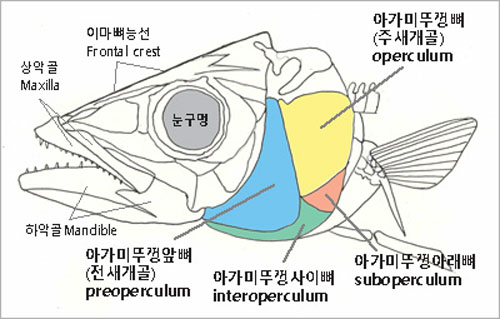 Illustrated by Kim In Young. |
※위의 한국말 용어는 대부분 필자가 임의로 번역해 사용한 것이다. ※사전 상으로는 operculum의 복수가 opercula이며 opercular는 형용사이다. 그러나 전문 글에서 실제 사용된 예를 보면 operculum, opercula, opercular, opercule가 뒤죽박죽 혼용되고 있다. |
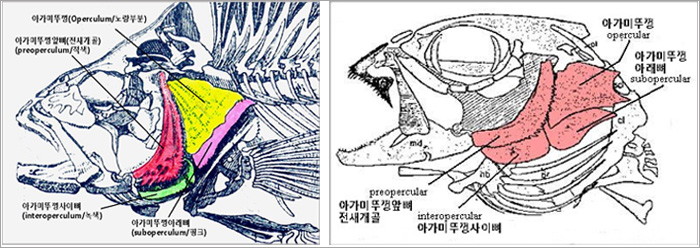 아가미뚜껑결합부의 4가지 구성 뼈 해부도. 좌우 그림 모두 같은 내용이 저자에 따라 다르게 표현된 것임. Left/ Author/Hubert Ludwig(1891). Right/http://palaeos.com/vertebrates/bones/dermal/opercular.htmlg |
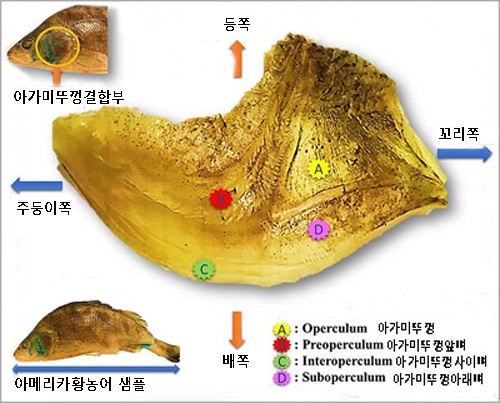 사진으로 본 아가미뚜껑결합부 구조. 아메리카 황농어(아메리카 황농어(American yellow perch; Perca flavescens)의 예이다. Author/Liz0618. Wikipedia. |
| 3. 새조골(鳃絛骨). Branchiostegal ray. |
 새조골(鳃絛骨). Branchiostegal ray. 그림의 모델 물고기; the species of the illustration/Esociformes, Esocidae(Pikes), Muskellunge(Esox masquinongy). Illustrated by Kim In Young. ※ 새조골(鳃絛骨)의 뜻; 아가미 뚜껑 가장 아래쪽에 있는 여러 개의 길고 가느다란 뼈들이며 커브가 틀어져 있고 끝이 뾰족한 것들도 자주 있다. 아가미 막을 지탱해 주는 역할을 한다. 새조골의 수는 종 구분의 중요한 지표가 된다. ※ Definition of branchiostegal rays/Series of long, curved bony rays that support the branchiostegal(gill) membrane behind the lower jaw. |
4. 아가미 활(궁)의 구조 Structure of gill arch 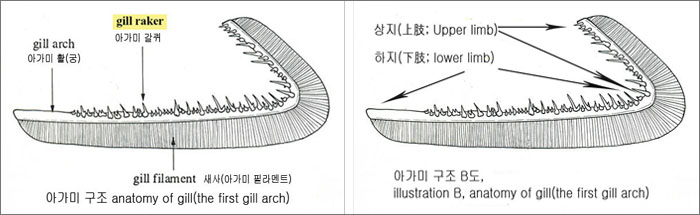 Derived work by Kim In Young |
 눈다랑어의 좌측 제1아가미궁 사진. 1st left gill arch of Bigeye tuna(Thunnus obesus). Author/Wibowo Djatmiko |
|
|
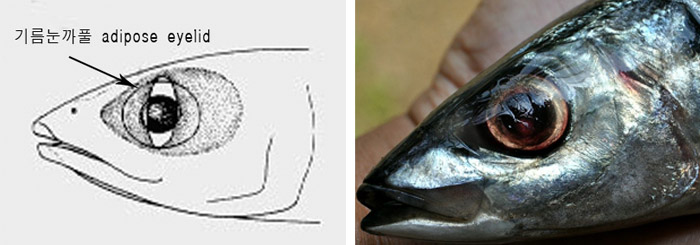 Left/Derived from FAO. Right/Author/Wibowo Djatmiko (Wie146) 5.기름눈까풀 Adipose eyelid An adipose eyelid is a transparent eyelid found in fish, that covers some or all of the eye. They are most commonly found on deep sea(benthic) fish, but can also be seen on non-benthic fish. Some fish that this feature is found on include: milkfish, herring-like isospondyls, jacks, mullets, and mackerel. Though the true purpose of these bodily structures is not known, it is generally accepted that the eyelids play some role in affecting the vision of the fish or otherwise serving to protect the fish. There are four proposed theories; increasing the fish's ability to focus; providing the capability of seeing polarized light; block out ultraviolet light; physical barrier against foreign objects. |
|
6. 인두치와 인두턱. Pharyngeal teeth and Pharyngeal jaws 인두치(咽頭齒). Pharyngeal teeth 중국 서커(Chinese sucker; Myxocyprinus asiaticus/Family Catostomidae)는 인두치가 1열이며 빗살 구조로 생겼다. 검정우럭과(Centrarchidae)의 붉은귀우럭(redear sunfish; Lepomis microlophus)의 인두치는 두꺼우며 인두치 판이 움직이는 구조이다. 먹이의 딱딱한 껍질을 분쇄시킨다. 곰치(family Muraenidae)는 인두 턱(pharyngeal jaws)에 인두치가 나 있다. 유령칼고기(ghost knifefish; Sternarchogiton nattereri; family Apteronotidae)는 인두치의 판이 위와 아래에 있고 각각 9-11개와 7-9개의 인두치가 있다. 농어목의 키클리드과(Family Cichlidae) 물고기들도 아래턱 이빨을 인두 하부 뼈로 확장시킨 인두치를 갖고 있으며 이것으로 먹이를 분쇄시킨다. 바다 지렁이의 어떤 종(새예동물; 鰓曳動物;Priapulida)도 입에 인두가 뒤집어진 상태로 노출되어 있는데 여기기 인두치가 있다. Pharyngeal teeth The Chinese high fin banded shark(Myxocyprinus asiaticus)(family Catostomidae) has a single row of pharyngeal teeth with comb-like arrangements. The redear sunfish(family Centrarchidae) has thick pharyngeal teeth composed of hard, movable plates, which it uses to crush the exoskeletons of prey. The pharyngeal jaws of the moray eel (family Muraenidae) possess their own set of teeth. The dentary of the ghost knifefish species Sternarchogiton nattereri (family Apteronotidae) has upper and lower pharyngeal tooth plates bearing 9-11 and 7-9 teeth, respectively. The mouth cone ("everted pharynx") of a possible new species of Meiopriapulus, a marine worm in the Priapulida, bears pharyngeal teeth. The lower pharyngeal bones of cichlids also carry specialized teeth which augment their normal mandibular teeth in the breakdown of food. |
 Left/잉어의 인두치. pharyngeal teeth of Common carp(Cyprinus carpio). Author/MAKY.OREL Right/금붕어의 인두치. Pharyngeal teeth of a goldfish. Author/BiotopAG |
 Left/민어과(family Sciaenidae) 레드 드럼(Red drum/Sciaenops ocellatus)의 아가미 활 구조와 인두치 도해. Illustration of Section showing gill arches and pharyngeal teeth of the Red drum(Sciaenops ocellatus; family Sciaenidae). Date/1910. Author/Roy W. Miner Right/검은잉어(잉어과의 눈불개아과)의 인두치. Illustrated pharyngeal teeth of Black Carp. Source/archive.usgs.gov |
 Left/스티프헤드 패롯피시(파랑비늘돔과) 인두치의 위쪽(등쪽) 부분 도해. Illustrated upper pharyngeal teeth of a Parrot-fish(Steephead parrotfish; Chlorurus strongylocephalus). Author/David Starr Jordan(1851–1931) Right/스티프헤드 패롯피시(파랑비늘돔과) 인두치의 아래쪽 부분(목구멍의 하부) 도해. Illustrated lower pharyngeal teeth of a Parrot-fish(Steephead parrotfish; Chlorurus strongylocephalus). Author/David Starr Jordan(1851–1931) |
|
인두턱. Pharyngeal jaws
인두턱은 입 안쪽 목구멍이나 인두에 있는 또 한 벌의 턱을 말한다. 물론 이빨도 나있다. 정상적인 입 턱과 다르며 입 턱이 그랬듯이 아가미 활이 변형되어 생긴 것으로 추정된다. 대부분의 물고기들은 인두턱을 가지고 있지 아니하다. 인두턱을 가진 물고기로는 곰치(Moray eels; 뱀장어목 곰치고)와 틸라피아((Tilapia; 농어목 키클리드과)가 유명하다. 특히 곰치의 인두턱은 움직이는 범위가 매우 크다. 곰치는 먹이를 통째로 삼키는 다른 물고기들처럼 입을 갑자기 크게 벌려 입 안에 저 압력 상태를 만들어 먹이를 빨아들이지 못하기 그 대안으로 발달시킨 기능인 것으로 보인다. 비좁은 틈바구니에 살기 때문일 수 있다. 곰치는 먼저 날카로운 이빨이 있는 앞쪽의 입 턱으로 먹이를 잡으면 즉시 뒤에 있는 인두 턱이 튀어나와 먹이를 다시 잡은 다음 식도로 끌어들여 삼킨다. 틸라피아(tilapia)의 인두턱은 매우 특화된 기능을 가진 것으로 유명하며 이 기능 때문에 종들이 다양하게 잘 번식한 것으로 해석된다. 그러나 빅토리아 호수에서는 이 기능이 오히려 다른 포식 형 물고기들과의 경쟁에서 약점이 되는 것으로 연구되었다. 곰치의 인두턱이 발견된 것은 오래되지 않은 일로 2007년캘리포니아, 데이비스 대학(UC Davis scientists) 과학자들에 의해서였다. 이로부터 28년 전인 1979년에 개봉된 헐리우드 영화 에일리언 시리즈 영화에서 외계의 괴물이 입 안에서 제2인 입인 인두 턱이 튀어나와 먹이를 잡아먹는 장면이 등장했다. 이 외계 동물은 제노모르프(xenomorph)라는 가상적인 학명도 붙여졌다. 그러나 실제 인두 턱은 이 영화가 나오기 전에 이미 다른 물고기들에서 발견되어 있었다. |
 영화 에일리언의 외계인 디자인. Alien design. creature in Alien franchise. Author/H.R Giger. |
|
Pharyngeal jaws Pharyngeal jaws are a "second set" of jaws contained within an animal's throat, or pharynx, distinct from the primary or oral jaws. They are believed to have originated as modified gill arches, in much the same way as oral jaws. Moray eels; Most fish species with pharyngeal teeth do not have extendable pharyngeal jaws. A particularly notable exception is the highly mobile pharyngeal jaw of the moray eels. These are possibly a response to their inability to swallow as other fishes do by creating a negative pressure in the mouth, perhaps induced by their restricted environmental niche(burrows). Instead, when the moray bites prey, it first bites normally with its oral jaws, capturing the prey. Immediately thereafter, the pharyngeal jaws are brought forward and bite down on the prey to grip it; they then retract, pulling the prey down the moray eel's gullet, allowing it to be swallowed. Cichlids; A notable example are fish from the family Cichlidae. Cichlid pharyngeal jaws have become very specialized in prey processing and may have helped cichlid fishes become one of the most diverse families of vertebrates. However, later studies based on Lake Victoria cichlids suggest that this trait may also become a handicap when competing with other predator species. Popular culture; The very mobile pharyngeal jaws of moray eels were discovered in 2007 by UC Davis scientists. Almost three decades before(1979), the fictional xenomorph creature from Alien series was first depicted showing a second set of jaws for attacking its prey. However, at that time pharyngeal jaws in other fishes were already known. |
 Left/곰치의 두개골과 인두턱. Skull and pharyngeal jaws of a Gymnothorax miliaris(spotted moray). Author/EvenBadScientistsCanObserve Right/ 곰치의 이중턱 구조의 작동을 표현한 도해. 정상적인 앞 쪽 턱이 먹이를 물면 뒤에 있는 인두턱이 튀어 나와 다시 문다. Moray eels have two sets of jaws: 1) the oral jaws that capture prey; and 2) the pharyngeal jaws (similar to the jaws of the monster in the movie, "Alien") that advance into the mouth and move prey from the oral jaws to the oesophagus for swallowing. Author/Zina Deretsky, National Science Foundation (after Rita Mehta, UC Davis); Ryan Wilson(pbroks13) |
|
7. 추성(追星). Nuptial tubercle(Breeding tubercle) 추성은 물고기의 머리, 몸, 또는 지느러미 살의 피부에 돋아나는 단단하고 작은 돌기이며 혹 같은 모양이거나 또는 스파이크 모양이다. 산란기에 암컷과 수컷이 서로 접촉하는데 도움을 주는 기능을 가진다. 추성은 비 케라틴(non-keratinized) 성분의 피부 세포(손톱, 머리카락, 동물의 발굽 성분)가 밀집되어 만들어진 것이 있고 외측에만 얇은 케라틴 성분의 막을 친 것이 있고 스파이크 모양인 것은 전체가 케라틴 세포로 구성되어 있다 추성은 산란 행동시에 암수가 서로 짝을 유지하게 하는 기능을 가졌고 둥지와 영역을 방어하는 무기 역할을 하며 암컷의 발정을 자극하는 기능을 하며 서로 종을 구분하는 표식이 되기도 한다. 머리에 큰 스파이크가 있으면 라이벌 수컷과 싸워 이기는데 유리하며 둥지의 알을 탐내는 적을 물리치는 데도 유용하다. 작은 혹 모양 추성들은 머리 부분이 아닌 몸 쪽에도 생길 수가 있는데 이 추성은 접촉 기관(contact organs)이라고도 부른다. 이 추성은 짝과의 접촉 상태를 감지하여 서로 떨어지지 않게 도와 준다. 추성이 크고 수가 많은 수컷일수록(피부가 거칠수록) 지배 수컷이 되는 경우가 많다. 그리고 지배 수컷일수록 짝짓기 행동이 더 활발하다. 그리하여 암컷은 이것으로 우수한 수컷을 선택하는 기준을 삼을 수 있다. |
 Left/연준모치(Eurasian minnow; Phoxinus phoxinus; 잉어과 황어아과) 수컷의 추성(追星, 머리 등부분에 여러 개가 나있고 아가미뚜껑 뒷부분에도 큰 추성이 나타나 있다. Nuptial tubercle(or Breeding tubercle, or Nuptial organ) of Eurasian minnow(Phoxinus phoxinus). Numerous small blue dots on head and a large blue blotch are all nuptial marks. Right/on preparing. |
 스톤롤러(stoneroller; Campostoma anomalum; 잉어과 황어아과)의 추성. 머리 위에서부터 몸의 등쪽에 집중적으로 나 있다. 복부에 부레를 감고 있는 창자를 나타내고 있다. Stone-roller, Campostoma anomalum (Rafinesque). Family Cyprinidon. Showing nuptial tubercles and intestines coiled about the air-bladder. Author/David Starr Jordan(1851–1931) |
Nuptial tubercle(Breeding tubercle) Breeding tubercle is hard bumps or small spikes that is usually small, raised, epidermal structures grown on regions of the head, body, or fin rays, primarily function to facilitate contact between two individuals for breeding. May consist of aggregations of non-keratinized epidermal cells, the same with a light, superficial keratinized cuticle, or with substantial number of fully keratinized cells that are organized to form a discrete, usually conical cap. Keratin, the same materials as hair, hooves, and fingernails. Breeding tubercles may function to maintain body contact between the sexes during spawning; in the defence of nests and territories; in the stimulation of females in courtship; and in some forms perhaps in sex and species recognition. Large head spikes may be useful for fighting off rival males. The menacing “horns” on the swollen heads should keep away nest predators. Smaller tubercles(sometimes called contact organs) can also appear elsewhere on a fish’s body, may be used as touch receptors to help locate a mate and keep them close. Males having many, large breeding tubercles(i.e. rough skin) were significantly more often dominant than those with smooth skin. The dominant male exhibits a more active courtship behaviour than its subordinate rival. As a result of the relationship between skin roughness and male dominance, breeding tubercles may be used by the females as a cue for choosing a high‐quality mate. Thus, breeding tubercles might offer a workable tool for examination of sexual selection among cyprinids. |
| text on preparation |
| text on preparation |
| text on preparation |


|
| Copyright ⓒ FISHILLUST.COM All rights reserved. All contents can not be used without permission of the copyright holder. |


 검색




 아가미 구조 anatomy of gill. 농어목 바리과의 한 종. Epinephelus coioides. Author/Rob and Stephanie Levy
