Oder Scorpaeniformes Family Scorpaenidae(Scorpionfishes or rockfishes)
Cheekspot scorpionfish
Scorpaenodes evides(Jordan & Thompson, 1914). Max;15cm TL
Scorpaenodes littoralis(Scientific species name before update)
Korean name/juhong-gam-peng(주홍감펭)
Japanese name/イソカサゴ(Isokasago)
Chinese name/浅海小鲉
D/spine 13, soft ray 8~9, A/spine 3, soft ray 5-6. P1/17~19. P2/spine 1, soft ray 5. Vert/24-27. LL/22-26. Gill raker/14-20.
Distribution; Indo-Pacific/southeastern coasts and Jeju Island of Korea, south of central Japan, Taiwan, South China Sea, Philippines, Papua New Guinea, west and eastern coasts of Australia, north of New Zealand, Tonga, Midway Islands. Hawaii, Sri Lanca, Arabian sea, Seychelles, South Africa.
General; Body oval in shape and flattened to the side. Head large and with numerous spines. Eyes are large and the eyeballs are as high as the back edge of the head. The interocular septum is recessed. Mouth is large and oblique. The lower jaw is slightly longer than the upper jaw, and the rear end of the mandible extending below the rear edge of the pupil. Both jaws and vomer with fine teeth, and the palatine bones have no teeth.
A pair of spines just in front of the nostrils. A pair of spines facing backwards in front of the upper edge of the eyes. At the center of the upper edge of the eye, there is a pair of ophthalmic spines facing upward, and two pairs of spines just behind them. There are 3 pairs of sharp spines on lower side in front of eye and 2 sharp spines below eye. In addition to the spines, there are several thin, long skin flaps on dorsum of the head. 1 skin flap on the posterior edge of the anterior nostril, and there is no flap or a few flaps on the side of the body. The almost entire gill cover, including the area behind and below the eye, and the head are covered with cycloid scales. The area between the base of the pectoral fin and the gill cover is covered with very small cycloid scales. The body is covered with large ctenoid scales. The lateral line is complete and begins obliquely, then becomes straight and ends at the base of the caudal fin.
The dorsal fin originates slightly in front of the upper edge corner of the gill cover. The last hard spine of dorsal fin is connected with the soft fin by membrane. The base of spine part is longer than the base of the soft ray part. The origin of the last soft ray of anal fin is in front of the origin of the last soft ray of the dorsal fin. The pectoral fin is large, rounded, and broad, with the rear end extending slightly past the anus and almost reaching the origin of the anal fin. The upper rays of the pectoral fin are branched, while the lower rays(slightly more than half of the total number of rays) are unbranched. The back of the caudal fin is slightly rounded
When alive, the body ground color is basically pale yellow-red, with several broad orang red blotches on the body going down inconspicuously from the upper side to the belly, and dark marks the width size of the eye are arranged roughly radially around the eyes on the head. This basic pattern arrangement changes the pigment density depending on the environment, creating various contrasts. The unpatterned areas become lighter or brighter white, while the red of the patterned areas becomes deeper or darker. The dark marks around the eyes can become black or merge together to form a broad black area on the head, while other bright areas can become even brighter and reach white.
In general species descriptions, it is said the most distinctive feature of the Cheekspot scorpionfish(Scorpaenodes evides) is the black blotch the size of eye on sub-opercle, but this is not accurate description. This blotch is a part of the black mark pattern system that radiates around the eyes, and unlike the black marks above, it tends to remain the longest after death. In the past, when ichthyologists had no choice but to study dead specimens, this last remaining black spot would have seemed to be a characteristic, hence the name “Cheekspot scorpionfish)” -(my guess).
Found in rocky areas along the coasts. Carnivorous. With weak poison in the spines of dorsal fin.
|


 주홍감펭 분포도. Distribution map of Cheekspot scorpionfish(Scorpaenodes evides). Ref/AquaMaps(2019, October). Cite date/January, 2025. Edited by Kim In Young(fishillust.com)

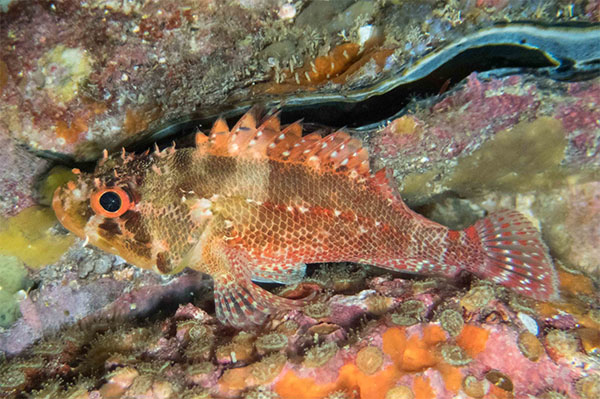 주홍감펭. Cheekspot scorpionfish(Scorpaenodes evides). Location/North Solitary Island, New South Wales, Australia. Author/Ian Shaw. Source/iNaturalist.org. (CC BY-NC)
 주홍감펭. Cheekspot scorpionfish(Scorpaenodes evides). at Northwest Solitary Island, New South Wales. Author/Ian V. Shaw
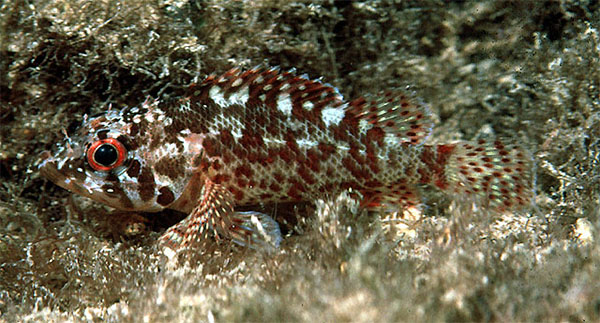

 주홍감펭. Cheekspot scorpionfish(Scorpaenodes evides). Author/Izuzuki
 주홍감펭. Cheekspot scorpionfish(Scorpaenodes evides). at Fly Point, Port Stephens, New South Wales, Author/Richard Ling
 주홍감펭. Cheekspot scorpionfish(Scorpaenodes evides). Location/Port Stephens, New South Wales, Australia. Author/Erik Schlogl. (CC BY-NC)
 주홍감펭. Cheekspot scorpionfish(Scorpaenodes evides). Location/Sutherland Shire - East, New South Wales, Australia. Author/Nigel Marsh. (CC BY-NC)
 한국 바다에서 잡힌 주홍감펭. 잡힌 후 시간이 많이 지나지 안은 개체. 위치 설명 없음.
 주홍감펭. 보존 개체. Preserved specimen of Cheekspot scorpionfish(Scorpaenodes evides). 10.5 cm TL. Locality/Oman, Eagles' Retreat. Date:/1990. Author/Randall's tank photos. (CC BY-NC)
 주홍감펭. 보존 개체. Preserved specimen of Cheekspot scorpionfish(Scorpaenodes evides). 10.5 cm TL. Locality/Marquesas Islands, French Polynesia, 2008. Author/Williams, Jeffrey T. (CC BY-NC)




 검색
