
사이트 로그인
사이트 로그인
|
분류계통/경골상강→조기강→쏨뱅이목→볼락과→장문볼락 Copyright by Kim In Young. 김인영 그림
|
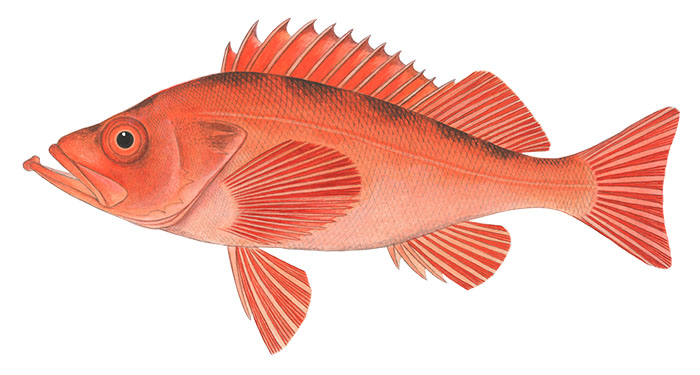 |
| 장문볼락 기본 모습. Lateral view of Pacific Ocean perch(Sebastes alutus) |
쏨뱅이목 볼락과 분포; 북태평양/한국의 동해(추정), 일본 북부에서부터 베링해의 나바린 곶(Cape Navarin)-오호츠크해 제외-, 알류산 열도, 알래스카 반도. 미국 캘리포니아주 라졸라까지(샌디에이고)까지. [한국 시장의 장문볼락은 어떤 종인가?]. 우리나라 홈쇼핑 시장에 장문볼락 또는 적어(赤魚; 빨간고기; Redfish)라는 이름의 생선을 판매하고 있는 업체가 많이 발견된다. 글자로만 보면Pacific Ocean perch(Sebastes alutus)를 의미한다. 그러나 물고기의 학명을 밝힌 업체가 전혀 없어서 진짜 장문볼락(Sebastes alutus)인지 아닌지 알 수가 없다. 쇼핑 몰들의 원산지를 확인해 보면 거의 모두 포르투갈, 스페인, 아이슬란드로 모두 대서양산이었다. 따라서 한국에서 판매되고 있는 장문볼락은 북태평양에서 나오는 한국 종은 아니라는 것이다. 그렇다고 해서 수입산이 맛이 없다는 것은 아니며 이 종들도 맛있는 생선으로 널리 알려져 있다. 대서양산이 값이 저렴해서 수입되고 있을 것이다. 대서양에도 장문볼락과 속명(Sebastes)이 같은 여러 종의 볼락이 있으며 공통적으로Redfish라는 이름을 공유한다. 포르투갈에서 많이 잡히는 종은 대서양큰붉은볼락(Deepwater Redfish; 학명/Sebastes mentella)인 것으로 보인다. 장문볼락 이름의 유래/장문볼락의 장문은 한자어로 長吻이다. 長(장)은 긴 장자이고 吻(문)은 ‘입술’ 또는 ‘입 끝’의 뜻인데 여기서는 ‘입 끝’이다. 즉 입 끝에 길쭉한 돌기가 있다는 의미이다. 입이 길어서 장문볼락이라고 설명한 경우가 있는데 입이 긴 볼락은 다른 종들도 있으므로 장문볼락은 아래턱 끝에 긴 돌출부를 나타낸 이름으로 해석하는 것이 맞는다고 본다. 또는 이 돌기 때문에 입이 더 길어 보일 수도 있겠다. 몸은 옆으로 납작하며 몸 높이가 높다. 머리의 등쪽 앞 부분에 날카로운 1쌍의 가시, 그리고 머리 뒤쪽에 잘 발달한 1쌍의 가시가 있다. 눈 뒤 가장자리의 바로 위쪽에 2쌍의 가시, 그리고 눈 아래 가장자리에는 가시가 없다. 눈은 매우 크다, 주둥이가 길다. 입이 크고 비스듬하게 놓여 있다. [장문볼락 특유의 특징]. 장문볼락의 가장 특이한 특징은 아래턱의 왼쪽과 오른쪽이 입 앞 끝에서 서로 만나 봉합된 부분에 있다. 이 봉합부가 아래턱의 위와 아래로 크게 돌출되어 있고 두께는 매우 얇다. 측면에서 보면 이 돌출부가45도 각도로 비스듬하게 아래턱 끝에 붙어 있다. 볼락 종류에는 아래턱 끝에 돌기가 있는 것들이 많지만 대개 아래턱 끝에서 아래 방향으로만 있고 크지는 않다. Sebastes alutus와 비슷하게 길쭉한 턱 돌기를 가진 종이 하나 더 있는데 Redstripe rockfish(Sebastes proriger; 북태평양산)이다. 그러나 돌기가 장문볼락보다는 약간 작아 보인다.
위턱에는 옆면을 따라 3∼4줄의 작은 이빨이 있고 아래턱에는 1줄의 이빨이 있다. 전새개골(preopercle:)의 뒤 가장자리에는 5개의 날카로운 가시가 있으며, 주새개골(opercular)에는 2개의 가시가 있다. 등지느러미는 극조부와 연조부가 연결되어 있으며 극조부의 뒤는 낮고 연조부는 높아서 두 부분의 차이가 잘 드러난다. 가슴지느러미는 길며 뒤 끝이 항문에 달한다. 가슴지느러미는 상반부의 가장자리가 둥글다. 가슴지느러미의 맨 위 첫 연조는 불분지 연조이며 그 다음 8 연조는 분지 연조이며 그 아래 9 연조는 불분지 연조이다. 뒷지느러미의 가시는 3번째 가시가 가장 길다. 꼬리지느러미의 뒤 가장자리는 중간에서 안으로 약간 패여서 위와 아래에 대칭적인 엽을 만든다. 장문볼락의 유생은 다른 볼락 유생과 유사한 발달 특징을 가지고 있어 식별 및 구분이 어렵다. 그러나 유전학적 기법을 이용하면 유생과 치어를 구별할 수 있다. 치어는 나이가 좀 들면 성어와 동일한 체색을 보이고 위턱보다 아래턱이 더 길어지기 때문에 이 현상을 가지고 어느 정도 식별이 가능하다. 성어의 몸색은 진한 적색에서부터 가벼운 적색까지 여러 기지로 나타나며 등쪽에 3∼4 개의 어두운 반점 무늬가 있다. 또한 색이 등쪽은 진하고 배쪽으로 연해지는 특징이 있다. 지느러미들도 모두 적색이다. 주새개골 위쪽이 약간 검은 색일 수 있다. 볼락 종류(양볼락과와 볼락과)는 거의 모두 가시에 독이 있고 이것을 사냥이나 자기 방어에 이용하지만 장문볼락은 가시에 독이 없다. 군집 생활을 하며, 외해에서 주로 서식한다. 성어는 수심 150–420의 대륙붕 외곽과 경사면에서 주로 발견된다. 여름에는 150~300m로 얕은 수심으로 올라온다. 가을에는 300~420m 수심으로 깊게 이동하여 다음 해 5월까지 머무른다. 이 계절 이동은 여름에는 섭이를 위하여 겨울에는 산란을 위한 것으로 보인다. 장문볼락은 일반적으로 바닥 가까이 사는 반 저서성(semi-demersal)이지만 분포 상태를 보면 때에 따라 회유성을 나타내는 일도 많다. 야간에는 수면 쪽으로 떠오르는 것이 관찰되는데 이는 야간에 위쪽에 나타나는 플랑크톤 난바다곤쟁이(euphausiid)를 먹기 위해서이다. 장볼락은 다른 볼락 종류들에 비해서 더 많이 알려져 있는 종이지만 생태에 관해서는 잘 알려져 있지 못하다. 난태생(卵胎生/ovoviviparous/어미의 몸 속에서 알의 부화가 일어나며 일정 기간 어미의 영양을 공급 받다가 새끼로 출산됨))이다. 수태는 가을에 있으며 수컷의 정자는 암컷의 몸 속에 보관되어 있다가 약 2개월 뒤에 수정된다. 분만은 4월~5월 사이에 일어난다. 어린 치자어는 해류를 따라 부유생활을 하는 것으로 생각된다. 1년 이내에 저서형으로 바뀐다. 작은 새끼들은 연안의 바위가 많고 숨을 곳이 많은 지형으로 내려가 약 3년을 살다가 대륙붕의 외해 쪽 깊은 수심으로 이동하며 성장하면서 점점 더 깊은 수심으로 이동하다가 마지막에는 대륙붕 경사면으로 내려가 성어로 성장한다. 장문볼락은 주로 플랑크톤을 먹고 산다. 좀 큰 유어와 성어는 주로 바다난곤쟁이류를 먹으며 요각류, 단각류, 갑각류 새우등을 약간 곁들여 먹는다. 알류샨 열도에서는 바다난곤쟁이류를 놓고 명태와 먹이 경쟁을 벌인다. 장문볼락을 잡아먹는 포식자는 은대구, 태평양 가자미, 향유고래 등이다. 유어는 바닷새, 다른 볼락류, 연어, 쥐노래미류, 기타 큰 저서 물고기들이 잡아먹는다. 장문볼락은 성장 속도가 매우 느린 물고기이다. 성숙도가 50%에 이른 어는 정도 나이든 개체들은 10.5년 산 것들이다. 아주 늙은 개체의 최대 나이는 알래스카의 경우 98세였다. 상업적으로 어획 되는 개체들 중 50%는 나이가 7~8세로 추정되었다. 북태평양 수역의 매우 중요한 상업 어종이며 저층 트롤어업에 의하여 주로 어획된다. 현재 남획되어 자원이 감소하고 있다. |
Oder Scorpaeniformes Family Sebastidae(Rockfishes, rockcods and thornyheads). Distribution; North Pacific/Eastern coasts(assumption) of Korea, Honshu, Japan to Cape Navarin in the Bering Sea(but not in the Sea of Okhotsk) and along the Aleutians from Stalemate Bank and Bowers Bank to the Alaska Peninsula. and La Jolla, California. [Issue; The “jang-mun-bol-la(장문볼락)” sold in the Korean market, what’s the species?] In home shopping market of Korea, there are many companies that sell fish called Jang-mun-bol-lak or Redfish(赤魚). If you look at the letters alone, it means Pacific Ocean perch(Sebastes alutus). However, since no company has revealed the scientific name of the fish, it is impossible to know whether it is a real Sebastes alutus or not. When check the origin of import, almost all are from the Atlantic Ocean; Portugal, Spain, Iceland and Canada. Therefore, the Jang-mun-bol-lak or Redfish sold in Korea is not Korean species that comes from the North Pacific Ocean. However, that does not mean that the imported ones are not tasty, as these species are also widely known as delicious fish. The Atlantic ones are probably imported because they are cheap. In Atlantic Ocean, There are also several species of genus Sebastes and they all share the name Redfish. The species that is caught a lot in Portugal seems to be the Atlantic redfish(Deepwater Redfish; scientific name/Sebastes mentella). [Etmology of the Korean name Jang-mun-bol-lak(장문볼락)] can be changed into English as Jang-mun rock fish. Jang-mun is written’長吻’ in Chinese character. 長(Jang) means the “long”, (mun) means the tip of mouth. In other words, the name suggests a long protrusion at the tip of the mouth. Some other authors say this fish’s Korean name derived from the long mouth but there are multiple other rock fishes with long mouths. I think it is correct to interpret the Korean name refers to the long protrusion at the tip of lower jaw. Or, the mouth may appear longer because of this protrusion. The body is laterally flattened and the body depth is deep. There is a pair of sharp spines on the front dorsal side of the head, and a pair of well-developed spines on the back of the head. Two pairs of spines just above the rear edge of the eye, and no spines on the lower edge of the eye. The eyes are very large. The snout is long. The mouth is large and set slanted. [Unique feature of the Pacific Ocean perch]. The most unique feature of the Pacific Ocean perch is the suture where the left and right sides of the lower jaw meet at the front end of the mouth. This suture protrudes distinctively above and below the lower jaw and is very thin. When viewed from the side, this protrusion is attached to the end of the lower jaw at a 45-degree angle. Many rockfish species have a protrusion at the tip of the lower jaw, but it is usually only downward from the end of the lower jaw and is small or not large. Another species with an elongated jaw protrusion similar to Sebastes alutus is the Redstripe Rockfish(Sebastes proriger). However, the protrusion appears to be slightly smaller than that of the Pacific Ocean perch(from North Pacific).
The upper jaw has 3-4 rows of small teeth along the side, and the lower jaw has 1 row of teeth. 5 sharp spines on the back edge of the preopercle, and 2 spines on the opercular. The spinous and soft rayed part of dorsal fin is connected. The posterior spinous part is low while the soft rayed part high, clearly showing the difference between the two parts. The pectoral fin is long and the rear end reaches the anus. The upper margin of the pectoral fin rounded. The uppermost 1 ray of pectoral fin is unbranched, the next eight are branched, and nine of the lower rays are unbranched. The posterior margin of the caudal fin is slightly indent in the middle, forming symmetrical lobes above and below. The larvae of Pacific ocean perch are challenging to identify and distinguish from other rockfish larvae because they all contain similar developmental characteristics. However, genetic techniques can identify larvae and juveniles. Older juveniles were relatively less challenging to locate as they displayed identical coloration to the adults and showed a protrusible lower jaw that extended further out than the upper jaw. The body color of the adult fish varies from deep red to light red, and wih 3 to 4 dark blotches on upper dorsum. It also has the characteristic of deep coloration dorsally and lighter toward the belly. The fins are also all red. The upper part of gill cover may be slightly blackish. All the fishes within this family(Scorpaenidae and Sebastidae) contain venom in their spines, which are used for hunting and self-defense. However, the spines on the Pacific ocean perch do not have poison. They live in groups. Adults are found primarily offshore on the outer continental shelf and the upper continental slope in depths 150–420m. In the summer, adults inhabit shallower depths, especially those between 150 and 300 m. In the fall, the fish apparently migrate farther offshore to depths of ~300–420 m. They reside in these deeper depths until about May, when they return to their shallower summer distribution. This seasonal pattern is probably related to summer feeding and winter spawning. Pacific ocean perch are generally considered to be semi-demersal but there can at times be a significant pelagic component to their distribution. Pacific ocean perch often move off-bottom at night to feed, apparently following diel euphausiid migrations. There is much uncertainty about the life history of Pacific ocean perch, although generally more is known than for other rockfish species. The species appears to be ovoviviparous(the eggs develop internally and receive at least some nourishment from the mother), with internal fertilization and the release of live young. Insemination occurs in the fall, and sperm are retained within the female until fertilization takes place ~2 months later. The eggs hatch internally, and parturition(release of larvae) occurs in April–May. Pacific ocean perch larvae are thought to be pelagic and drift with the current. Transformation to a demersal existence may take place within the first year. Small juveniles probably reside inshore in very rocky, high relief areas, and by age 3 begin to migrate to deeper offshore waters of the continental shelf. As they grow, they continue to migrate deeper, eventually reaching the continental slope, where they attain adulthood. Pacific ocean perch are mostly planktivorous. Larger juveniles and adults fed primarily on euphausiids, and to a lesser degree, copepods, amphipods and mysids. In the Aleutian Islands, it has been suggested that Pacific ocean perch and walleye pollock compete for the same euphausiid prey. Predators of adult Pacific ocean perch are likely sablefish, Pacific halibut, and sperm whales. Juveniles are consumed by seabirds, other rockfish, salmon, lingcod, and other large demersal fish. Pacific ocean perch is a very slow growing species, a relatively old age at 50% maturity is 10.5 years, and a very old maximum age of 98 years in Alaska. Age at 50% recruitment to the commercial fishery has been estimated to be between 7 and 8 years in the Gulf of Alaska. It is a very important commercial fish in the North Pacific waters, mainly caught by low-level trawlers. Currently, it is overfished and the resource is decreasing. |
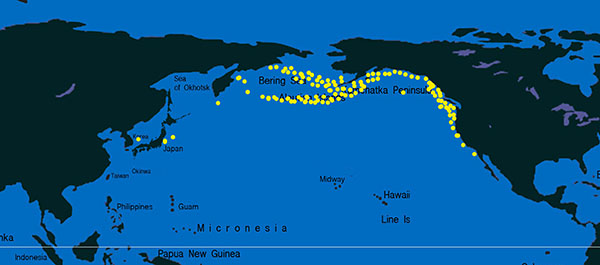
| 장문볼락 분포도. Pacific Ocean perch(Sebastes alutus). Derived work. Author/fishillust.com |
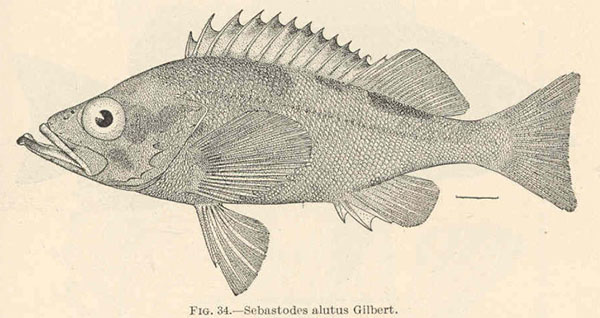 장문볼락 묘사도. Illustratinon of Pacific Ocean perch(Sebastes alutus). Date/1907. Author/Barton Warren Evermann(1853–1932). (CC BY-NC) |
 장문볼락의 신선한 상태의 죽은 개체 사진. Photo of dead specimen in fresh state. Pacific Ocean perch(Sebastes alutus). Author/NOAA. (CC BY-NC) |
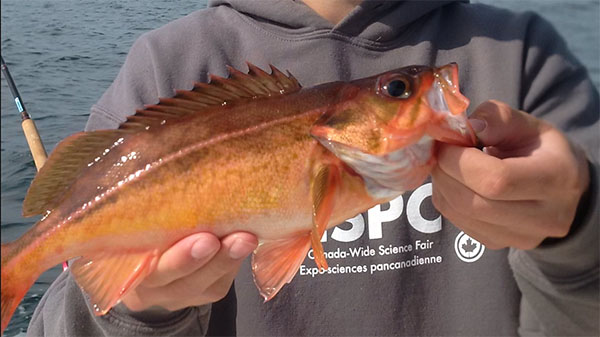
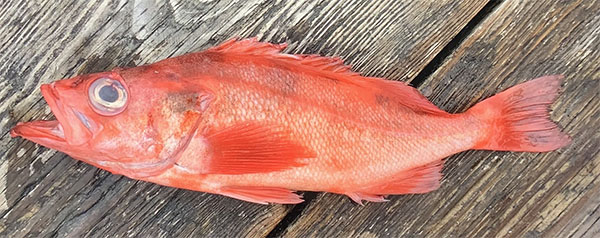 장문볼락. Pacific Ocean perch(Sebastes alutus). Location/Sitka 30 Mile Circle, Alaska. Author/LJBRION. (CC BY-NC) |
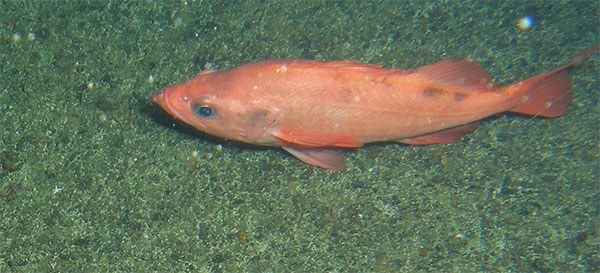 대심도 해저 바닥의 장문볼락. ROV 촬영. Pacific Ocean perchSebastes alutus) on the deep sea floor. ROV photo. Location/Coastal British Columbia, Canada. Creator/Jackson W.F. Chu. Original photo flipped. (CC BY-NC) |
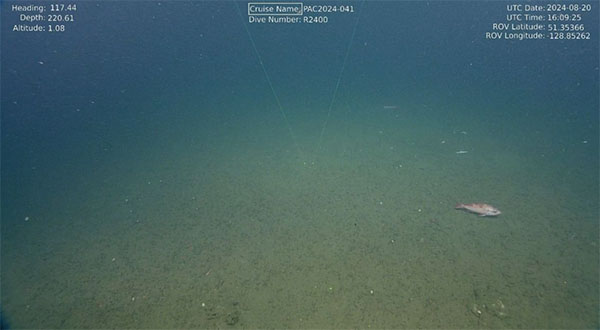 수심 220m에서 ROV로 촬영된 장문볼락. 해양조사선 활동 중의 사진. A Pacific Ocean perch photographed by an ROV at a depth of 220 m. location/Canada. date; 2024.08.20. Author/dandumont. This image was captured from an ROV survey to a Glass Sponge Reef MPA in Hecate Strait, BC in August 2024. Expedition PAC2024-041. (CC BY-NC) |
 장문볼락. 성어(34 cm)의 수중 사진. Photo of adult Pacific ocean perch(~34 cm) taken from the submarine Delta, on Albatross Bank in the Gulf of Alaska, near Kodiak Island. Author/ NOAA. (CC BY-NC) |
 장문볼락의 입 속. Looking inside mouth of Pacific Ocean perch(Sebastes alutus). Author/LJBRION. (CC BY-NC) |
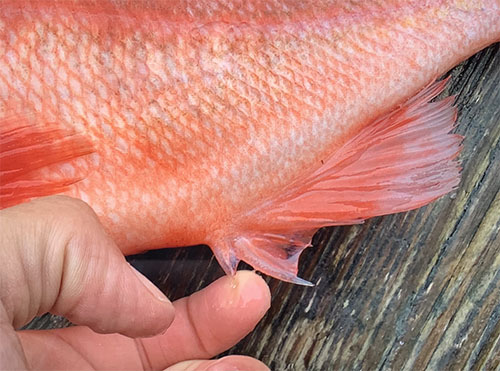 장문볼락의 뒷지느러미. Anal fin of Pacific Ocean perch(Sebastes alutus). Author/LJBRION. (CC BY-NC) |
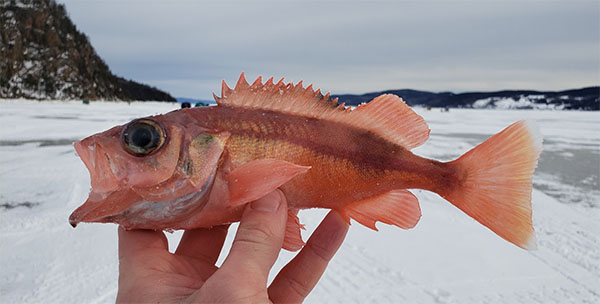 대서양큰붉은볼락(Deepwater Redfish; 학명/Sebastes mentella). 한국 생선 시장에서 많이 판매되고 있는 적어(赤魚)는 포르투갈에서 많이 잡히는 대서양큰붉은볼락인 것으로 보인다. Atlantic Deepwater Redfish(Sebastes mentella). The redfish sold in large quantities in Korean fish markets appears to be the Atlantic Deepwater Redfish, which is caught in large quantities in Portugal. Locaton/Québec, Canada. Author/Bradley Rasmussen. (CC BY-NC) |
 외형이 장문볼락과 매우 유사하다고 알려진 붉은줄볼락(학명; Sebastes proriger). 북태평양산으로 장문볼락의 분포지와 겹치는 부분이 많다. The Redstripe Rockfish(Sebastes proriger) is known to be very similar in appearance to the Pacific Ocean perch(Sebastes alutus). It is native to the North Pacific and has a large overlapping distribution area with the Pacific Ocean perch. Location/British Columbia, Canda. Author/Jacob Bowman. (CC BY-NC) |
 저인망으로 잡은 장문볼락. Pacific Ocean perch(Sebastes alutus). Caught during trawls. Author/Kathy Hough for NOAA |
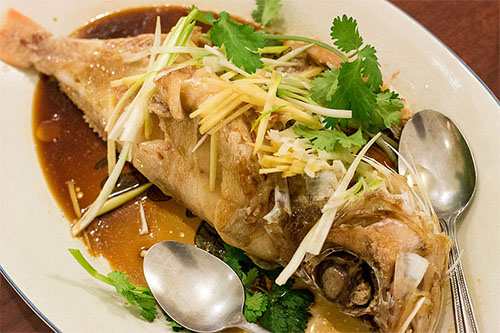 볼락류인 적어(red rockfish; 종명 미상)의 중국식 찜 요리. A Chinese steamed dish of red rockfish (species unknown). Location/Somerville, Massachusetts, United States. Author/Tim Sackton. (CC BY-NC) |
| text on preparation |


|
| Copyright ⓒ FISHILLUST.COM All rights reserved. All contents can not be used without permission of the copyright holder. |


 검색
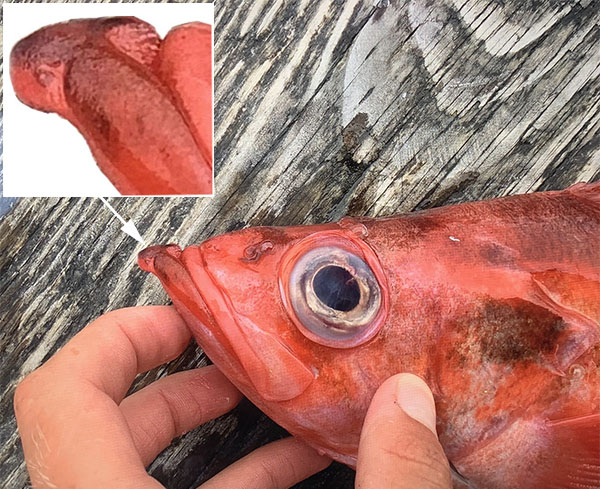 장문볼락의 머리. 아래턱의 좌우가 입 끝에서 서로 봉합된 부분이 길쭉하고 날카롭고 돌출되어 있다. Author/LJBRION. (CC BY-NC). Remake by Kim in-young.
