
사이트 로그인
사이트 로그인
|
분류계통/경골상강→조기강→쏨뱅이목→볼락과→눌치볼락 Copyright by Kim In Young. 김인영 그림
|
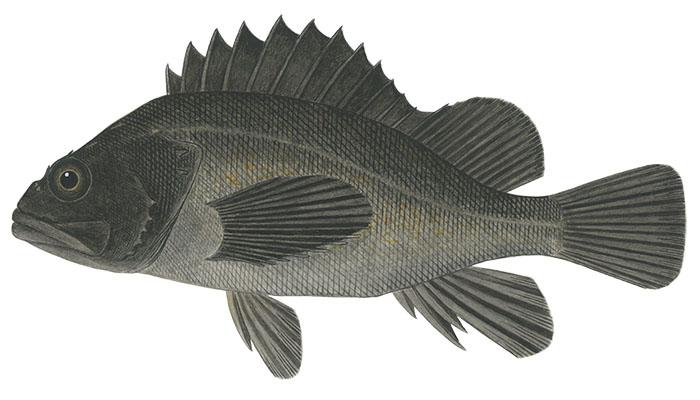 |
눌치볼락 기본 모습. Lateral view of Korean fox jacopever(Sebastes ijimae). ★This species name and its scientific classification are no longer scientifically recognized. |
쏨뱅이목 볼락과 Oder Scorpaeniformes Family Family Sebastidae(Rockfishes, rockcods and thornyheads). 분포; 서북태평양/한국의 부산, 전남, 제주. 일본의 하코다테(홋카이도), 미야기현, 사가미만(도쿄 부근), 와카사만(돗토리현), 하마다(시마네현). 어류학계에는 일찍이 “누루시볼락 종 복합군(Sebastes vulpes complex)”이라는 과제가 있어왔다. 여기서 complex는 “종 복합군(species complex)”을 말하며 생물학 용어이다(복합체라고도 한다). 어떤 한 종의 물고기에 서로 매우 비슷하게 생겼지만 외형(주로 색상)이 약간 다른 복수의 물고기가 섞여 있는데 환경차이에서 나온 변이인지 유전자가 다른 종인지 분별이 안 되는 경우를 말한다. “누루시볼락 복합군”은 눌치볼락, 누루시볼락, 띠볼락 이들 3종이 서로 너무 비슷해서 서로 다른 종인지 아니면 동일 종인지 의심이 가는 현상을 말한다. 일본 어류학자, 3인(Nozomu Muto, Yoshiaki Kai, 및 Tetsuji Nakabo)은 “누루시볼락 복합군”을 규명하기 위한 유전자 분석 연구를 수행하여 2018년 5월 29일 논문을 발표하였다(출처; link.springer.com). 논문에 따르면 누루시볼락과 띠볼락(S. zonatus)은 독립된 별개의 종이며 눌치볼락(Sebastes ijimae)은 유전자가 누루시볼락과 동일하며 누루시볼락의 동종이명으로 처리해야 한다는 것이다(junior synonym-후행이명). 논문의 결과를 인용하여 기존 정보를 수정시키지 않은 소스들이 아직 많이 남아 있는 것으로 보인다. 예를 들어 2025년 5월 현재 한반도의 생물다양성(환경부 국립생물자원관) 어류 목록에 아직 등재되어 있다. 그러나 세계적 권위가 있고 수시로 수정을 하는 웹사이트 “Eschmeyer's Catalog of Fishes”는 논문의 결과를 인용하여 눌치볼락은 누루시볼락의 동종이명이라는 사실을 명기하고 있다(검색 날자/2025년 5월). 필자는 에시마이어 캐털로그에 따라 눌치볼락을 누루시볼락의 동종이명으로 정리하고자 한다. [한국명과 영명의 유래] 볼락 속(Genus Sebastes)의 한국명 중에 눌치볼락과 누르시볼락이 있는데 두 이름 모두 체색이 “누르스름한”, “누릇누릇한” 갈색을 띠는 특징에서 나온 이름인 것으로 추측된다고 한다. 한국명 볼락 속에는 영명으로 jacopever(자코페버)라고 부르는 3종이 있는데 눌치볼락(Sebastes ijimae)과 누르시볼락(Sebastes vulpes) 그리고 띠볼락(Sebastes zonatus)이다. 영명은 순서대로 각각 Korean fox jacopever, Fox jacopever, Bended jacopever이다. 이 3종은 아직 글로벌(global)한 영명이 없는 것으로 파악되는데 극소수 출처(권위가 별로 없는)에서 “jacopever(자코페버)”를 사용하고 있다. 필자도 마땅한 다른 영명을 찾지 못해서 “jacopever”를 사용하였으나 합리적이라고 생각하지는 않는다. "jacopever"는 남아프리카 지방에서 대서양에 사는 한 볼락 종을 호칭하는 이름이다. 따라서 서북태평양 종들인 한국의 볼락류에게 이 이름은 어울리지 않는다. 이 용어는 “아프리칸스어(Afrikaans word)”라고 하며 아프리카 원주민 언어는 아니며 네덜란드어에서 발달한 언어로 남아프리카공화국에서 사용되는 언어라고 한다. 네델란드어 Afrikaansch(meaning 'African')가 어원이다. 눌치볼락의 기존 설명들 종합. 몸과 머리는 측편되었고, 체고가 약간 높은 타원형이다. 머리는 크고, 눈 지름과 주둥이 길이는 거의 비슷하다. 두 눈 사이는 약간 오목하다. 양턱 중 위턱이 아래턱보다 약간 앞으로 나가 있거나 같다. 위턱 뒤 끝은 눈 뒤끝을 훨씬 지난다. 양턱과 서골, 구개골에 이빨이 있다. 뺨 아래쪽에 가시가 없다. 코 부분의 가시는 작고 흔적적이다. 전새개골 가장자리에 5개의 가시가 있고 주새개골 위쪽에 2개의 뼈 융기선이 있으며 그 끝은 짧은 가시로 끝난다. 눈 위 앞에 작고 뭉툭한 가시가 있다. 눈 위쪽에 약한 융기뼈가 있고 그 끝은 뭉툭한 가시이다. 등지느러미 기점은 아가미뚜껑 뒤 끝 보다 극조 약 3개 거리로 앞쪽에 있다. 등지느러미 마지막 극조는 바로 전 극조 길이와 비슷하다. 등지느러미 연조 길이는 극조 길이와 비슷하거나 극조 보다 약간 짧다. 등지느러미 연조부 가장자리는 둥글다. 등지느러미 연조부 시작점은 뒷지느러미 연조부 시작점보다 약간 앞에 있다. 뒷지느러미 기저부 뒤 끝은 등지느러미 연조 기저부의 뒤끝보다 약간 앞에 위치한다. 가슴지느러미는 몸통 중앙보다 약간 아래쪽에 위치하며 뒤 끝은 항문에 거의 이른다. 가슴지느러미의 맨 위쪽 1연조는 불분지 기조, 그 다음 7-8 연조는 분지 기조, 그 다음 8연조는 불분지 기조이다. 분지 기조들 사이에는 막의 패임이 없고 아래쪽 불분지 기조들 사이의 막은 패임이 있다. 배지느러미는 가슴지느러미보다 약간 뒤에서 시작되고 뒤는 항문에 이르지 못한다. 꼬리지느러미 뒤는 약간 둥근 절단형이다. 측선은 완전하며 앞부분은 약간 등쪽으로 치우쳐 있다. 주둥이와 위턱을 제외한 머리와 몸통에 빗비늘이 덮여 있다. 몸은 거의 전체가 검거나 흑회색이며 배쪽은 위쪽보다 약간 밝은 회흑색이다. 주둥이 부분이 더 검다. 몸에 얼룩 무늬들이 있으며 무늬의 가장자리는 경계선이 희미하다. 가슴지느러미 막이 검다. 누루시볼락과 비슷하나 머리와 배지느러미가 더 길다. 난태생이다. 수심 20~50m 연안의 암초 지역에 서식한다. (알려진 정보가 부족한 종임) |
Oder Scorpaeniformes Family Family Sebastidae(Rockfishes, rockcods and thornyheads). Distribution; Northwest Pacific/Busan, Jeonnam, and Jeju in Korea. Hakodate(Hokkaido), Miyagi Prefecture, Sagami Bay(Tokyo area, Wakasa Bay(Tottori Prefecture), Hamada(Shimane Prefecture). In the ichthyology community, there has long been a problem called the “Sebastes vulpes complex.” Here, complex refers to “species complex” and is a biological term. It refers to a case where multiple fish that look very similar but have slightly different appearances (mainly colors) are mixed in a single species name, and it is difficult to tell whether they are simply a variation resulting from environmental difference or genetically different species. “Sebastes vulpes complex” refers to the phenomenon in which the three species Sebastes ijimae, Sebastes vulpes, and Sebastes zonatus are so similar that it is questionable whether they are different species or the same species. Three Japanese ichthyologists(Nozomu Muto, Yoshiaki Kai, and Tetsuji Nakabo) conducted a genetic analysis study to clarify the “Sebastes vulpes complex” and published the paper on May 29, 2018(source: link.springer.com). According to the paper, Sebastes vulpes, and Sebastes zonatus are independent species, and Sebastes ijimae is genetically identical to Sebastes vulpes and should be treated as a junior synonym of Sebastes vulpes. It appears that there are still many sources that have not corrected existing information by citing the results of the paper. For example, as of May 2025, it is still listed on the list of fish of the Korean Peninsula Biodiversity(National Institute of Biological Resources, Ministry of Environment). However, the world-renowned and frequently updating website “Eschmeyer's Catalog of Fishes” cited the results of the paper and stated that the Sebastes ijimae is a synonym of the Sebastes vulpes(search date/May 2025). According to the Eschmeyer's Catalog, the author would like to classify the Sebastes ijimae as a synonym of the Sebastes vulpes, which is simply a color variation. [Origin of Korean and English names] Among the Korean names for the genus Sebastes, there are “nul-chi-bolak(눌치볼락)” and “nur-si-bolak(누르시볼락),” and it is presumed that both names came from the characteristics of their yellowish gray body colors. There are three species in the genus Sebastes that are called jacopever in English: Sebastes ijimae, Sebastes vulpes, and Sebastes zonatus. They are “Korean fox jacopever“,“Fox jacopever“, and “Bended jacopever“, respectively. It is understood that these three species do not yet have global English name, and “jacopever” is used in very few sources(without much authority). I also used “jacopever” because I could not find another suitable English name, but still, I do not think it is reasonable. “jacopever” is the name used to refer to a species of rockfish that lives in the Atlantic Ocean in South Africa. Therefore, this name is not suitable for the Korean rockfishes, which is distributed in the Northwest Pacific. This term is said to be an Afrikaans word, and is not an indigenous African language, but a language developed from Dutch and used in South Africa. “Afrikaans” is derived from the Dutch word Afrikaansch(meaning ‘African’). Known texts about the Sebastes ijimae The body and head are laterally compressed, and the body is oval with slightly deep depth. The head is large. Eye diameter and snout length almost equal. The space between the eyes is slightly concave. The upper jaw is slightly forward of the lower jaw or is equal each other. The posterior end of the upper jaw extends far beyond the posterior end of the eye. Teeth on the jaws, palatine bone, and palatine bone. No spines on the lower cheek. The spines on the nose area are small and vestigial. 5 spines on the margin of the preopercle. 2 bony edges on the posterior upper margin of opercular, which end in short spines. A small, blunt spine in upper front of the eye. A weak bony ridge above the eye, which ends in a blunt spine. The origin of dorsal fin is about 3 spines in front of the posterior tip of the gill cover. The last spine of dorsal fin is about the same length as the previous one. The length of the soft ray of the dorsal fin is similar to or slightly shorter than the spine. The margin of the soft ray of the dorsal fin is rounded. The origin of the soft ray of the dorsal fin is slightly in front of the origin of the soft ray of the anal fin. The posterior end of anal fin base is slightly in front of the posterior end of the dorsal fin base. The pectoral fin is located slightly below the center of body, and its posterior end almost reaches the anus. The uppermost soft ray of the pectoral fin is unbranched, the next 7-8 soft rays are branched, and the next 8 soft rays are unbranched. There is no membrane notch between the branched rays, but the membrane between the lower unbranched rays is notched. The pelvic fin starts slightly behind the pectoral fin base and does not reach the anus. The caudal fin has a slightly rounded truncation at the posterior margin. The lateral line is complete and the front part is slightly shifted toward the dorsal side. The head and body, except the snout and upper jaw, are covered with ctenoid scales. The body is almost blackish or gray uniformly, with darker snout. Sometimes large vertical blotches on the body with indistinct margins. The membranes of pectoral fin is black. Similar to Sebastes vulpes, but has longer head and pelvic fins than Sebastes vulpes. It is an ovoviviparous species. It lives in coastal reef areas at depths of 20 to 50 m. Information deficient species. |
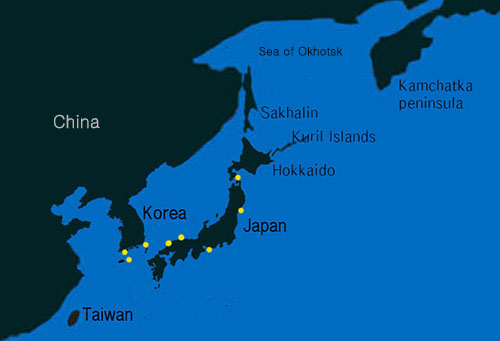 눌치볼락의 분포도. Distribution map of Korean fox jacopever(Sebastes ijimae). Author/Kim in-young(fishillust.com). |
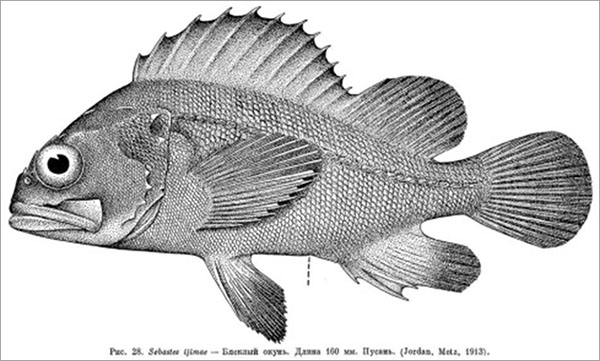 눌치볼락 묘사도. 눌치볼락이 누루시볼락의 동명이명임이 밝혀지기 전 자료임. Illustration of Korean fox jacopever(Sebastes ijimae). source/fishbiosystem.ru/. ※Data from before it was discovered that sebastes ijimae is a synonym of Sebastes vulpes. |
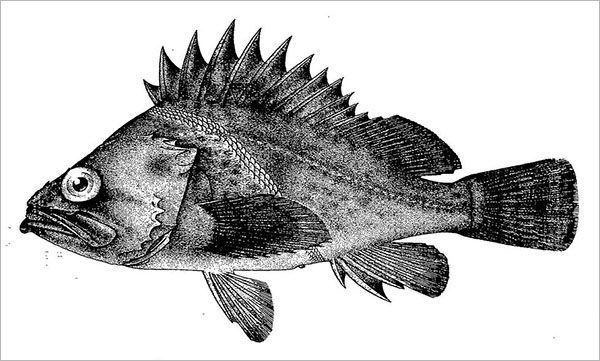 눌치볼락 묘사도. 눌치볼락이 누루시볼락의 동명이명임이 밝혀지기 전 자료임. Illustration of Korean fox jacopever(Sebastes ijimae). source/fishbiosystem.ru/. ※Data from before it was discovered that sebastes ijimae is a synonym of Sebastes vulpes. |
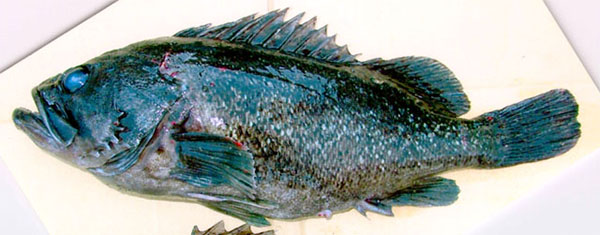 눌치볼락. 눌치볼락이 누루시볼락의 동명이명임이 밝혀지기 전 자료. Korean fox jacopever(Sebastes ijimae). 48cm TL. Location/Japan, Shizugawa, Miyagi. Remark/Angler: Tetsuya Abe; Girth: 36 cm; Weight: 1.94 kg; January 2004; Photo provided by Glenda Kelly of IGFA. Source/fishbase.se/. ※Data from before it was discovered that sebastes ijimae is a synonym of Sebastes vulpes. |
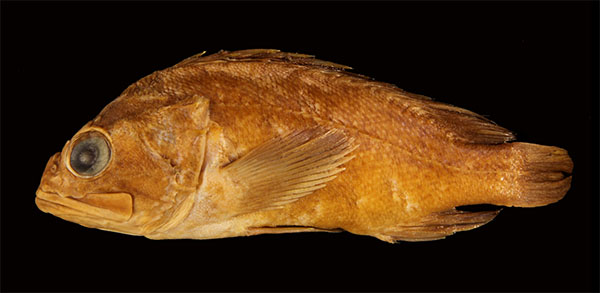 눌치볼락 보존 개체 사진. 정기준(正基準) 표본. 연도/1911. ※눌치볼락이 누루시볼락의 동명이명임이 밝혀지기 전 자료. Preserved specimen, Holotype of Korean fox jacopever(Sebastes ijimae). Year 1911. Location/Asia Korea, Republic of. Rights holder/Field Museum of Natural History(Chicago, USA). ※Data from before it was discovered that sebastes ijimae is a synonym of Sebastes vulpes. (CC BY NC).Asia Korea, Republic of. Rights holder/Field Museum of Natural History(Chicago, USA). (CC BY NC). |
| text on preparation |


|
| Copyright ⓒ FISHILLUST.COM All rights reserved. All contents can not be used without permission of the copyright holder. |


 검색
