
사이트 로그인
사이트 로그인
|
분류계통/경골상강→조기강→쏨뱅이목→볼락과→황점개볼락 Copyright by Kim In Young. 김인영 그림
|
 |
| [Illustration 1] 황점개볼락 기본 모습. Lateral view of Mottled yellow spot rockfish(Sebastes nudus) |
|
Copyright by Kim In Young. 김인영 그림
|
 |
| [Illustration 2] 황점개볼락 체형의 기본 틀. Basic body frame of Mottled yellow spot rockfish(Sebastes nudus) |
|
쏨뱅이목 볼락과 분포; 서북태평양/한국의 동해 중부이남, 제주도, 대한해협, 일본의 홋카이도 남부에서부터 남쪽으로 태평양 연안을 따라 가나가와 현(Kanagawa), 규슈와 세토 내해(Seto Inland Sea)까지, 중국의 발해만과 황해(칭다오, 웨이하이)에 분포한다. 눈은 비교적 큰 편이며 동그랗다. 두 눈 사이는 밑으로 패였고 비늘이 있다. 눈 앞쪽에 한 쌍의 콧구멍이 있다. 머리에 강한 가시들이 발달해 있다. 눈 앞에 튼튼하게 잘 발달한 가시가 있다. 눈 위에 있는 가시는 잘 발달한 튼튼한 가시이며 끝이 안구의 뒤 가장자리에 이르거나 또는 넘어 간다. 눈 뒤에 있는 가시는 단순한 모양이며 후방 쪽으로 등을 향하고 있다. 정수리의 가시가 잘 발달해 있다. 눈 아래에는 가시가 없고 융기선도 없다. 전새개골에 5개의 가시가 있는데 1, 2번 가시는 크게 발달했으며 뒤를 향해 있다. 4, 5번 가시는 작고 끝이 뭉툭하며 복부 쪽을 향해 기울어져 있다. 주새개골에 2개의 날카로운 가시가 뒤를 향해 있으며 위쪽 가시가 아래 쪽 가시보다 약간 더 크다. 등지느러미의 1번 가시는 짧고 5번 가시가 가장 길며 마지막 가시는 끝에서 두 번째(last but one) 가시 보다 길이가 약간 길거나 거의 같다. 등지느러미의 연조부 가장자리는 둥글다. 등지느러미 연조부 시작점은 뒷지느러미 연조부 시작점보다 약간 앞에 있다. 뒷지느러미 기저부 뒤 끝은 등지느러미 연조 기저부의 뒤 끝보다 앞에 있다. 뒷지느러미 가시는 2번 가시가 가장 길고 투박하다. 가슴지느러미는 몸통에서 중앙 아래쪽으로 위치하며 뒤 끝은 항문(총배설강)에 이르지 못한다. 가슴지느러미 기조들은 모두 연조들이며 맨 위쪽 연조는 불분지 기조이고 그 아래로 약 7~8개 기조는 분지 기조이며 그 아래의 나머지 기조들은 모두 불분지 기조이다. 배지느러미는 가슴지느러미 기부보다 훨씬 뒤쪽에서 시작되며 뒤 끝은 항문에 이르지 않는다. 꼬리지느러미 뒤 가장자리는 절단형이지만 위와 아래의 모서리는 약간 둥글다. 꼬리지느러미의 주요기조 수는 14개이다. "주요기조"는 꼬리지느러미를 지지하는 꼬리뼈(미추골; hypural)에 의해 지지되는 기조를 의미한다. 몸색은 서식환경에 따라 변화가 매우 심하다. 신선한 상태에서 바탕색은 주로 황갈색 내지 흑갈색이다. 일반적으로 몸의 등 쪽과, 등지느러미, 가슴지느러미, 꼬리지느러미, 뒷지느러미에 불규칙한 모양의 황색점들이 있고 머리에도 약간의 점들이 있으며 몸통에는 황색점이 거의 없다. 이 상태에서 발전하여 몸통에 일정한 크기의 작고 둥근 황색점들이 소수 또는 다수로 나타나는 경우가 있다. 이 황색점들은 각각 비늘 면적 안에 있다. 즉 비늘 자체의 색이다. 황색점이 많이 나타난 경우에는 일본 명, "황금 볼락(Ougon-murasoi; Golden rockfish)"이 매우 어울린다. 또한 어떤 경우에는 자세히 살펴야 황색 점이나 그 흔적이 겨우 보인다. 머리에는 불규칙한 모양의 어두운 무늬들이 분산되어 있는데 이것들은 눈에서부터 방사상으로 배열된 3개의 불분명한 띠 무늬로 설명된다. 황점개볼락(Sebastes nudus)과 종 구별의 혼선을 일으키는(species complex) 개볼락(Sebastes pachycephalus)은 등지느러미, 꼬리지느러미, 뒷지느러미, 가슴지느러미에 검은 점들이 있으나 황점개볼락은 이곳에 검은 점이 없거나 있어도 불분명하다. 포르말린 액에 고정시킨 개체는 머리와 몸은 전체적으로 검으며 신선할 때 있었던 황색이나 황적색 무늬들은 희미하게 백색으로 변한다. 정착성 어류로서 근해의 암초지대에 주로 서식한다. 난태생 물고기로서 1∼5월경 새끼를 낳는다 주로 새우류, 게류 등 갑각류와 작은 어류, 두족류 등을 잡아먹는다. 식용 가치가 높은 물고기이다. 2014년에 한국 분포 종으로 등록되었다. 개볼락 콤플렉스(개볼락 종복합체) • 등지느러미 극조 기저부 아래 등 부분에 잔 비늘이 개볼락에는 있고 황점개볼락은 이 부분에 비늘이 없다. (※ 아래 도해 그림 참조) 
※ 황점개볼락의 영명 "Mottled yellow spot rockfish"에 대하여 |
Oder Scorpaeniformes Family Family Sebastidae(Rockfishes, rockcods and thornyheads). Distribution; Northwest Pacific/East Sea, Korean Strait, and Jeju Island in Korea, Japan (from southern Hokkaido southward along the Pacific coast of Japan to Kanagawa, to northern Kyushu Island, Seto Inland Sea), and the Bohai Sea, Yellow Sea(Qingdao, Weihai) of China. The head is large and covered with ctenoid scales except on the tip of the snout, the maxilla, the lachrymal, the lower jaw, the margin of the preopercle, and the opercular membrane. The body is also covered with ctenoid scales, but the area in front of the base of the pectoral and pelvic fins, as well as the lower part of the abdomen, is covered with cycloid scales. A narrow area along the anterior ventral margin of the abdomen is usually scaleless. Along the entire length of the dorsal fin’s spinous portion, its narrow area below the dorsal base lacks small scales and remains scaleless surface. This scaleless area serves as an important character for distinguishing Sebastes nudus from Sebastes pachycephalus in the debate over the "Sebastes pachycephalus Species Complex". In rare cases, however, a few small scales may be present on the front part of this otherwise scaleless area. The eyes are relatively large and round. The interorbital space is concave and scaled. There is a pair of nostrils in front of the eyes. Strong spines are developed on the head. A stout, well‑developed spine is present in front of the eye. The spine above the eye is a well‑developed, stout spine, and its tip reaches to or extends beyond the posterior margin of the eyeball. The spine behind the eye is simple in shape and directed posteriorly toward the dorsal side. The parietal spine is well developed. No spines or ridges below the eye. Five spines on the preopercle, of which the first and second are strongly developed and directed posteriorly. The fourth and fifth spines are small, blunt at the tip, and inclined ventrally. Two sharp spines on the opercle pointing backward, and the upper spine is slightly larger than the lower one. The first dorsal‑fin spine is short, fifth spine longest, the last spine is slightly longer than or nearly equal to the penultimate spine. The margin of the soft‑rayed portion of the dorsal fin is rounded. The origin of the soft‑rayed dorsal fin lies slightly anterior to the origin of the soft‑rayed anal fin. The posterior end of the anal‑fin base is located anterior to the posterior end of the soft‑rayed dorsal‑fin base. Of the anal‑fin spines, the second is the longest and robust. The pectoral fin is situated on the lower half of the side of the body, and its tip does not reach the anus(cloaca). All pectoral‑fin rays are soft rays; the uppermost ray is unbranched, the next approximately 7–8 rays are branched, and all remaining lower rays are unbranched. The pelvic fin originates well posterior to the pectoral‑fin base, and its tip does not reach the anus. The posterior margin of the caudal fin is truncate, but the upper and lower corners are rounded. The number of principal caudal‑fin rays is 14. “Principal rays” refers to those fin rays that are supported by the hypural bones of the caudal skeleton. The body color varies greatly depending on the habitat. In a fresh state, the base color is usually yellowish brown to dark brown. Typically, irregularly shaped yellow spots are found on the back, dorsal fin, pectoral fin, caudal fin, and anal fin, with a few also present on the head, while the body itself shows almost no yellow spots. From this condition, the body may further develop small, round yellow spots of a certain size, appearing either sparsely or abundantly. These yellow spots are located within the area of each scale, meaning they represent the color of the scales themselves. When many yellow spots are present, the Japanese name Ougon-murasoi(Golden rockfish) is very fitting. In some cases, however, the yellow spots or their traces can only be seen upon close inspection. On the head, irregular dark markings are scattered, and these can be described as three indistinct bands radiating from the eye. Sebastes nudus and Sebastes pachycephalus, which causes taxonomic confusion as a species complex, can be distinguished in that Sebastes pachycephalus has black spots on the dorsal, caudal, anal, and pectoral fins, whereas Sebastes nudus lacks such spots or, if present, they are indistinct. In specimens fixed in formalin, the head and body become uniformly dark, and the yellow or yellowish red markings that were present when fresh fade to a faint whitish color. As a sedentary fish, it inhabits mainly nearshore rocky reef areas. It is ovoviviparous and gives birth to young from about January to May. It feeds chiefly on crustaceans such as shrimps and crabs, as well as small fishes and cephalopods. It is a fish of high food value. It was recorded as a species distributed in Korean waters in 2014. Sebastes pachycephalus complex The Sebastes pachycephalus complex initially consisted of four subspecies: Subsequent research revealed that the first two are actually one species, Sebastes pachycephalus (the Brassblotched rockfish), and the third and fourth are combined into a single species, Sebastes nudus(the Yellow-spotted Korean rockfish). • There are small scales beneath the base of the dorsal fin spines on the back of the Spotbelly rockfish(Sebastes pachycephalus), whereas the Yellow-spotted Korean rockfish(Sebastes nudus) lacks scales in this area. ※ Refer to the diagram below
※ About the temporary English name "Mottled yellow spot rockfish" of Sebastes nudus. |
 황점개볼락 분포도. Distribution map of Yellowspot brass bloched rockfish(Sebastes nudus). Author/Kim in-young(fishillust.com) |
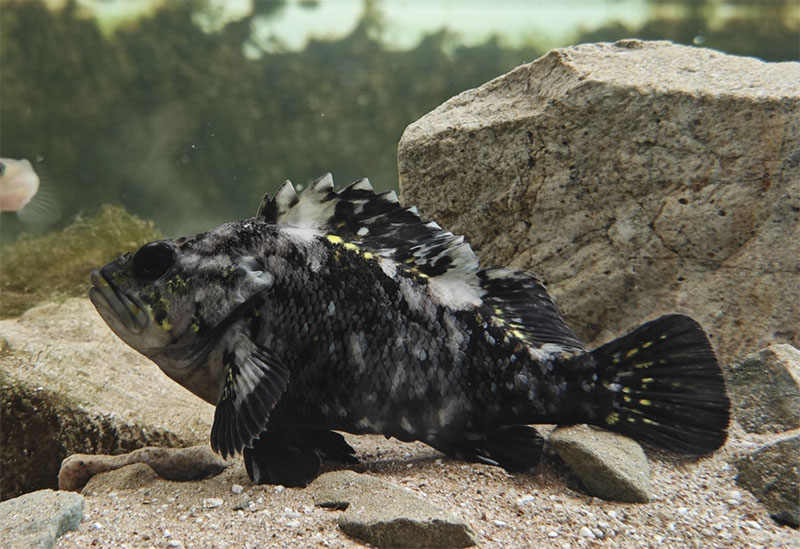 황점개볼락 수중사진(수족관?). Underwater photo(aquarium?) of Yellowspot brass bloched rockfish(Sebastes nudus). Location/Qingdao, Shandong Province, China(중국 산둥성 칭다오). Author/李博恒. (CC BY-NC) |
 황점개볼락. 채집용 어항에서 살아있는 상태. Yellowspot brass bloched rockfish(Sebastes nudus). Alive in a small collection fish tank. Location/South Korea. Date/May, 2025. Author/이승환(i-seung-hwan). (CC BY-NC) |
 text on preparation |
 황점개볼락. Yellowspot brass bloched rockfish(Sebastes nudus). Dead specimen. Location/South Korea. Date/May, 2025. Author/구성회(gu-seong-hoe). (CC BY-NC) |
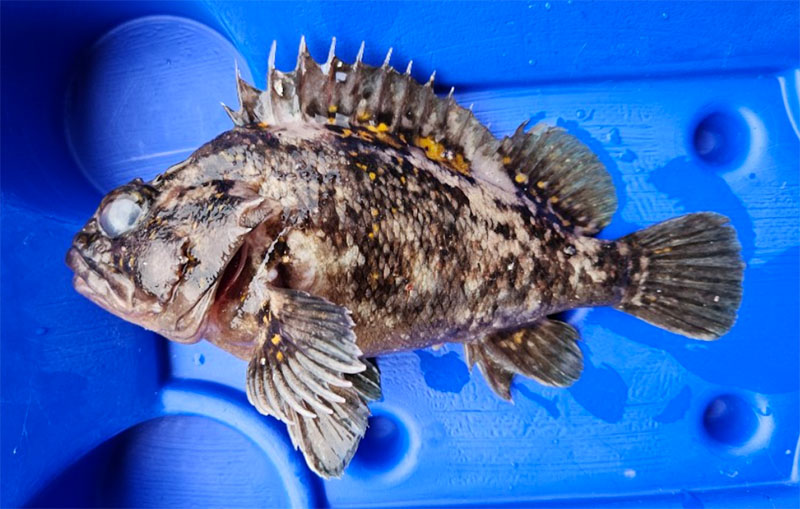 황점개볼락. 죽은 개체. Yellowspot brass bloched rockfish(Sebastes nudus). Dead specimen. Location/South Korea. Date/november, 2024. Author/이승환(i-seung-hwan). (CC BY-NC) |
 횟집 식당 수조에 들어있는 황점개볼락. 바닥에는 광어류가 있고 옆에는 우럭(조피볼락)이 있다. Yellow-spotted rockfish in a fish tank at a Korean style sashimi restaurant. An flounder on the bottom and Korean rockfishes(Sebastes schlegelii) around it. Location/South Korea. Author/희건(hui-geon) |
 황점개볼락. 수조의 유리창 반사광 때문에 실물이 잘 안보이지만 자세히 보면 색상 특징을 읽을 수 있다. Yellowspot brass bloched rockfish(Sebastes nudus). Because of the reflection on the water tank glass, the specimen is not clearly visible, but if you look closely, you can discern its color characteristics. Location/Qingdao City, Shandong Province, China(중국 산둥성 칭다오시). Date/2024. Author/orcinusss. (CC BY-NC) |
| text on preparation |
 text on preparation |
 text on preparation |

| text on preparation |
 text on preparation |
| text on preparation |
| text on preparation |
| text on preparation |


|
| Copyright ⓒ FISHILLUST.COM All rights reserved. All contents can not be used without permission of the copyright holder. |


 검색
