
사이트 로그인
사이트 로그인
|
분류계통/경골상강→조기강→쏨뱅이목→볼락과→황볼락 Copyright by Kim In Young. 김인영 그림
|
 |
| 황볼락 기본 모습. Lateral view of Oweston sting fish(Sebastes owstoni) |
쏨뱅이목 볼락과 분포; 서북태평양/한반도의 동해 중부 이북(남한 일부 포함), 일본 북부, 러시아의 프리모르스키 지방(Primorskii Krai)과 오호츠크 해에 분포. 입은 위로 경사져 있다. 주둥이는 짧고 뾰족하며 아래턱이 위턱보다 조금 튀어나왔다. 아래턱 앞은 뾰족하지 않다. 위턱의 뒤는 동공의 중앙 아래에 이르고 위턱 뒤의 모서리는 각이 져 있다. 양턱에는 작은 이빨이 1줄로 나 있고, 서골(vomer)과 구개골에도 이빨이 있다. 등지느러미의 극조 수가 14개로 다른 볼락류 평균치 13에 비해서 1개가 더 많다. 등지느러미는 5∼8번째 가시가 가장 길고 연조의 길이는 짧다. 등지느러미 가시 사이의 막은 깊게 패어 있다. 가슴지느러미는 비교적 길어서 뒤끝이 항문을 초과하고 12번째 등지느러미 가시 아래에 이른다. 꼬리지느러미 뒤 가장자리는 안으로 패였다. 몸통에 빗비늘이 덮여 있다. 머리에는 안구 앞쪽 주둥이 부분과 양턱 그리고 전새개골 경계선을 제외한 나머지 부분에 빗비늘이 있다. 위턱 뒤 부분에 비늘이 있다는 정보와 없다는 정보가 있는데 본 사이트는 나카보 테츠지(Nakabo Tetsuji)의 "Fishes of Japan with pictorial keys to the species"의 주장을 받아들여 위턱에 비늘이 없는 것으로 정리하였다. 황볼락은 암수의 몸색이 다르다. 황볼락의 몸색은 어린 시절에는 암수 모두 적색이다. 수컷은 약 12cm(SL) 이하에서는 모두 적색이었다가 이 크기에서부터 성장하면서 모두 황색으로 변한다. 암컷은 성장해도 계속 적색이며 체장이 약 17cm(SL)가 넘는 개체들 중에서는 예외적으로 황색인 것들이 있다(출처; Yagishita,N.,Kai, Y., Yamasaki, A. et al. Sexual dimorphism in Sebastes owstoni from the Sea of Japan). 배는 흰색을 띤다. 등쪽에 서너 개의 불분명한 어두운 반점 띠가 수직 방향으로 나타난다. 등지느러미 극조부, 가슴지느러미, 배지느러미는 연한 오렌지색을 띠며, 등지느러미 연조부, 꼬리지느러미는 주황색을 띤다. 적색인 암컷의 사진은 온라인 일본 생선에서 찾을 수 있다(저작권이 있어 소개하지 못함). 러시아에서는 황볼락을 Красный морской окунь(Krasnyy morskoy okun')라고 부르는데 뜻이 붉은 농어(red sea bass)이다. 황볼락의 암컷을 기준한 이름일 것이다. 수심 100∼300m의 암초 지역에 주로 서식하며 작은 갑각류를 먹이로 한다. 일본의 서부 해안(한국의 동해)에서 저인망으로 많이 잡히며 값이 싸고 맛있는 생선으로 취급 받는다. [황볼락과 노랑볼락 한국명의 혼란]. 한국명에 "황볼락"과 "노랑볼락"이라는 이름의 볼락류가 있다. 황볼락은 학명이 Sebastes owstoni이며 노랑볼락은 학명이 Sebastes steindachneri 이다. 한국명 "황볼락"의 첫 글자 황은 한자의 황(黃)이며 노란 색을 뜻한다. 한국명 "노랑볼락"의 첫 단어 "노랑"은 한국 원어로 노란 색을 의미한다. 즉 이름의 뜻은 모두 "노란색 볼락"인데 종은 달라서 혼동을 일으킨다. 노랑볼락보다 황볼락이 더 진한 노란색이다. [황볼락의 영명에 대하여] 세계적으로 호칭되는 영명은 없다. 일본의 어류 관련 문헌들이 'Oweston sting fish"로 부르고 있다. |
Oder Scorpaeniformes Family Family Sebastidae(Rockfishes, rockcods and thornyheads). Distribution; Northwest Pacific/north of central east coast of Korean peninsula(including some part of South Korea), northern Japan, Primorskii Krai and Sea of Okhotsk of Russia. The mouth is obliquely directed upward. The snout is short and pointed, with the lower jaw moderately protruding beyond the upper jaw. The front of the lower jaw is not pointed. The posterior end of the upper jaw reaches below the center of the pupil, and its rear edge is angular. Both jaws bear a single row of small teeth, and teeth are also present on the vomer and palatine bones. The dorsal fin has 14 spines—one more than the average of 13 found in other rockfish species. Among the dorsal fin spines, the 5th to 8th are the longest, while the soft rays are relatively short. The membrane between the dorsal fin spines is deeply notched. The pectoral fins are relatively long, extending beyond the anus and reaching below the 12th dorsal fin spine. The posterior margin of the caudal fin is slightly concave. The body is covered with ctenoid scales. On the head, ctenoid scales are present except for the area around the snout in front of the eye, both jaws, and the boundary of the preopercle. Although there are conflicting reports regarding the presence of scales on the posterior part of the upper jaw, this site follows the view of Nakabo Tetsuji in “Fishes of Japan with Pictorial Keys to the Species”, and thus treats the species as lacking scales on the upper jaw. The body color of Sebastes owstoni differs between males and females. In their young stage, both sexes are red. Males remain red up to about 12 cm standard length(SL), but as they grow beyond this size, they turn completely yellow. Females, however, retain their red coloration throughout growth, although a few individuals exceeding about 17 cm SL are exceptionally yellow(Source: Yagishita, N., Kai, Y., Yamasaki, A. et al. Sexual dimorphism in Sebastes owstoni from the Sea of Japan). The abdomen is whitish. 3~5 faint, dark vertical bands appear along the dorsal side. The spinous part of the dorsal fin, as well as the pectoral and pelvic fins, are pale orange, while the soft part of the dorsal fin and the caudal fin are orange. Photographs of red-colored females can be found on the Japanese online fish market(not shown here due to copyright restrictions). In Russia, this species is called “Красный морской окунь(Krasnyy morskoy okun’), meaning “red sea bass,” likely referring to the coloration of the female. It lives mainly in reef areas with a depth of 100 to 300 m and feeds on small crustaceans. It is caught in large numbers mainly by bottom trawling in the Sea of Japan. It's cheap and delicious. [Confusion in Korean names for Sebastes owstoni and Sebastes steindachneri] [On the English Name of Sebastes owstoni] There is no widely recognized English name for Sebastes owstoni. Only Japanese fish literatures refers to it as the Oweston sting fish. |
 황볼락 분포도. Distribution map of Japanese yellow seaperch(Sebastes owstoni). Edited by Kim in-young(fishillust.com). Data source; fishbiosystem.ru/ and Korean data. |

| 황볼락. 수족관 사진. Aquarium photo. Oweston Sting Fish(Sebastes owstoni). Location/Niigata City Aquarium Marinepia Nihonkai(Sea of Japan). Author/新潟市水族館(Niigata City Aquarium). (CC BY NC) |
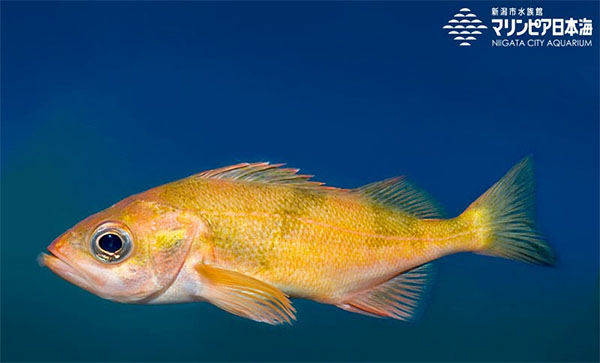 황볼락. 수족관 사진. Aquarium photo. Oweston Sting Fish(Sebastes owstoni). Location/Niigata City Aquarium Marinepia Nihonkai(Sea of Japan). Author/新潟市水族館(Niigata City Aquarium). (CC BY NC) |
 황볼락. 죽은 개체. Japanese yellow seaperch(Sebastes owstoni). Dead specimen. Location/Korea. Right holder/국립생물자원관(National Institute of Biological Resources, Korea). (CC BY NC) |
 황볼락. Japanese yellow seaperch(Sebastes owstoni). Length/18㎝. Location/ Korea. Author/명정구(right reserved). |
 황볼락. 장소/강원도 속초시 동명동. Japanese yellow seaperch(Sebastes owstoni). Location/Dong-myeong-dong, Sokcho-si, Gang-won-do, Korea. Author/채유민. (CC BY NC) |
 일본 동경 생선시장의 황볼락. Japanese yellow seaperch(Sebastes owstoni) for sale at Tsukiji Fishmarket, Tokyo. Author/MichaelMaggs. Original photo rotated 90 degrees to the left. From Wikimedia. (CC BY NC). |
| text on preparation |


|
| Copyright ⓒ FISHILLUST.COM All rights reserved. All contents can not be used without permission of the copyright holder. |


 검색
