Oder Scorpaeniformes Family Family Sebastidae(Rockfishes, rockcods and thornyheads).
Spotbelly rockfish(or Brass blotched rockfish). Sebastes
Sebastes pachycephalus(Temminck & Schlegel, 1843) max length/42.0 cm TL
Korean name/gae-bol-lak(개볼락)
Japanese name/ムラソイ(Murasoi/무라소이).
Chinese name/厚頭平鮋(후두평유)
D/spine 13, soft ray 11~13. A/spine 3, soft ray 5~7. P1/17~19. LLp/30~35. Gill rakers/20~25. Vert/26
Distribution; Northwest Pacific/almost all around of Korean peninsula including Jeju Island, south of Hokkaido Japan, Yellow Sea and Pohai Sea coasts of China, and primorsky krai, Russian.
General; Usually The body length is usually about 25 cm but can grow up to 42.0 cm. The body is laterally compressed, with a somewhat high, egg-shaped oval form. The head and eyes are large. The mouth is large, slightly upward-slanting, and terminal. Small teeth are present on both jaws, the vomer, and the palatine bones. The lower jaw is set back compared to the upper jaw at the front of the snout. The posterior end of the upper jaw does not quite reach, or just barely touches, the rear edge of the eye. The lateral line is complete and slightly displaced dorsally in the anterior part of the trunk. The spines on the head are large and strong, located in front of the eyes (preocular), above the eyes (supraocular), behind the eyes (postocular), and on the parietal region. The interorbital space is concave, and both eyes have prominent ridges. Posterior part of head is rounded and raised.
The head is covered with ctenoid scales except for the anterior snout, the upper and lower jaws, the lower part in front of the eyes, the margin of the preopercle, and the opercular membranes. The body is also covered with ctenoid scales, but the area in front of pectoral fin base, near the base of the pelvic fin, and the lower abdomen are covered with cycloid scales. A narrow anterior portion of the ventral abdomen is usually scaleless. Sebastes nudus lacks scales on the narrow dorsum area beneath the entire base of the dorsal fin spiny portion, whereas Sebastes pachycephalus has fine scales densely packed there—this is one of the distinguishing traits used to separate the two species within the “Sebastes pachycephalus species complex.” These fine scales often extend onto the spine bases and membranes.
In the dorsal fin spiny portion, the first spine is the shortest, the fifth spine is the longest, and the last spine is slightly longer than the penultimate spine. The margin of the dorsal fin soft portion is rounded, and all rays are branched. The pectoral fins are rounded, with their posterior tips not reaching the anus. In the anal fin, the second spine is the longest and stoutest. The posterior margin of the caudal fin is nearly truncate, with rounded upper and lower corners.
The body coloration varies depending on habitat or depth, but the variation is less pronounced than in Sebastes nudus. Overall, the ground color is yellowish brown, dark brown or olive brown. There are three dark brown vertical saddle-like bands on the trunk, with one smaller saddle mark each on the caudal peduncle and the posterior part of the head. Dark brown spots are irregularly scattered over the head and body. The dorsal, pectoral, anal, and caudal fins bear dark brown spots, which appear distinct when the ground color is light, but become obscure when the overall coloration is dominated by dark brown. Unlike Sebastes nudus, there are no yellow or bright yellowish-red spots or blotches. Preserved specimens in formalin are generally black on the head and body.
This is a sedentary fish that inhabits nearshore rocky bottoms and is carnivorous. It mainly feeds on shrimps, crabs, other crustaceans, small fishes, and cephalopods. It is ovoviviparous, with the breeding season occurring around January to February(off Busan, Korea) or April to May(off Tokyo, Japan).
※ Regarding the English names of Sebastes pachycephalus; Spotbelly rockfish and Brass blotched rockfish
There is no globally recognized English name for Sebastes pachycephalus and even the official data from the National Institute of Fisheries Science of Korea does not list one. However, examples of the names "Spotbelly rockfish" and "Brass blotched rockfish" have been found in use in Japan and Korea. The name "Spotbelly rockfish" means "a rockfish with black spots on its belly." Yet, in this species, black spots also appear not only on the belly but on all fins except the pectoral, lower head area, and pelvic fins. The term "Spotbelly rockfish" was coined during a period of confusion surrounding the "Sebastes pachycephalus species complex", to distinguish between two very similar subspecies — Sebastes pachycephalus pachycephalus and Sebastes pachycephalus nigricans. The name “Brass blotched rockfish” literally means “with brass-colored blotch rockfish.” Typically, Sebastes pachycephalus has blackish brown blotches, but rarely, specimens with yellow-greenish markings on lighter base color have been observed. It is thought that the name originated from such rare examples(photographic materials cannot be presented here due to copyright restrictions).
What is the "Sebastes pachycephalus complex"
The Brassblotched rockfish(Sebastes pachycephalus) and the Yellow-spotted Korean rockfish (Sebastes nudus) form what is known as the Sebastes pachycephalus complex, which in Korean is called the “Gaebolak species complex.” The species name Sebastes pachycephalus refers to the Brassblotched rockfish. A “species complex” means a group of organisms that are called by the same name but include two or more closely related species that are difficult to distinguish, leading to taxonomic confusion.
The Sebastes pachycephalus complex initially consisted of four subspecies:
1. Sebastes pachycephalus pachycephalus
2. Sebastes pachycephalus nigricans
3. Sebastes pachycephalus nudus
4. Sebastes pachycephalus chalcogrammus
Subsequent research revealed that the first two are actually one species, Sebastes pachycephalus (the Brassblotched rockfish), and the third and fourth are combined into a single species, Sebastes nudus(the Yellow-spotted Korean rockfish).
• There are small scales beneath the base of the dorsal fin spines on the back of the Spotbelly rockfish(Sebastes pachycephalus), whereas the Yellow-spotted Korean rockfish(Sebastes nudus) lacks scales in this area. ※ Refer to the diagram below
• Distinct black spots are present on the dorsal, anal, and caudal fins in Sebastes pachycephalus, whereas they are absent or faint in Sebastes nudus.
• In fresh specimens, yellow(to yellowish-red) markings are absent in Sebastes pachycephalus but present in Sebastes nudus.
• The fins of Sebastes nudus are larger than those of Sebastes pachycephalus. The number of pectoral-fin rays differs slightly: Sebastes nudus has 16–18, whereas Sebastes pachycephalus has 17–19.
• Hybrids: According to the study, hybridization may have occurred between these two species. Some specimens display intermediate features, which strongly suggests hybridity.
※Main reference/New Record of Sebastes nudus and Redescription of Sebastes pachycephalus(Pisces: Scorpaenidae) from Korea by Hyo Jae Yu, Jin-Koo Kim(PDF). Fish Aquat Sci 17(1), 129-136, 2014

| Comparative diagram of the presence or absence of scales beneath the base of the dorsal fin spines in the Sebastes nudus(A) and Sebastes pachycephalus(B). Scales are absent in S. nudus, whereas present in S. pachycephalus. |
|


 개볼락 분포도. Distribution map of Spotbelly rockfish(Sebastes pachycephalus). Reference/GBIF, fishbase. org and other description. As of May, 2022. Author/fishillust.com(Kim in young).
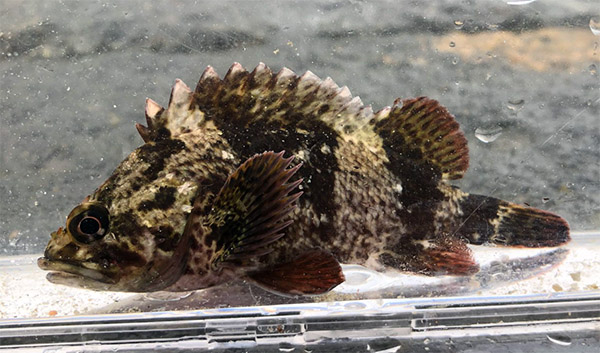 개볼락. 물고기 관찰 수조 사진. Spotbelly rockfish(Sebastes pachycephalus). In fish observing tank. Location/Japan. Author/堀内伸一. (CC BY NC)
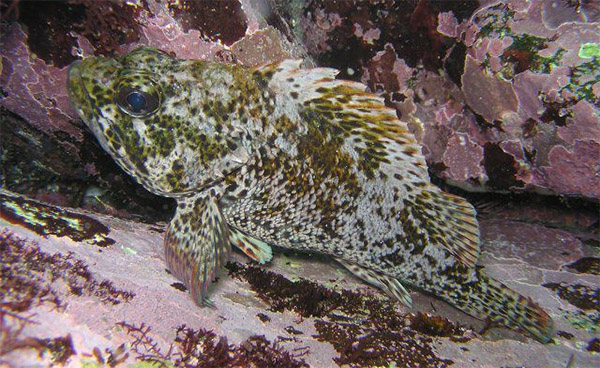 개볼락. 수중사진. Spotbelly rockfish(Sebastes pachycephalus) at depth. Original photo flipped. Author/Izuzuki. (CC BY NC)
 개볼락. 수족관 사진. Spotbelly rockfish(Sebastes pachycephalus). Body length/about 10cm. Location/Nagisa Aquarium in Japan.(なぎさ水族館飼育展示個体))。Author/Totti. (CC BY NC)
 개볼락. 위치/전북 군산시 옥도면. Spotbelly rockfish(Sebastes pachycephalus. Location/Okdo-myeon, Gunsan-si, Jeollabuk-do, Korea. Author/이완옥(Lee Wan-ok). Source/naturing.net/. (CC BY NC)
 개볼락. 물고기 관찰 수조 사진. 위치/제주도 서귀포시 남원읍 하례리. Spotbelly rockfish(Sebastes pachycephalus. In fish observing tank. Location/Ha-rye-ri, Nam-won-eup, Seo-gwi-po-si, Jeju-do, Korea. Original photo flipped. Author/희건(Hee-geon). Source/naturing.net/. (CC BY NC)
 개볼락. 물고기 관찰 수조 사진. Spotbelly rockfish(Sebastes pachycephalus. In fish observing tank. Location/South Korea. Author/김진우( Kim Jin-woo). Source/naturing.net/. (CC BY NC)
 개볼락 유어. Juvenile of Spotbelly rockfish(Sebastes pachycephalus. Location/South Korea. Author/강민(Kang min). Source/naturing.net/. (CC BY NC)

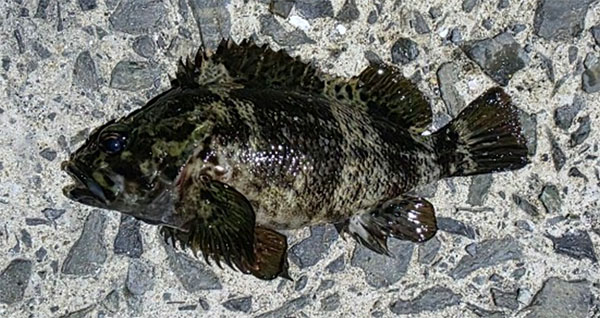 개볼락. Spotbelly rockfish(Sebastes pachycephalus. Location/South Korea. Original photo flipped. Author/Medusa. Source/naturing.net/. (CC BY NC)
 개볼락. 관찰 수조 사진. Spotbelly rockfish(Sebastes pachycephalus. In fish observing tank. Location/South Korea. Author/차다현(cha-da-hyeon). Source/naturing.net/. (CC BY NC)
 개볼락. Spotbelly rockfish(Sebastes pachycephalus. Location/South Korea. Original photo flipped. Author/차다현(cha-da-hyeon). Source/naturing.net/. (CC BY NC)
 개볼락. 작은 유어. 물고기 관찰 수조 사진. 왼쪽(left)/약 13mm, 오른쪽(right)/약 22mm.Small juvenile of Spotbelly rockfish(Sebastes pachycephalus. In fish observing tank. Location/South Korea. Author(both phto)/희건(Hee-geon). Source/naturing.net/. (CC BY NC)




 검색
