
사이트 로그인
사이트 로그인
|
분류계통/경골상강→조기강→쏨뱅이목→볼락과→검정볼락 Copyright by Kim In Young. 김인영 그림
|
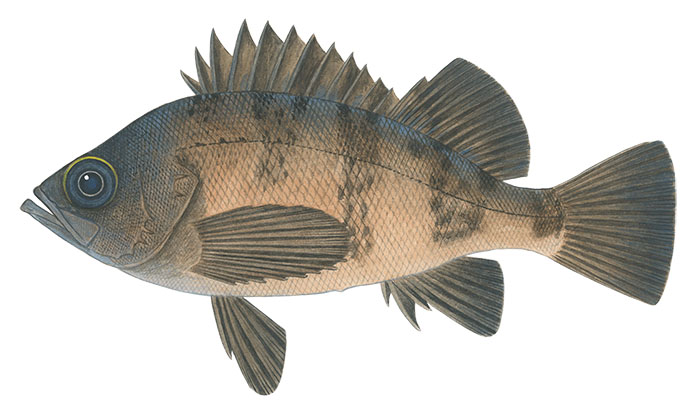 |
| 검정볼락 기본 모습. Lateral view of Japanese black seaperch(Sebastes ventricosus) |
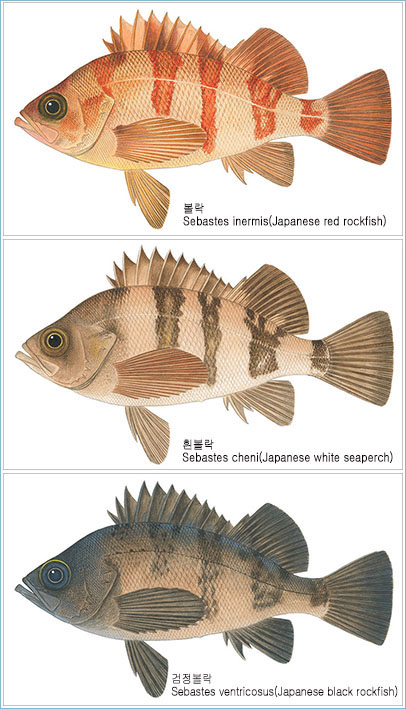 “볼락 종 복합체”의 3종 비교도. 설명은 이하 글에 있으며 더 자세한 내용은 “볼락" 페이지에 있음. Three species of “Sebastes inermis species complex”. Descriptions are given below and further details can be found in the page of Japanese red rockfish(Sebastes inermis). Author/Kim in-young(fishillus.com). |
쏨뱅이목 볼락과 분포; 서북태평양/한국의 제주도, 추자도, 거문도를 비롯해 남해와 동해 일부 해역에서 발견된다. 한국의 서해에서는 거의 발견되지 않는다. 일본은 홋카이도 남부부터 혼슈, 시코쿠, 규슈 해안까지 전 해역에 분포한다. 최근(2025년) 대만의 마쭈열도(馬祖列島; Matsu Islands; 26°N 주변)에서도 발견 보고되었다. 검정볼락의 설명; 몸은 체고가 약간 높은 타원형이며 머리와 몸통은 옆으로 납작하다. 눈은 툭 불거지고 매우 크며 눈 지름은 주둥이 길이보다 크거나 같다. 머리에는 주둥이 위, 눈 앞, 눈 위, 눈 아래, 및 머리 정수리에 가시가 있는데 눈 아래 가시 2개는 날카로우나 나머지 가시들은 약하다. 주둥이는 원뿔형으로 끝이 뾰족하다. 입이 크다. 양턱, 서골, 구개골에 작은 이빨이 촘촘히 나 있다. 아래턱 앞 끝의 이빨은 바깥에서 보인다. 위턱의 뒤 끝은 눈 중간 부분 아래에 이른다. 머리와 몸통은 빗비늘로 덮여있다. 아래턱 아랫면에 조밀하게 배열된 미세한 비늘이 있다. 측선은 완전하고 등선을 따라 곡선으로 흐르며 몸통 앞부분에서는 치우쳐있다. 등지느러미 기점은 아가미뚜껑 가장자리 위쪽 위에 위치한다. 등지느러미 마지막 극조 길이는 그 직전의 극조보다 길다. 전새개골 가장자리에 5개의 가시가 있다. 아가미뚜껑(주새개골) 위쪽 가장자리에 2개의 가시가 있다. 뒤통수 부위의 가시는 매우 작거나 흔적적이다. 아래턱이 위턱보다 앞으로 돌출되어 있다. 위턱 뒤는 동공의 끝에 거의 이른다. 양턱, 서골, 구개골에 작은 이빨이 있다. 꼬리지느러미 뒤 가장자리는 약간 둥근 절단형이다. 꼬리지느러미의 펼침이 좁을 때는 뒤 가장자리의 둥글기가 없어지고 중간이 약간 안으로 패인다. 그러나 펼침을 확장시키면 약간 둥글어지고 패임도 없어진다. 몸색; 작은 개체일 때 등쪽에 푸른색(blue color)이 두드러지며 거지면서 진한 청록색으로 변하다가 나중에는 검푸른 검정색이 된다. ※ ‘볼락 종 복합체’에 대하여. 새로 규명된 Sebastes cheni는 국제적으로 흰볼락(Japanese white rockfish)이라는 이름으로 알려져 있으며 1988년에 러시아의 어류학자(Vladimir Viktorovich Barsukov)가 일본에서 채집된 표본을 근거로 연구하여 이미 신종으로 발표한 종이다. 한국과 일본에만 분포한다. 새로 규명된 Sebastes ventricosus는 국제적으로 검정볼락(Japanese black rockfish)이라는 이름으로 알려져 있으며 1843년에 네덜란드 동물학자(Coenraad Jacob Temminck)와 독일 동물학자(Hermann Schlegel)가 일본에서 채집된 표본을 근거로 연구하여 이미 신종으로 발표한 종이다. 한국과 일본에만 분포한다. 볼락(Japanese red rockfish)은 1829년 프랑스 동물학자(Georges Cuvier)가 발표한 종으로 알려져 있다. 볼락도 한국과 일본에만 분포한다. “볼락 종 복합체” 3종의 연구 결과는 세계 어류학계에는 적용되고 있는 과정에 있다. 그러나 아직 수정시키지 않은 정보가 많이 남아있어서 혼동이 일어난다. 한국의 어류학계와 관련 국가 기관들도 이에 대해 전혀 언급하고 있지 않다(2025년 5월 기준). 필자가 검색해 본 결과 어류 분류에 관해 가장 권위가 높은 정보 사이트의 하나인 Eschmeyer's Catalog of Fishes(The California Academy of Sciences)에는 새로 정리된 3 종 학명이 모두 인정(valid)되어 있다. 결론적으로 이 3종은 모두 일본과 한국에 분포하는 독립 종들로 귀결되었다. 한국의 낚시인들은 볼락의 생김새에 따라 이름을 금볼락, 청볼락, 갈볼락 3가지 별칭으로 호칭한다고 한다. 필자는 정식 어류학자가 아님으로 결정을 내리는 것이 옳은 일인지 의문이기는 하나 3종을 모두 한국 종으로 정리하는 바이다. 볼락 별칭인 금볼락, 청볼락, 갈볼락 각각의 학명은? ◎학명;Sebastes inermis ◎학명;Sebastes cheni ◎학명; Sebastes ventricosus |
Oder Scorpaeniformes Family Sebastidae(Rockfishes, rockcods and thornyheads). Distribution; Northwest Pacific/the South Sea of Korea including Jeju Island, Chuja Island, and Geomun Island, and some parts of East Sea, rarely found in the West Sea of Korea. In Japan, throughout the entire sea area from southern Hokkaido to the coasts of Honshu, Shikoku, and Kyushu. Recently(2025) reported to have been found in the Matsu Islands (around 26°N) in Taiwan. Description of Black rockfish(Sebastes ventricosus); The body is oval, slightly tall, and the head and trunk are flat on the sides. The eyes are bulging and very large, and the diameter of the eye is greater than or equal to snout length. There are spines on the head above the snout, in front of the eyes, above the eyes, under the eyes, and on the crown of the head; the two spines under the eyes are sharp, but the rest spines are small and weak. The snout is cone-shaped and pointed. The mouth is large. Both jaws, vomer, and palatine bones are densely packed with small teeth. The teeth at the front end of the lower jaw are visible from the outside. The back end of the upper jaw reaches below the middle of the eye. The head and body are covered with ctenoid scales. There are fine scales densely arranged on the underside of the lower jaw. The lateral line is complete, curved paralleling to the dorsal line, and is shifted to dorsal side at the anterior body. The origin of the dorsal fin is located above the upper edge of the gill cover. The last spine of the dorsal fin is longer than the previous one. Five spines on the edge of the preopercle bone, two spines near the upper edge of the gill cover(operculum). The spine on the occipital head is very small or rudimentary. The lower jaw protrudes forward from the upper jaw. The back of the upper jaw almost reaches the end of the pupil. There are small teeth on both jaws, vomer, and the palatine bone. The posterior edge of the caudal fin is slightly rounded and truncate. When the caudal fin is spread narrowly, the posterior edge loses its roundness and the middle is slightly sunken in. However, when the spread is expanded, it becomes slightly rounded and the sunkenness disappears. Body color; When small, the back is bluish, changing to deep blue-green as it grows, and later becoming dark blue-black. ※What is the “Sebastes inermis Species Complex”? The newly identified Sebastes cheni is known as “Japanese white rockfish” and was already announced as a new species in 1988 by a Russian ichthyologist(Vladimir Viktorovich Barsukov) based on specimens collected in Japan. It is distributed only in Korea and Japan. The newly identified Sebastes ventricosus is known as “Japanese black rockfish”, and was already announced as a new species in 1843 by Dutch zoologist Coenraad Jacob Temminck and German zoologist Hermann Schlegel based on specimens collected in Japan. It is distributed only in Korea and Japan. The Bol-lak(Japanese red rockfish/Sebastes inermis) was announced in 1829 by French zoologist Georges Cuvier. It is also distributed only in Korea and Japan. The research results of the three species of “Bolrak species complex” are in the process of being applied to the world ichthyology community. However, there is still a lot of information that has not been corrected, which is causing confusion. The Korean ichthyology community and related national organizations have not mentioned this at all (as of May 2025). Eschmeyer's Catalog of Fishes(The California Academy of Sciences), one of the most authoritative information sites on fish taxonomy, confirmed all three newly identified species names as valid. In conclusion, these three species are all independent species distributed commonly in Japan and Korea. It is said that Korean anglers call this rockfish by three nicknames, gold rockfish, blue rockfish, and brown rockfish, depending on its appearance. However, it is not known which nickname corresponds to which scientific name, respectively. This is because anglers are speaking without principles on SNS. I am not a formal ichthyologist, so I am not sure if it is the right thing to do, but I would classify all three species as Korean species. Which Korean nickname corresponds to which scientific name, respectively?. ◎ Scientific name; Sebastes inermis ◎Scientific name; Sebastes cheni ◎Scientific name; Sebastes ventricosus |
 검정볼락 분포도. Distribution map of Japanese black rockfish(Sebastes ventricosus). Edited by Kim in-young. Main ref. GBIF(2025). |
 검정볼락의 가슴지느러미와 뒷지느러미의 기본 모양과 기조의 수. 가슴지느러미 기조들은 모두 연조이며 수는 16개, 뒷지느러미는 극조 3 연조 7개(8개일수도 있음). 가슴지느러미의 분지 기조와 불분지 기조의 구성 비는 약간 차이가 있을 수 있다. “볼락 복합체 3종”은 외관으로 구별하기가 어려우며 확실하게 구별하는 방법은 종 마다 수가 다른 가슴지느러미의 기조 수를 확인하는 것이다. 그리고 뒷지느러미의 연조 수도 보조 참고 수단이 된다. The basic shape and number of rays of pectoral and anal fins of Japanese black seaperch(Sebastes ventricosus). Pectoral fin rays are all soft rays and number is 16. Anal fin has 3 spines and 7(or 8) soft rays. The composition ratio of branched and unbranched ray of the pectoral fin may differ slightly. It is difficult to distinguish the three species in “Sebastes inermis species complex.” by appearance, and the only way to distinguish them is to check the number of rays on the pectoral fin, which varies by species. The number of soft rays on the anal fin also serves as an auxiliary reference. Illustraton by Kim in-young. |
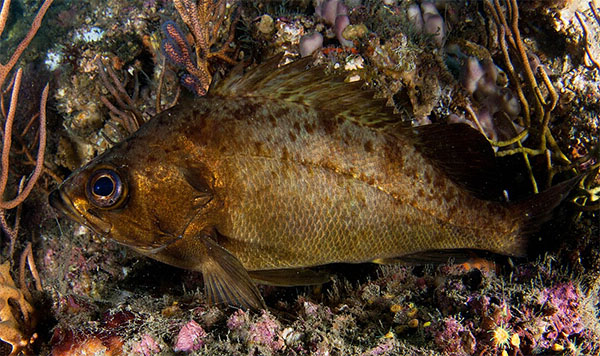 검정볼락 수중 사진. Underwater photo of Japanese black rockfish(Sebastes ventricosu). Location/Japan. Orginal photo flipped. Author/ Joi Ito. (CC BY NC) |
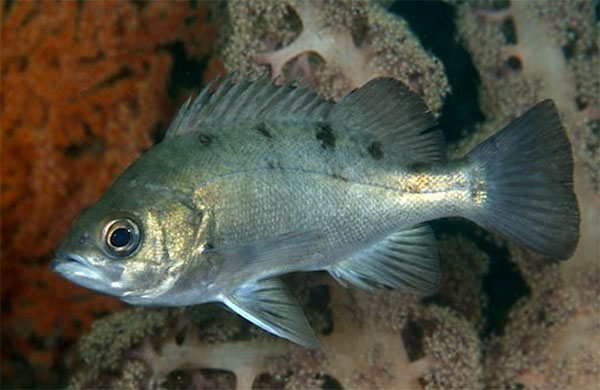 text on preparation검정볼락. 사진의 저자는 가슴지느러미의 기조 수가 16개인 것을 확인하고 검정볼락임을 선언하였다. Japanese black rockfish(Sebastes ventricosu). The author of the photo confirmed that the number of pectoral fin rays is 16 and declared asl Black rockfish(Sebastes ventricosu). Location/Japan. Author/Izuzuki(izuzuki.com). Original photo flipped. (CC BY NC) |
The black rockfish(Sebastes ventricosu) has slightly dull yellow rim around the edge of its eyeball. The location of the exposure changes depending on the eyeball roll. The author of the photo expressed interest in the shape of the teeth in the mouth viewed from above. Original photo flipped. Author/Izuzuki(izuzuki.com/). (CC BY NC). To reconfirm the gold-rimmed eyes of the black rockfish, visit: https://www.inaturalist.org/observations/19486448. |
 검정볼락. Japanese black rockfish(Sebastes ventricosu). Location/Japan. Author/Izuzuki(izuzuki.com) (CC BY NC) |
 검정볼락. Japanese black rockfish(Sebastes ventricosu). Location/Japan. Author/Izuzuki(izuzuki.com) (CC BY NC) |
 검정볼락. 관찰용 소형 어항에 살아있음. 출처/네이처링. ※ 평가/저자가 가슴지느러미의 기조 수를 확인해 보고 종(검정볼락)을 확인했다는 설명이 없음. Japanese black rockfish(Sebastes ventricosu). Alive in a small observation tank. Location/Korea. Orginal photo flipped. Author/희건(hui-geon). Source/naturing.net. ※Comment/No description that the reviewer(author) checked the number of pectoral fin rays and confirmed the species(Black rockfish; Sebastes ventricosu). (CC BY NC) |
 검정볼락. 죽은 개체 출처/네이처링. 저자는 청볼락이라고 기술하였으므로 이는 검정볼락이라는 뜻이다. Japanese black rockfish(Sebastes ventricosu). Location/Korea. Author/오도현(Oh Do-hyun). Source/naturing.net. (CC BY NC) |
 검정볼락. Japanese black rockfish(Sebastes ventricosu). Location/ Nagasaki , Japan. Author/ kuroshio. (CC BY NC) |
 검정볼락. 수중사진. Underwater photo of Japanese black rockfish(Sebastes ventricosu). Location/Japan. Author/ kuroshio. Original photo flipped and cropped. (CC BY NC) |
 검정볼락 보존개체. Preserved specimen of Japanese black rockfish(Sebastes ventricosu). Collected in Japan. Orginal photo flipped. Rights holder/Naturalis Biodiversity Center. (CC BY NC) |
 검정볼락. 보존 표본. Preserved specimen of Japanese black rockfish(Sebastes ventricosu). Collected in Japan. Author/ CAS California Academy of Sciences. (CC BY NC) |
| text on preparation |


|
| Copyright ⓒ FISHILLUST.COM All rights reserved. All contents can not be used without permission of the copyright holder. |


 검색
 검정볼(Sebastes ventricosu)은 안구 가장자리에 약간 칙칙한 노란색 테두리가 있다. 안구를 굴리는데 따라 노출되는 위치가 달라진다. 사진의 저자는 위에서 내려다본 입의 이빨 모양에 관심을 표시했다. 검정볼락의 금테 눈을 재확인하려면 다음 사이트에 들어가보라. https://www.inaturalist.org/observations/19486448
