Oder Scorpaeniformes Family Family Sebastidae(Rockfishes, rockcods and thornyheads).
Yellow barred red rockfish
Sebastiscus albofasciatus (Lacépède, 1802). max length/25.0 cm TL
Korean name/Puk-gam-peng(붉감펭)
Japanese name/アヤメカサゴ(Ayame-kasago)
Chinese name/白條紋石狗公
D/spine 12, soft ray 12~13. A/spine 3, soft ray 5. P1/16~18. Caudal fin/14~16(main 14). Vert/24-25. LLs/49~53. Gill rakers/21-22. Branchiostegal/7.
Distribution; Northwestern Pacific/South Sea, and Jeju Island of Korea, south of central Japan(including Okinawa), Taiwan, Hong Kong, East China Sea, South China Sea.
General; Its English common name is also the "yellowbarred stingfish." The specific epithet albofasciatus means "white-banded." The French ichthyologist Bernard Germain de Lacépède, who first described this species in 1802, named it after seeing a drawing of the fish that depicted a white band at the base of the caudal fin. However, in reality, the fish does not possess such a color pattern.
The body and head are both laterally compressed, with a slightly high body depth and an elongated shape that resembles a long oval. The eyes are relatively large and equal in length to the snout. Both jaws are similar in length, with the posterior end of the upper jaw reaching below the middle of the eye. Hard spines are developed on the head. There is one sharp, backward-pointing spine on the suborbital bone below the eye. There are five spines on the margin of the preopercle and two spines on the upper margin of the opercle. The lateral line is nearly parallel to the dorsal profile. Ctenoid scales cover the entire body, except for the snout area, the anterior part of the upper jaw, and the lower jaw.
The origin of the dorsal fin is located well forward of the posterior end of the operculum. The membranes between the anterior dorsal spines form distinct notches. The length of the last spine is similar to or slightly longer than the penultimate spine. The margin of the soft dorsal fin is rounded, and the length of the dorsal spines is nearly equal to that of the dorsal soft rays. The pectoral fin is positioned slightly below the center of the body. The tip of the pectoral fin extends past the cloaca but does not reach the origin of the anal fin base. Approximately the upper half of the pectoral fin rays are branched, while the lower half are unbranched soft rays. The upper unbranched rays are significantly longer than the adjacent branched rays, giving the pectoral fin an indented rather than rounded shape.
The coloration appears vibrant. The body color is a light reddish-orange base with a pinkish-white belly. All fins are yellow. Dark reddish-yellow spots and maze-like yellow stripes are scattered across the head and body. Five white blotches are positioned at nearly regular intervals from below the fourth dorsal spine to the caudal peduncle. In dead specimens, the color darkens, and the white blotches fade(becoming dull yellowish), causing dark areas next to the white blotches can look like five blackish blotches or bands. The fins are scattered with small dots similar to those on the body, and the pectoral fins have several small black dots arranged along the direction of the rays.
While the Yellowbarred stingfish and the Marbled rockfish(Sebastiscus marmoratus) share a similar body shape, the Yellowbarred stingfish looks more vibrant due to the yellow stripes and spots covering its body and its yellow fins. In contrast, the Marbled rockfish has a dark reddish-black color, making the two visually distinct. The Yellowbarred stingfish also possesses a suborbital spine that the marbled rockfish lacks. As a deep-sea fish, it inhabits rocky areas at depths of 30 to 200 meters, living in slightly deeper waters than the marbled rockfish. It is ovoviviparous and gives birth to young in the spring around April. It is also caught by fishing. Globally, there are only three species in the genus Sebastiscus: Sebastiscus marmoratus, Sebastiscus tertius, and Sebastiscus albofasciatus.
|


 붉감펭 분포도. Distribution map of Yellow barred red rockfish(Sebastiscus albofasciatus). Derived work from GBIF. Author/fishilust.com.
 붉감펭 수중사진. Underwater photo. Yellow barred red rockfish(Sebastiscus albofasciatus). Location/ Izu Oceanic Park, Japan. Depth/-32m. Author/Izuzuki.com. (CC BY-SA)
 붉감펭. Yellow barred red rockfish(Sebastiscus albofasciatus). Location/South Korea. Author/오도현(O-do-hyeon). (CC BY NC)
 붉감펭 수중사진. Underwater photo. Yellow barred red rockfish(Sebastiscus albofasciatus). Location/Izu Oceanic Park, Japan. Depth/-41m. Author/Izuzuki.com. (CC BY NC)
 붉감펭 수중사진. Underwater photo. Yellow barred red rockfish(Sebastiscus albofasciatus). Water depth/-6m. Location/Osezaki cape in Shizuoka Prefecture, Japan. Author/Izuzuki.com. (CC BY NC)
 붉감펭 수중사진. Underwater photo. Yellow barred red rockfish(Sebastiscus albofasciatus). Water depth/-6m. Location/Osezaki cape in Shizuoka Prefecture, Japan. Author/Izuzuki.com. (CC BY NC)
 붉감펭. Yellow barred red rockfish(Sebastiscus albofasciatus). Location/제주시(Jeju island, Korea). Author/채유민(chae-yu-min). (CC BY NC)
 붉감펭. Yellow barred red rockfish(Sebastiscus albofasciatus). Location/Wakayama City Japan. Author/marsel mersinaj. (CC BY NC)
 붉감펭. Yellow barred red rockfish(Sebastiscus albofasciatus). Location/Zhoushan, Zhejiang, China. Author/李博恒 (liboheng). (CC BY NC)
 붉감펭 수중사진. Underwater photo. Yellow barred red rockfish(Sebastiscus albofasciatus). Location/South Korea. Author/idi. (CC BY-NC)
 붉감펭 보존 개체. Preserved specimen for research. Yellow barred red rockfish(Sebastiscus albofasciatus). Collected location/China. Publisher/Dataset University of Kansas Biodiversity Institute
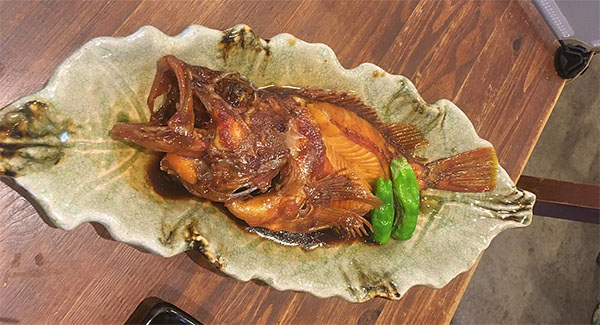 붉감펭 찜, 일본 요리로 추정됨. Steamed fish. Yellow barred red rockfish(Sebastiscus albofasciatus). Probably Jananese cuisine. Author/Nesnad. Original photo rotated 90° clockwise.
 생선 시장의 붉감펭 Yellow barred red rockfish(Sebastiscus albofasciatus) in fish market. Location/Zhoushan, Zhejiang, China. Author/李博恒(Li Boheng). Original photo rotated 90° clockwise.
 생선 시장의 붉감펭 Yellow barred red rockfish(Sebastiscus albofasciatus) in fish market. Location/Zhoushan, Zhejiang, China. Author/Pin-Tsen JIN.




 검색
