
사이트 로그인
사이트 로그인
|
분류계통/분류계통/경골상강→조기강→쏨뱅이목→볼락과→쏨뱅이 Copyright by Kim In Young. 김인영 그림
|
 |
|
Copyright by Kim In Young. 김인영 그림
|
 |
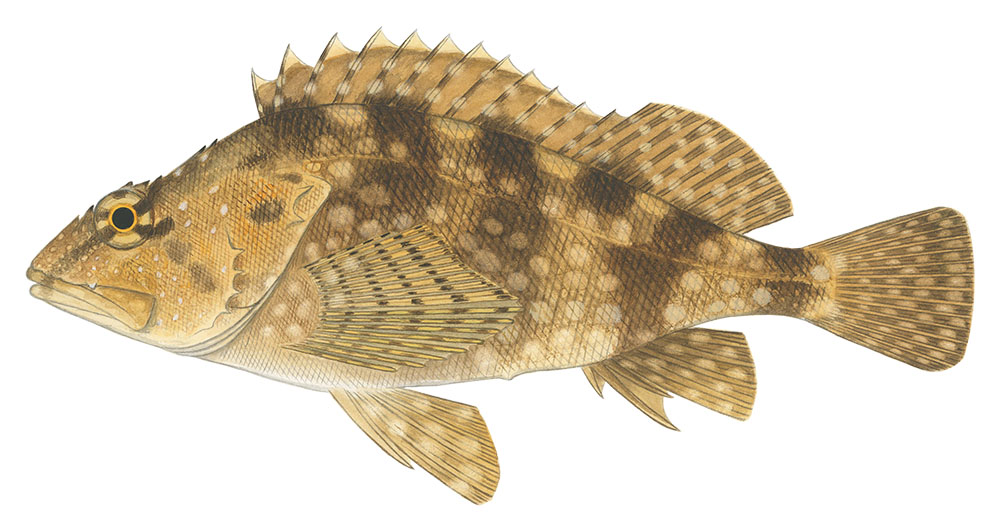
| [illustration 2] 쏨뱅이 기본 모습. 적색 국면. Red phase lateral view of False kelpfish(Sebastiscus marmoratus). |
|
Copyright by Kim In Young. 김인영 그림
|
 |
| [illustration 3] 쏨뱅이 체형의 기본 프레임. Basic external body frame of False kelpfish(Sebastiscus marmoratus) |
쏨뱅이목 볼락과 분포; 서북태평양/한국의 남해안(군산, 여수, 추자도, 부산)과 제주도. 일본 본토 전역(홋카이도 남부까지), 중국, 필리핀, 베트남, 타이만에 분포한다. 비분포 해역인 노르웨이와 오스트레일리아에서도 발견된 바 있는데 이는 선박의 선박평형수(ballast water)에 들어갔던 개체가 방류되면서 이입된 것이다. 몸과 머리는 측편되었고 타원형이다. 체고는 높은 편이다. 두 눈 사이는 깊이 패었다. 코 부분에 가시는 작으나 분명하다. 위턱 위쪽의 눈 앞 뼈 가시는 넓적하다. 눈 위쪽에 약한 뼈-융기가 있다. 눈 아래에 뼈 융기와 가시는 없다. 눈앞의 등쪽(Preocular) 가시는 작으나 분명하다. 안와상부 (supraorbital)와 두정부(parietal)에 뒤로 향한 날카로운 가시들이 발달하였다. 물속에 살아있을 때 머리의 등쪽 가시, 전개새골 가시, 눈 아래 가시의 끝에 피질이 자라나온 짧은 실 같은 돌기(cirri)가 있으며 가시만 있고 이 돌기들이 없는 경우도 있다. 전새개골에 5개 가시가 있다. 주새개골 위쪽에 2개의 가시가 있다. 주둥이 앞의 위턱은 아래턱보다 약간 앞에 있다. 위턱 뒤끝은 눈 뒤쪽 가장자리에 이르거나 약간 넘는다.. 양턱, 서골, 구개골에 작은 이빨이 있다. 좌우 아가미덮개(주새개골)는 아가미목(협부)과 융합되어 있다. 측선은 완전하며 몸통 앞부분은 등쪽으로 약간 치우쳐 있다. 머리와 몸통에 빗비늘이 덮여있다. 머리의 배쪽, 주둥이 부위 및 두 눈 사이에 비늘은 없다. 등지느러미 기점은 아가미뚜껑 뒤끝보다 앞에 자리한다. 등지느러미 제4극조는 길이가 가장 길다. 등지느러미 마지막 극조은 바로 앞의 극조보다 길이가 약간 더 길아. 등지느러미 연조부 가장자리는 둥글다. 등지느러미 극조 길이는 연조 길이와 거의 비슷하다. 등지느러미 극조부 기저의 길이는 연조부 기저 길이보다 길다. 등지느러미 연조부 기점은 뒷지느러미 연조부 기점보다 약간 앞에 자리한다. 가슴지느러미는 몸통 중앙보다 약간 아래에 위치하며 모두 연조로 구성되어 있다. 가슴지느러미 겨드랑이에 피부편이 없다. 가슴지느러미 가장자리의 위쪽 측면(분지 연조 부분)은 곡선이 아니고 거의 직선이다. 가슴지느러미 기조 수는 17~19 개로 알려져 있으나 대개의 경우 18개이다. 가슴지느러미 위쪽의 10 연조는 분지 연조이며 아래쪽 8개 연조는 불분지 연조이다. 가슴지느러미 뒤끝은 항문(총배설강)을 초과하며 뒷지느러미 기점에는 이르지 못한다. 배지느러미는 가슴지느러미 기부보다 약간 뒤쪽에 자리하며 그 뒤끝은 항문(총배설강)을 초과한다(※ 가슴지느러미와 배지느러미 길이의 정보 출처; Fishes of Japan with pictorial keys… By Tetsuji Nakabo, Tokai University Press,2002). 총배설강은 몸통 중앙보다 약간 뒤쪽에 자리한다. 뒷지느러미 기저부 뒤끝은 등지느러미 연조부 기저 뒤끝보다 약간 앞에 자리한다. 꼬리지느러미 뒤는 약간 둥근 절단형이다. 몸의 바탕색은 환경과 수심에 따라 체색 변이가 매우 심하다. 우세한 색에 따라 황갈색 국면, 적갈색 국면,, 적색 국면, 암(흑)갈색 국면,이 있다. 몸의 일부분에 녹갈색이 보이는 경우도 있다. 등지느러미 기점에서부터 미병부까지 등 쪽에는 6개의 어두운 암갈색 안장 무늬가 보인다. 등쪽은 암색이 강하고 체측 및 복부로 갈수록 황색 또는 연한 적색조가 증가한다. 머리와 몸에는 벌집 모양이나 불규칙한 모양의 흰색(또는 연한 바탕색) 반점이 다수 산재해 있다. 지느러미에는 암갈색과 백색이 교차하는 반점 또는 줄무늬가 나타난다. 자신의 위치에 맞춰 위장색을 띠기 때문에 동일 서식 환경 내에서도 개체 간의 색상 차이가 뚜렷하다. 살아있을 때는 색채 대조가 매우 뚜렷하나, 죽은 후에는 색이 바래어 하얗고 흐린 회백색을 띠는 특징이 있다." 저서성, 야행성 어류이다. 해초류가 발달한 연안 바다의 바위 지대에서 발견된다. 난태생으로 10~11월에 교미하여 11~3월경에 새끼를 낳는다. 치어는 2년이 지나서 성숙된다. 수컷은 항문 뒤에 작은 교미기가 있다. 겨울에는 수심이 깊은 곳으로 봄에는 얕은 곳으로 이동하는 습성을 보이며 크기가 커지면서도 깊은 수심 쪽으로 이동한다. 주로 갑각류와 작은 물고기를 먹는다. 등지느러미, 뒷지느러미 및 배지느러미 가시에 독성이 있다. 가시에 찔리면 통증이 매우 심하다. 일본에서 양식된다. ※ 쏨뱅이의 영명 False kelpfish는 “가짜켈프피시”의 뜻이다. 이름이 “가짜켈프피시”라면 진짜켈프피시가 있다는 말이 되며 이 물고기는 진짜 켈프피시를 닮았다는 의미를 가진다. 영명이 켈프피시((kelpfish)인 종은 Chironemus marmoratus이며 오스트레일리아, 뉴질랜드, 칠레에 분포하는 종이다. 원래 농어목으로 분류된 종인데 업데이트된 분류에서는 검정우럭목(order Centrarchiformes/배스류) 켈프피시과(family Chironemidae/Kelpfishes)에 속한다. 켈프(kelp)는 다시마목(order Laminariales) 다시마과(Laminariaceae)에 속하는 대형 갈조류의 총칭이다. 켈프피시는 켈프 해조 숲에서 많이 발견되기 때문에 켈프피시라고 부를 것이다. 여기서 말하는 켈프의 종은 거대다시마(Giant kelp/Macrocystis pyrifera)일 것이며 한국 연근해에서는 서식하지 않는 종이다. (진짜 켈프피시 사진은 사진 소개란 아래 쪽에 첨부되어 있음) |
Oder Scorpaeniformes Family Family Sebastidae(Rockfishes, rockcods and thornyheads). Distribution; Western Pacific/Southern coast of Korea(Gunsan, Yeosu, Chujado, Busan) and Jeju Island, Korea. It is distributed throughout mainland Japan(up to southern Hokkaido), China, the Philippines, Vietnam, and the Gulf of Thailand. It has also been found in Norway and Australia, which are non-distribution areas, because individuals that entered ship ballast water were released and introduced. The body and head are laterally compressed and oval-shaped. The body depth is relatively high. The interorbital space is deeply concave. The nasal spine is small but distinct. The preorbital spine above the upper jaw is broad. There is a weak bony ridge above the eyes. There are no bony ridges or spines below the eyes. The preocular spine is small but distinct. Sharp, backward-pointing spines are well-developed on the supraorbital and parietal regions. When alive in water, there are short, thread-like projections(cirri) grown from the skin at the tips of the dorsal head spines, preopercular spines, and suborbital spines, though there are cases where only the spines are present without these projections. There are 5 spines on the preopercle. There are 2 spines on the upper part of the opercle. The upper jaw in front of the snout is slightly in front of the lower jaw. The posterior end of the upper jaw reaches the posterior margin of the eye or passes. Small teeth are present on both jaws, vomer, and palatine. The left and right gill covers(opercles) are fused with the isthmus. The lateral line is complete, and the anterior part is slightly biased toward the dorsal side. The head and body are covered with ctenoid scales. There are no scales on the ventral side of the head, the snout area, and between the eyes. The dorsal fin origin is located anterior to the posterior end of the opercle. The fourth dorsal fin spine is the longest. The last dorsal fin spine is slightly longer than the preceding spine. The margin of the soft dorsal fin is rounded. The length of the dorsal fin spines is nearly equal to the length of the soft rays. The base length of the spinous dorsal fin is longer than the base length of the soft dorsal fin. The origin of the soft dorsal fin is located slightly anterior to the origin of the anal fin soft rays. The pectoral fin is located slightly below the mid-lateral body line and consists entirely of soft rays. There is no scaly flap at the axil of the pectoral fin. The margin(upper side) of the branched ray section of the pectoral fin is nearly straight rather than curved. The number of pectoral fin rays is known to be 17 to 19, but in most cases, it is 18. The upper 10 rays of the pectoral fin are branched, while the lower 8 rays are unbranched. The posterior end of the pectoral fin extends past the anus(cloaca) but does not reach the anal fin origin. The pelvic fin origin is located slightly posterior to the pectoral fin base, and its posterior end extends past the anus (cloaca). (*Source of pectoral and pelvic fin length information: Fishes of Japan with pictorial keys… By Tetsuji Nakabo, Tokai University Press, 2002). The cloaca is located slightly posterior to the middle of the body. The posterior end of the anal fin base is located slightly anterior to the posterior end of the soft dorsal fin base. The posterior margin of the caudal fin is slightly rounded truncate. The body's ground color varies greatly depending on the environment and water depth. Depending on the dominant color, there are yellowish brown phase, reddish-brown phase, red phase, and dark brown phase. Greenish tints may be observed on certain parts of the body. Six dark brown saddle-shaped markings are visible along the back, extending from the origin of the dorsal fin to the caudal peduncle. The dorsal side is darkly colored, with yellowish or pale reddish tints increasing toward the flanks and belly. Numerous white or pale irregular honeycomb-shaped spots are scattered across the head and body. Fins display alternating dark brown and white spots or stripes. Because it camouflages itself to match its surroundings, distinct color differences exist among individuals even within the same habitat. While the color contrast is highly vivid when alive, it fades to a dull grayish-white after death. It is a benthic, nocturnal fish. It is found in rocky areas of coastal waters with well-developed seaweed. It is ovoviviparous, mating from October to November and giving birth to young between November and March. Fry mature after two years. Males have a small copulatory organ behind the anus. It exhibits a behavior of moving to deeper waters in winter and shallower waters in spring, and also moves toward deeper waters as it grows larger. It mainly feeds on crustaceans and small fish. The spines of the dorsal, anal, and pelvic fins are venomous. Being stung by the spines causes severe pain. It is aquaculture-bred in Japan. False kelpfish, the English name for the scorpionfish(Sebastiscus marmoratus) implies that a true kelpfish exists that resembles it. The true "Kelpfish" is Chironemus marmoratus, which is distributed across Australia, New Zealand, and Chile. Originally classified under the order Perciformes, updated taxonomy places it in the family Chironemidae(kelpfishes) within the order Centrarchiformes(Basses). Kelp is a general term for large brown algae belonging to the family Laminariaceae under the order Laminariales. The kelpfish is likely named so because it is frequently found in kelp forests. The specific kelp species referred to here is likely the giant kelp (Macrocystis pyrifera), which does not inhabit the coastal waters of Korea. (The true Kelpfish image is attached below the photo introduction section.) |
 쏨뱅이 분포도. 노르웨이와 오스트레일리아에 분포 표시가 되어 있으나 정상적인 분포는 아니며 선박의 균형수에 딸려 들어갔던 개체가 방류된 것이라고 보여진다. Distribution map of False kelpfish(Sebastiscus marmoratus). Main source/fishbase. org. and GBIF. Author/fishillust.com. There are extralimital records of S. marmoratus, it has been recorded twice in Australia and once in the North Atlantic off Norway. These records are thought to probably be a result of fish being transported to these locations in the ballast water of ships. |
 쏨뱅이. 수중 사진. False kelpfish(Sebastiscus marmoratus). underwater photo. Location/Sai Kung, Hongkong. Author/hkbruce. (CC BY-NC) |
 쏨뱅이. 채집 어항 사진. False kelpfish(Sebastiscus marmoratus). Portable fish tank photo. Location/South Korea. Author/희건04. (CC BY-NC) |
 쏨뱅이. 채집 어항 사진. 위치/부산광역시 기장군. False kelpfish(Sebastiscus marmoratus). Portable fish tank photo. Location/Gijang, Busan, Korea. Author/희건04. (CC BY-NC) |
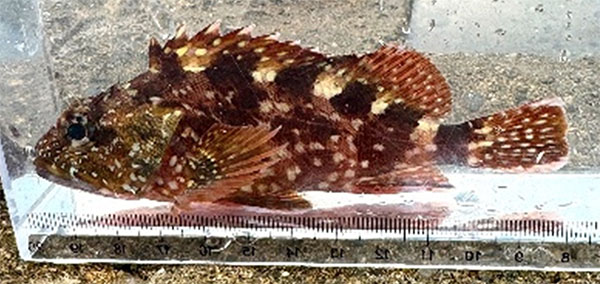 쏨뱅이. 채집 어항 사진. False kelpfish(Sebastiscus marmoratus). Portable fish tank photo. Location/Hayama, Kanagawa, Japan. Author/mojineko. (CC BY-NC) |
 쏨뱅이. 수중 사진. False kelpfish(Sebastiscus marmoratus). Underwater photo. Location/Sai Kung, Hongkong. Author/Ryan Yue Wah Chan. (CC BY-NC) |
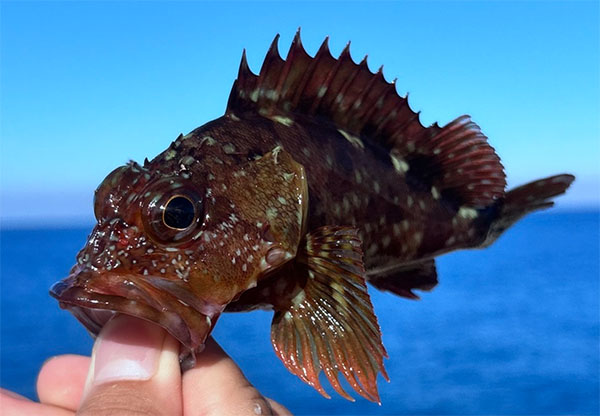 쏨뱅이. 갓 잡힌 개체. 적색 국면의 경우. False kelpfish(Sebastiscus marmoratus). A freshly caught specimen. In the case of the red phase. Location/Iki, Nagasaki, Japan. Author/youmu. (CC BY-NC) |
 쏨뱅이. 수족관 사진. False kelpfish(Sebastiscus marmoratus). Aquarium photo. Location/Hakkeijima Sea Paradise, Japan. Author/自分. (CC BY-NC) |
 쏨뱅이. 수족관 사진. False kelpfish(Sebastiscus marmoratus). のとじま水族館飼育展示個体. Aquarium photo. Location/Notojima Aquarium, Japan. Author/Totti. (CC BY-NC) |
 위에서 내려다 본 쏨뱅이의 머리쪽 모습. 화살표의 부속물들은 가시 끝에서 돋아나온 피질돌기이다. 이 돌기들이 없는 경우도 있다. 죽은 개체의 경우에는 돌기가 오그라들거나 말라서 보이지 않을 것이다. Top-down front view of a False kelpfish(Sebastiscus marmoratus). The appendages indicated by the arrows are skin flaps(cirri) growing from the tips of the spines. These flaps may be absent in some cases. In dead specimens, the flaps may shrivel or dry up and become invisible. Location/Tai Po, Hongkong. Author/Ryan Yue Wah Chan. (CC BY-NC) |
 쏨뱅이 머리. 머리의 가시 끝에서 돋아나온 피질돌기가 없는 경우(백색 화살표). 눈 아래의 위턱 경계선과 그 뒤 전새개골 가시에는 피질돌기가 보인다(흑색 화살표). Head of Sebastiscus marmoratus. When dermal flaps are absent at the tips of the head spines(white arrows). Dermal flaps are present at the Suborbital bone spine and the preopercular spines(black arrows). Location/Sai Kung, Hongkong. Author/Ryan Yue Wah Chan. (CC BY-NC) |
 쏨뱅이. 채집 어항 사진. False kelpfish(Sebastiscus marmoratus). Portable fish tank photo. Location/Korea. Author/nke. (CC BY-NC) |
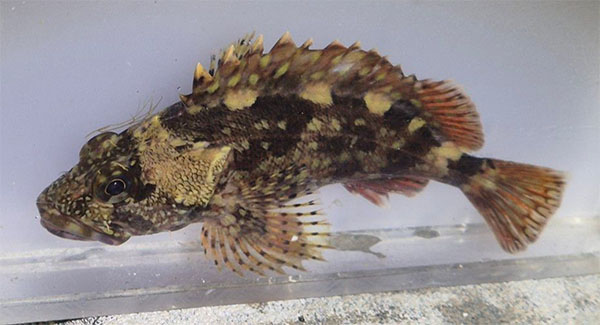 쏨뱅이. 채집 어항 사진. False kelpfish(Sebastiscus marmoratus). Portable fish tank photo. Location/Korea. Author/김진우. (CC BY-NC) |

| 쏨뱅이. False kelpfish(Sebastiscus marmoratus). Location/Zhoushan, Zhejiang, China. Author/Amaël Borzée. (CC BY-NC) |
 쏨뱅이. 수중사진. False kelpfish(Sebastiscus marmoratus). Underwater photo. Location/Sai Kung, Hongkong. Author/Ryan Yue Wah Chan. Original photo turned. (CC BY-NC) |
 쏨뱅이. lse kelpfish(Sebastiscus marmoratus). Location/Jeju Island Korea. 제주도 서귀포시 표선면. Author/채유민. (CC BY-NC) |
 크기가 큰 편에 속하는 쏨뱅이. False kelpfish(Sebastiscus marmoratus). Relatively large specimen. Location/Korea. Author/희건04. (CC BY-NC) |
 쏨뱅이 보존 개체 사진. 저자는 존 어니스트 "잭" 랜달(John Ernest "Jack" Randall, 1924년 5월 22일 ~ 2020년 4월 26일)이며 미국의 세계적인 어류학자이다. Preserved specimen of Sebastiscus marmoratus. Location/Taiwan. Randall's tank photos. Date/1975-06-15. by Randall, J.E. (John Ernest "Jack" Randall (May 22, 1924 – April 26, 2020) was a world-renowned American ichthyologist). (CC BY-NC) |
 생선시장의 쏨뱅이. False Kelpfish in fish market. Location/Zhoushan, Zhejiang, China. Author/李博恒(Lee Pok Hang). (CC BY-NC) |
 영명으로 진짜 "켈프피시(Kelpfish)". 학명; Chironemus marmoratus. 검정우럭목(order Centrarchiformes/배스류) 켈프피시과(family Chironemidae/Kelpfishes)에 분류된다. True "Kelpfish", species name; Chironemus marmoratus, Centrarchiformes(Basses), Chironemidae(Kelpfishes). Location/Bitangabee Bay south of Eden, New South Wales. Author/Andrew J. Green(Reef life Survey). (CC BY NC) |
| text on preparation |
| text on preparation |
| text on preparation |


|
| Copyright ⓒ FISHILLUST.COM All rights reserved. All contents can not be used without permission of the copyright holder. |


 검색
