
사이트 로그인
사이트 로그인
|
분류계통/경골상강→조기강→쏨뱅이목→볼락과→붉은쏨뱅이 Copyright by Kim In Young. 김인영 그림
|
 |
| [illustration 1] 붉은쏨뱅이 기본 모습. Lateral view of Red marbled rockfish(Sebastiscus tertius) [note] 이 페이지 사진 소개란에 몇 개의 사진이 올려져 있으나 붉은쏨뱅이의 기준적인 모습에 해당하는 것이 없다. 자유이용허락표시(CC; Creative Commons)된 사진이 희귀해서 이런 사진들 밖에 가져오지 못했다. CC 조건이 아닌 여러 사진들을 보면 Izuzuki의 수중 사진은 여러 변이 중에서 점 무늬가 매우 많은 경우로 보이며 이 경우가 기준적인 것으로 결론이 나지는 않는다. 이 세밀화는 인터넷에서 다른 갓 잡힌 개체들을 종합 분석하여 기준적인 외형을 도출해 낸 것이다. [note]. Although several photos are presented on this page, none fully represent the standard morphology of the Red marbled rockfish (Sebastiscus tertius). Due to the scarcity of Creative Commons (CC) licensed images, I had to work within these limitations. However, a comprehensive review of non-CC licensed field photos reveals that Izuzuki's underwater photograph depicts an atypical phase with an unusually high density of white spots, which should not be taken as the standard. To resolve and redefine the standard external appearance of this species, my illustration was derived by synthetically analyzing numerous freshly caught specimens documented across the internet. |
|
Copyright by Kim In Young. 김인영 그림
|
 |
| [illustration 2] 붉은쏨뱅이 외현 기본 틀. Basic external body frame of Red marbled rockfish(Sebastiscus tertius). |
쏨뱅이목 볼락과 분포; 서북태평양/한반도 남부, 일본 남부, 대만, 동중국해의 저우산군도(Zhoushan, 중국 저장성 동북부). ※ Mar 24, 2021 날자로 발표된 한 논문에 의하면 분포해역에 한반도 북부와 인도네시아를 포함시키고 있다(A NEW RECORD OF SEBASTISCUS TERTIUS (SCORPAENOIDEI: SEBASTIDAE) IN CHINESE MAINLAND COASTAL WATERS IN MORPHOLOGICAL CHARACTERS AND DNA BARCODING). 일반개요; 몸몸의 형태는 쏨뱅이와 매우 비슷하다. 체고는 높으며 옆으로 납작한 긴 타원형이다.. 머리는 크다. 눈은 크며 두 눈 사이는 안으로 오목하게 들어가 있다. 눈 위 앞(Preocular)에 가시는 작지만 분명하다. 머리가시(coronal spine), 뒤통수 가시, 뒤통수 측면 가시는 작다. 눈의 아래 골격에는 융기와 가시가 없다. 위턱 위쪽과 눈 아래 뼈 사이 경계부의 가시는 넓적하다. 전세개골에 5개의 가시가 있고 주새개골에는 2개의 가시가 있다. 위턱은 아래턱보다 약간 돌출되어 있는 경우가 많으며 서로 비슷한 경우도 있다. 위턱의 뒤는 동공의 끝에 달하지만 눈 뒤 끝에는 이르지 못한다(※ 쏨뱅이는 위턱 뒤가 안구의 뒤 가장자리를 초과한다). 양 턱에는 작은 이빨이 무리 지어 있고 구개골(palatine:입천장부)과 서골(vomer)에도 이빨이 있다. 등지느러미 기점은 아가미뚜껑 뒤 끝보다 앞에 있다. 등지느러미 앞쪽 가시들의 기조막은 깊게 패어 있다. 등지느러미 극조부의 마지막 극조는 바로 앞의 극조 길이와 비슷하다. 등지느러미 극조들의 길이는 연조들의 길이와 거의 비슷하다. 등지느러미 극조부의 기저 길이는 연조부의 기저 길이보다 길다. 등지느러미 연조부 기점은 뒷지느러미 연조부 기점보다 약간 앞에 자리한다. 가슴지느러미는 크고 넓다. 가슴지느러미는 몸통 중앙보다 약간 아래에 위치하며 그 뒤끝은 항문(총배설강)에 이르지 못한다(※ 쏨뱅이의 가슴지느러미 뒤는 항문을 초과한다). 가슴지느러미 기조 수(연조)는 18-20개로 알려져 있으나 대개의 경우 19개이다(쏨뱅이는 대개의 경우 18이다). 가슴지느러미 위쪽의 10개 연조는 분지 연조이며 아래쪽 약 9개 연조는 불분지 연조이다. 가슴지느러미 바닥 위쪽에 작은 피질돌기가 있다. 배지느러미는 가슴지느러미 기부보다 약간 뒤쪽에 자리하며 그 뒤끝은 항문(총배설강)에 이르지 못한다(※ 쏨뱅이의 배지느러미는 항문을 초과한다). 총배설강은 몸통 중앙보다 약간 뒤쪽에 자리한다. 뒷지느러미 바닥 뒤끝은 등지느러미 연조부 바닥 뒤끝보다 약간 앞에 자리한다. 꼬리지느러미 뒤는 거의 직선으로 잘린 모양이다. 측선은 완전하고 몸통 앞부분에서 등쪽으로 약간 치우쳐 있다. 측선비늘공(pored scales) 수는 49~54개이며 측선 비늘 수는 대략 70개를 넘는다. 몸은 빗비늘로 덮여 있다. 체색은 주황적색(orange-red), 적갈색(reddish brown) 또는 암갈색(dark brown)으로 변이가 크며, 등쪽이 몸 옆면보다 짙다. 몸과 머리, 각 지느러미에는 크기가 다양한 크림색 또는 백색 반점이 산재한다. 본 종의 특징은 대부분의 백색 반점이 갈색 또는 적갈색의 짙은 색소에 의해 둘러싸여 뚜렷한 윤곽을 형성한다는 점이다. 이러한 암색 테두리는 몸 옆면과 머리, 지느러미에서 특히 잘 발달하며, 반점의 경계가 비교적 흐리고 윤곽선이 없는 쏨뱅이(Sebastiscus marmoratus)와 구별되는 중요한 특징이다. 살아있는 개체에서는 반점이 청백색 또는 청록색 광택을 띠기도 한다. 지느러미는 대체로 주황적색에서 적갈색을 띠며 반점 역시 암색 테두리를 가진다. 배면은 백색 또는 연분홍색이다. 가슴지느러미 기부 쪽 중심에 경계부가 희미하고 큰 어두운 반점이 한 개 있다. 두 종이 모두 색상 변이가 커서 색상만으로 구별하기는 어렵다. 가장 이상적인 흰점의 가장자리에 진한 색의 경계가 보이면 붉은쏨뱅이이며 흰점 가장자리 경계선이 비어 있으면 쏨뱅이로 판단하는 것이다. 저서성 어류로 암초 지역에서 주로 서식한다. 먹이는 주로 새우류, 게류 등의 갑각류와 어류를 먹는다. 난태생(卵胎生) 물고기이다. 봄철이며 번식한다. 식용가치가 높은 어류이다 [종이 헷갈린 과거] 붉은쏨뱅이(Red marbled rockfish)는 과거에는 쏨뱅이(Sebastiscus marmoratus)와 같은 종인데 좀 더 깊은 수심에 사는 개체들이라고 알려져 있었다. 서로 너무 비슷했기 때문이다. 별개의 종으로 밝혀진 것은 1978년이며 연구자는 러시아의 어류학자 발수코프(V. V. Barsukov)와 대만계 어류학자 첸(L. C. Chen)이다. 학명은 Sebastiscus tertius로 정해졌다. 종소명 테르티우스(Tertius)는 세 번째라는 뜻인데 속명 "Sebastiscus(쏨뱅이 속)"에 분류된 세번째 종이라는 뜻이었다. 한국에서는 1993년에 독립종으로 등록되었고 국명을 붉은쏨뱅이라 하였다(김익수 교수, 이완옥 박사). [방언 해설] 붉은쏨뱅이를 방언으로 삼뱅이라고 부르는 경우가 있는데 이는 쏨뱅이와 붉은쏨뱅이가 너무 비슷해서 현지 어민과 낚시꾼들이 두 종을 구분하지 못하고 둘 다 방언으로 삼뱅이라고 통칭하기 때문에 생기는 결과라고 한다. 기본적으로 삼뱅이는 표준어 '쏨뱅이'의 사투리이다. 쏨뱅이의 방언에는 여러 가지가 있으며 그 중 삼뱅이는 전라남도를 포함한 남해안 지역의 사투리이다. |
Oder Scorpaeniformes Family Family Sebastidae(Rockfishes, rockcods and thornyheads). Distribution; Northwest pacific/southern Korean Peninsula, southern Japan, Taiwan, East China Sea(Zhoushan Islands). ※ According to a paper published on March 24, 2021, its distribution area includes Indonesia and the northern part of the Korean Peninsula. (A NEW RECORD OF SEBASTISCUS TERTIUS (SCORPAENOIDEI: SEBASTIDAE) IN CHINESE MAINLAND COASTAL WATERS IN MORPHOLOGICAL CHARACTERS AND DNA BARCODING). General; The body shape is very similar to that of the False kelpfish(Sebastiscus marmoratus). The body depth is high, and the body is compressed and elongated oval. The head is large. The eyes are large, and the space between the eyes(interorbital space) is concave inward. The preocular spine is small but distinct. The coronal spine, occipital spine, and lateral occipital spine are small. There are no ridges or spines on the suborbital bone. The spine at the boundary between the upper side of the upper jaw and the suborbital bone is broad. There are 5 spines on the preopercle and 2 spines on the opercle. The upper jaw often protrudes slightly beyond the lower jaw, or they are similar in front length. The posterior end of the upper jaw reaches the edge of the pupil but does not reach the posterior end of the eye (*Note: In the False kelpfish, the posterior end of the upper jaw extends past the posterior margin of the eye). Small teeth are clustered on both jaws, and teeth are also present on the palatine and vomer. The origin of the dorsal fin is located anterior to the posterior end of the operculum. The membranes between the anterior dorsal fin spines are deeply incised. The last spine of the spinous dorsal fin is similar in length to the spine right before it. The length of the dorsal fin spines is almost equal to the length of the dorsal soft rays. The base length of the spinous dorsal fin is longer than the base length of the soft-rayed dorsal fin. The origin of the soft-rayed dorsal fin is located slightly anterior to the origin of the anal fin rays. The pectoral fin is large and broad. The pectoral fin is located slightly below the center of the body, and its posterior end does not reach the anus(cloaca) (*Note: In the False kelpfish, the posterior end of the pectoral fin extends past the anus). The number of pectoral fin rays is known to be 18–20, and it is usually 19 (*Note: It is usually 18 in the False kelpfish). The upper 10 rays of the pectoral fin are branched rays, and the lower 9 rays are unbranched rays. There is a small dermal flap above the base of the pectoral fin. The pelvic fins are located slightly posterior to the base of the pectoral fin, and their posterior ends do not reach the anus(cloaca) (*Note: In False kelpfish, the pelvic fins extend past the anus). The cloaca is located slightly posterior to the center of the body. The posterior end of the anal fin base is located slightly anterior to the posterior end of the soft-rayed dorsal fin base. The posterior margin of the caudal fin is nearly truncate(cut straight). The lateral line is complete and slightly curved toward the dorsal side in the anterior part of the body. The number of pored lateral line scales is 49–54, and the total number of lateral line scales exceeds approximately 70. The body is covered with ctenoid scales. Coloration. Body coloration highly variable, ranging from orange-red and reddish brown to dark brown. Dorsal surface generally darker than the flanks. Sides and dorsal region covered with numerous cream-white to white spots of varying size. A characteristic feature of the species is that most white spots are distinctly bordered by darker brown or reddish-brown pigmentation, producing a ringed or outlined appearance. These dark-edged spots are particularly evident on the sides of the body, head, and fins, and contrast with the more diffuse, unbordered pale spots typical of Sebastiscus marmoratus. In living individuals, the pale spots may show bluish-white or turquoise iridescence. Fins are orange-red to reddish brown, often bearing pale spots similarly enclosed by dark margins. Ventral surface paler, whitish to pinkish. A single large dark spot with indistinct border at the center of the base of the pectoral fin. Both species have a high degree of color variation, making it difficult to distinguish them by color alone. The most ideal method is to identify it as a Red marbled rockfish(Sebastiscus tertius) if a dark border is visible around the edge of the white spots, and as a False kelpfish (Sebastiscus marmoratus) if the edge of the white spots has no border It is a demersal fish that mainly inhabits rocky reef areas. Its diet primarily consists of crustaceans, such as shrimp and crabs, as well as smaller fish. It is an ovoviviparous fish. Breeding occurs during the spring season. It is a fish species of high commercial and food value. [Confused Species in the Past] Red marbled rockfish was known in the past as the same species as False kelpfish(Sebastiscus marmoratus), simply as individuals living in deeper waters. This was because they looked too similar to each other. It was revealed as a distinct species in 1978 by the Russian ichthyologist V. V. Barsukov and the Taiwanese ichthyologist L. C. Chen. Its scientific name was designated as Sebastiscus tertius. The specific epithet tertius means "third," signifying that it was the third species classified under the genus Sebastiscus (the rockfish genus). In South Korea, it was officially registered as an independent species in 1993, and its Korean common name was designated as "Bul-geun-som-baeng-i" (by Professor Ik-Soo Kim and Dr. Wan-Ok Lee). [Commentary on Korean dialects] In some cases, the "Bul-geun-som-baeng-i(붉은쏨뱅이)" is called "Sam-baeng-i(삼뱅이)" in local dialects. This occurs because the False kelpfish and the Red marbled rockfish look so similar that local fishers and anglers cannot distinguish between the two species, leading them to collectively call both by the dialect name "Sam-baen-gi." Fundamentally, "Sam-baeng-i" is a regional dialect for the standard Korean name "Som-bang-i." There are various dialects for "Som-bang-i," among which "Sam-baeng-i" is the regional dialect used in the southern coastal areas of Korea, including Jeon-la-nam-do province. |
 붉은쏨뱅이 분포도. Distribution map of Red marbled rockfish(Sebastiscus tertius). Author/fishillust.com/. derived work from GBIF. |
 붉은쏨뱅이. Red marbled rockfish(Sebastiscus tertius). Location/Japan. Author/Izuzuki. (CC BY NC) |
 붉은쏨뱅이. 수조 사진. Red marbled rockfish(Sebastiscus tertius). In water tank. Location/Korea. Author/희건04. (CC BY-NC). Source/naturing.net |
 붉은쏨뱅이 Red marbled rockfish(Sebastiscus tertius). Location/Beppu, Oita, Japan. Author/ sharkdevotee. (CC BY-NC) |
 붉은쏨뱅이 Red marbled rockfish(Sebastiscus tertius). Location/Korea. Caught by trawling. Author/오도현. (CC BY-NC). Source/naturing.net |
 붉은쏨뱅이 Red marbled rockfish(Sebastiscus tertius). Location/Beppu, Oita, Japan. Author/sharkdevotee. (CC BY-NC) |
 붉은쏨뱅이 보존 개체 사진. Preserved specimen of Red marbled rockfish(Sebastiscus tertius). Location/Korea. Author/Marine Bio-Resource Information System, Korea. (CC BY-NC) |
 붉은쏨뱅이 Red marbled rockfish(Sebastiscus tertius). Location/Korea. Author/nke. (CC BY-NC). Source/naturing.net |
 붉은쏨뱅이 Red marbled rockfish(Sebastiscus tertius). Location/Futtsu Chiba Japan. Author/Michael Verdirame. (CC BY-NC) |
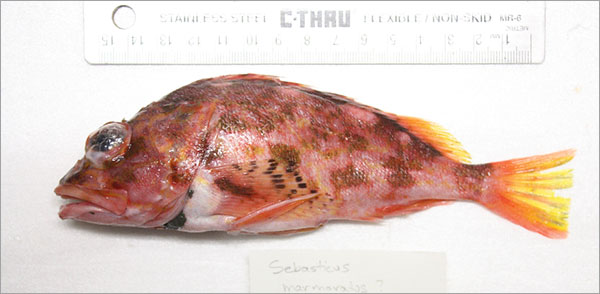 붉은쏨뱅이 보존 개체. Preserved specimen of Red marbled rockfish(Sebastiscus tertius). 150mm SL. Location/Asia China. Author/KUBI Ichthyology Collection. (CC BY NC) |
 붉은쏨뱅이의 가슴지느러미. 위쪽의 10개 연조는 분지 기조이며 아래쪽 9개 연조는 불분지 기조이다. The pectoral fin of Sebastiscus tertius. The upper 10 soft rays are branched, and the lower 9 soft rays are unbranched. Location/Beppu, Oita, Japan. Author/sharkdevotee. (CC BY-NC)text on preparation |
 생선 시장의 붉은쏨뱅이 Red marbled rockfish in fish market. Location/Hidden by author. Probably Korea. Author/idi. (CC BY-NC). Source/naturing.net |
| text on preparation |


|
| Copyright ⓒ FISHILLUST.COM All rights reserved. All contents can not be used without permission of the copyright holder. |


 검색
