
사이트 로그인
사이트 로그인
|
분류계통/경골상강→조기강→첨치목→첨치과→동갈메기(Golden cusk). Copyright by Kim In Young. 김인영 그림
|
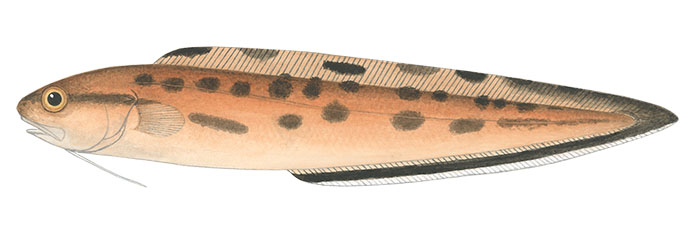 |
| 동갈메기 기본 모습. Lateral view of Golden cusk(Sirembo imberbis) ※동갈메기의 좌우 배지느러미는 각각 연조 1개로 이루어져 있다. The left and right pelvic fins of Sirembo imberbis consist of single soft ray each. 자료 출처(source)/Fishes of Japan with pictorial keys to the species, English edition, edited by Tetsuji Nakabo. Tokai University Press. 2002. |
첨치목 첨치과 분포; 서태평양/한국의 동해, 남해. 제주도, 일본 중부 이남, 타이완, 필리핀, 수마트라 섬, 오스트레일리아 중북부와 서부(인도양 포함), 아라푸라해 양 턱과 서골 및 구개골에 짧은 융모치가 있다. 서골의 좌우측 이빨은 V자형 대열(herringbone shape)로 서로 연결되어 있다. 혀는 두껍고 끝은 좁으며 고착되지 않고 자유스럽다. 윗입술보다 아랫입술이 더 두텁게 발달하였다. 전새개골에 가시가 없다. 주새개골에는 날카로운 가시가 1개 있다. 아가미 구멍은 크고 앞쪽으로 향한 하부의 끝은 동공 아래에 이른다. 새피막은 뺨에 붙어있지 않고 분리되어 있다. 새조골은 7개이다. 가짜 아가미(의새/擬鰓)도 발달하여 있다. 머리와 몸에 모두 비늘이 있으며 비늘은 중간 크기와 큰 크기의 둥근비늘이다. 측선은 직선형이며 체측의 위쪽에 있고 뒤 쪽 끝 부분에서는 분명하지가 않다. 등지느러미는 1개이며 아가미구멍 바로 뒤에서 시작되고 뒤 끝은 꼬리지느러미와 연결된다. 뒷지느러미는 항문과 가까운 위치에서 시작되며 역시 꼬리지느러미와 연결된다. 기조의 길이는 등지느러미 보다 약간 짧다. 가슴지느러미는 체측의 약간 아래 쪽에서 몸 방향을 따라 놓여 있고 뒤가 약간 뾰족한 편이며 9번이나 10번 기조가 가장 길다. 배지느러미는 목 부분에 있고 눈의 뒤쪽 가장자리 아래에서 시작된다. 배지느러미는 1개 기조로만 구성되어 있고 불분지 기조이며 왼쪽과 오른쪽 것이 서로 매우 가깝게 있다. 꼬리지느러미는 매우 좁다. 몸색은 황갈색이며 배쪽은 색이 연해진다. 등지느러미 가장자리에는 암갈색 띠가 둘려져 있고 기저부을 따라 5~7개 이상의 검은 점들이 배열되어 있다. 뒷지느러미에도 암갈색 띠가 둘려져 있으나 그 바깥쪽은 흰색 테두리이며 등지느러미에 있는 기저부의 검은 점들은 없다. 가슴지느러미와 배지느러미는 백색이다. 입과 복막은 무색이며 아가미 강 속은 회황갈색이다. 대륙붕 100-200m 수심의 모래나 펄 바닥에 살며 작은 물고기와 갑각류를 잡아먹는다. 난생이며 타원형 알은 젤라틴 덩어리 속에서 부유 생활을 하다가 부화한다. 이 물고기는 드물게 잡어로 잡히며 식용으로 경제적 가치가 없어서 대개는 다시 버려지며 과학적 연구용으로 채집된다. ※Main reference/baike.baidu.hk/item/仙鼬䲁 |
Order Ophidiiformes Family Ophidiidae(cusk-eels) Distribution; Western Pacific/East Sea, South Sea and Jeju Island of Korea, South of Central Japan, Taiwan, Philippines, Sumatra Island, North of central Australia including western Australia in Indian Ocean, Arafura Sea The mouth is slightly larger, posted anteriorly and very low, and the posterior end of the mouth reaches approximately below the posterior margin of the eye. The premaxilla is retractable. The maxilla is only exposed near the rear end, its rear end truncate, the center is slightly concave, and it extends slightly beyond the posterior edge of the eye. The lower jaw is slightly shorter than the upper jaw, and there is often a bony ridge on the ventral side. The upper and lower jaw, vomer and palatine have short-velvet teeth. The left and right vomer teeth are connected in a herringbone shape. Tongue thick, tip tapered and free. The lower lip is more developed than the upper lip. Preoperculum without spine. The main operculum has a sharp spine. Gill openings large, lower end reaching forward below pupil. The branchiostegal membranes separated and not connected to the cheeks. Number of branchiostegal 7. False gills developed. The scales are medium to large and round; there are scales all over the head and body. Lateral line, straight, and higher, not obvious near the rear end. One dorsal fin, starting just behind the rear end of the gill opening, the rear end is connected to the caudal fin. The anal fin begins near the posterior edge of the anus and is also connected to the caudal fin, and its rays are slightly shorter than the dorsal rays. The pectoral fins are lateral and attached slightly lower, slightly pointed, about the ninth to tenth rays are the longest. Pelvic fin posited on throat, starting below the back edge of the eye; the left and right pelvic fins are very close, each with only one ray, the rays are unbranched. The caudal fin is very narrow. Body yellowish brown, ventral side lighter. The edge of the dorsal fin rounded by black-brown band, and often with more than 5~7 dark spots on bottom line. The anal fin also has a similar black-brown longitudinal stripe, but the lower margin is white and spotless. The pectoral and pelvic fins are pale white. The mouth and peritoneum are colorless, while the gill cavity is gray-brown. It mainly inhabits sandy and muddy sediment environment of the continental shelf, at depth of about 100-200 meters, and feeds mainly on small fish and crustaceans. Because it is rare, even if the average fisherman catches it, it is only discarded in the bottom trash pile. Except for academic research, the economic value of eating is not great. Oviparous, with oval pelagic-eggs floating in a gelatinous mass. ※Main reference/baike.baidu.hk/item/仙鼬䲁 |
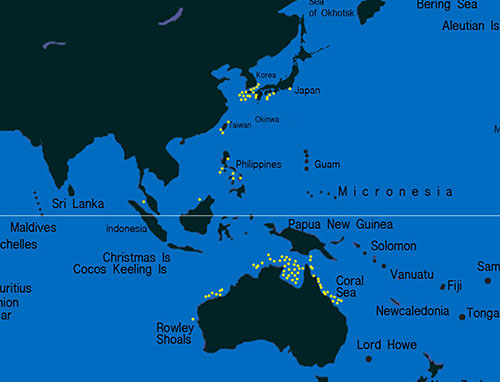 동갈메기 분포도. Distribution map of Golden cusk(Sirembo imberbis). Derived work. Author/Kim in young(fishillust.com) |

| 동갈메기 묘사도. Illustration of Golden cusk(Sirembo imberbis). Source/fishbiosystem.ru |
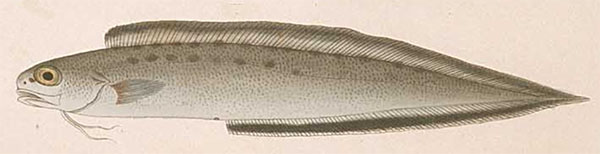 동갈메기 묘사도. Illustration of Golden cusk(Sirembo imberbis). Derived work from Kawahara Keiga(1786–). Source/fishbiosystem.ru |
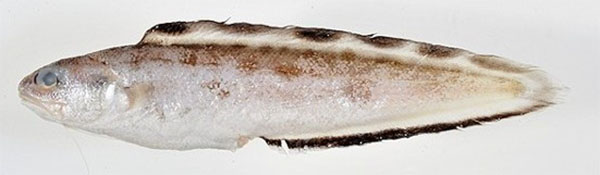 동갈메기 죽은 개체 사진. Dead specimen of Golden cusk(Sirembo imberbis). Author/Hiroshi Senoh(National Museum of Nature and Science, Kanagawa Prefectual Museum of Natural History) |

| 동갈메기 죽은 개체 사진. Dead specimen of Golden cusk(Sirembo imberbis). Author/CSIRO(Australian National Fish Collection). |


|
| Copyright ⓒ FISHILLUST.COM All rights reserved. All contents can not be used without permission of the copyright holder. |


 검색
