
사이트 로그인
사이트 로그인
|
분류계통/분류계통/분류계보/경골상강→조기강→홍메치목→매퉁이과→카이야꽃동멸 Copyright by Kim In Young. 김인영 그림
|
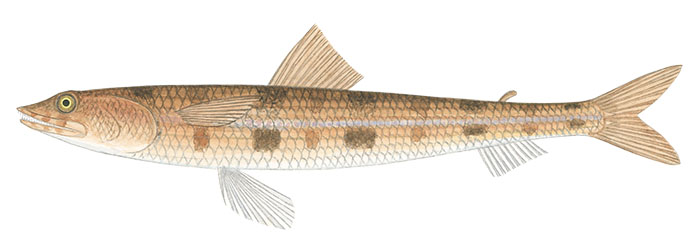 |
| 카이야꽃동멸 기본 모습. Lateral view of Gunther's lizardfish(Synodus kaianus) |
홍메치목 매퉁이과 분포; 인도-태평양/아프리카 동부의 세이셸 섬(Seychelles), 인도동남부, 인도네시아, 아라푸라해, 오스트레일리아 동북부와 서북부, 하와이, 필리핀, 남중국해, 타이완, 일본의 고치현과 혼슈의 수루가 베이(Suruga Bay), 한국의 제주도 남부에 분포한다. 등면은 주둥이 끝에서부터 목덜미까지 완만하게 올라갔다가 그 뒤로는 몸의 중심축과 나란하게 기름지느러미 기부까지 직선으로 뻗으며 그 이후에 다시 완만하게 하강하면서 꼬리지느러미 기부 상단에 이른다. 복면은 주둥이 끝에서 점진적으로 등지느러미 기점 아래까지 하강하였다가 이후 꼬리지느러미 기부 하단까지 완만하게 올라간다. 가슴지느러미 기부의 맨 위 지점은 아가미뚜껑 끝 지점 뒤이며 주둥이 끝 보다 약간 아래인 위치에 있다. 가슴지느러미는 근연종들 보다 긴 편이다. 뒤 끝은 뾰족하며 등지느러미 기점과 배지느러미 기점 사이를 그은 사선의 직전에 이르거나 닿는다. 몸 길이는 체고의 6.59-6.84 배이며 머리 길이의 3.27-4.49배이다. 가슴지느러미의 후단 가장자리는 거의 곧은 사선이다. 배지느러미 기점은 등지느러미 기점의 앞에 있으며 맨 안쪽 기조(8번)의 길이는 맨 외측 기조 길이의 2.18 배이며 가장 긴 기조는 제5번 기조이다. 배지느러미를 강제로 눕혔을 때 뒤 끝은 등지느러미 기부의 끝에 이르지 않는다. 양쪽 배지느러미 사이에는 한 쌍의 좁은 막 형태의 부속물이 있다. 등지느러미는 두 번째 기조가 가장 길다. 등지느러미의 기저부는 뒷지느러미의 기저부보다 길다. 뒷지느러미는 몸의 후방 꼬리지느러미의 기부와 가까운 위치에 있다. 뒷지느러미는 제3번 기조가 가장 길다. 기름지느러미에는 기조가 없으며 뒷지느러미 바로 위에 있다. 꼬리지느러미는 안으로 깊게 패인 정형이다. 머리 양쪽에 한 쌍의 콧구멍이 있으며 앞과 뒤의 콧구멍 거리는 가깝다. 앞콧구멍과 뒤콧구멍은 타원형이며 앞 구멍은 좌우 방향으로 타원형이고 뒤콧구멍은 전후 방향으로 타원형이다. 안구 앞에서 서로 가깝게 있다. 앞콧구멍의 뒤 가장자리에 피습이 있으며 넓고 확실하게 보인다. 전세개골과 주새개골의 가장자리는 가시가 없이 매끄럽다. 가짜 아가미 필라멘트(Pseudobranchial filaments)를 가지고 있다. 입은 크고 측면에서 볼 때 비스듬하게 놓여 있고 입의 뒤 끝은 눈의 뒤 가장자리를 넘어간다. 양턱과 구개골의 전반부에 원추형 이빨이 1줄씩 나있다. 구개골 앞 부분의 원추형 이빨은 맨 앞쪽 것과 뒤쪽 것의 길이 차이가 없다. 구개골의 후반부에는 원추형 이빨이 2줄로 나있다. 아래턱 앞 끝에는 3쌍의 송곳니가 있다. 혀에는 여러 줄의 송곳니가 나있다. 항문은 둥글며 뒷지느러미 바로 앞에 있다. 몸은 원형비늘로 덮여있으며 잘 떨어지는 성질이다. 지느러미와 눈 앞쪽의 머리 부분에는 비늘은 없다. 전새개골 전체에 비늘이 있다. 꼬리지느러미의 기부 중앙부에 2개의 큰 보조 비늘(axillary scales)이 있다. 측선은 아가미뚜껑 위 끝에서 시작하여 몸 축을 따라 직선으로 꼬리지느러미 기부에 이른다. 복강(腹腔)은 고르게 검다. 신선한 상태에서의 몸 빛깔; 측선 위쪽 몸은 어두운 갈색이며 아래 쪽은 고르게 은백색이다. 측선의 비늘들은 자주색이다. 체측에는 크고 작은 암갈색 점이 8∼10개 나타나는데 그 모양들은 4각형이다. |
Order Aulopiformes(Grinners). Family Synodontidae(Lizardfishes). Distribution; Indo-pacific/Seychelles in east sea of Africa, southeast India, Indonesia, Arafura Sea, north east and north west of Australia, Hawaii, Philippines, South China Sea, Taiwan, Kochi and Suruga Bay of Honshu in Japan, southern sea of Jejus Island of Korea. Dorsal profile gently elevated from snout tip to nape, straight and parallel to body axis along dorsal profile of nape to adipose fin origin, thereafter gently lowering to uppermost point of caudal-fin base. Ventral profile gradually lowering from snout tip to just below dorsal-fin origin, thereafter gently elevated to lowermost point of caudal-fin base. Uppermost point of pectoral-fin insertion is at the lelvel equal to uppermost posterior tip of opercle, and slightly below snout tip. The pectoral fin is relatively longer than the closely related species. Posterior tip of pectoral fin pointed, reaches just short of the line between dorsal-fin origin and pelvic-fin origin or reach to the line. The posterior edge of pectoral fin is almost straight obliquely. The body length is 6.59-6.84 times the body height and 3.27-4.49 times the head length. Pelvic fin origin anterior to dorsal-fin origin, length of innermost ray(8th ray) is 2.18 times the length of outermost ray, the fifth ray is the longest. Posterior tip of depressed pelvic fin not reaching to vertical through end of dorsal-fin base. Narrow, paired membranal process between pelvic fins. The second fin ray of dorsal fin longest. Dorsal-fin base longer than anal-fin base. The anal fin is located at the back of the body, close to the base of the caudal fin. Adipose fin without fin rays, located just above anal fin. Caudal fin forked. There is one pair of nostrils on each side, close to each other; the anterior nostril has a wide triangular nasal flap on posterior margin. Anterior and posterior nostrils oval, elongated transversely and longitudinally respectively, Posterior margins of preopercle and opercle are smooth without spines. It has Pseudobranchial filaments. The mouth is large and set obliquely when viewed from the side, and the rear end of the mouth extends beyond the rear edge of the eye. There is one row of conical teeth in the front part of both jaws and the palatine bone. There is no difference in length between the anterior and posterior conical teeth of anterior palatine bone. Posterior part of palatine bone with double-rowed conical teeth. Three-pairs of fanglike teeth on anterior tip of mandible. Several rows of fanglike teeth on tongue. Anus round, situated just before anal-fin origin. Body covered with large deciduous cycloid scales. Scales absent on fins, head(dorsum and lateral surface anterior to eye). Preopercle(cheek) entirely scaled. The base of the caudal fin has two large axillary scales. Lateral line originating on upper end of opercle, running straight. parallel to body axis, ending on caudal-fin base. Peritoneal uniformly black. Coloration of fresh specimen; Body above lateral line dark brown, lower part uniformly whitish-silver. Scales on lateral line purple. On the body side, with 8-10 large and small dark brown rectangular blotches. |
 카이야꽃동멸 분포도. Distribution map of Gunther's lizardfish(Synodus kaianus). Author/Kim in young(fishillust.com) |
 카이야꽃동멸 죽은 개체. Dead specimen of Gunther's lizardfish(Synodus kaianus). Author/Randall, John E. |
 카이야꽃동멸 죽은 개체. Dead specimen of Gunther's lizardfish(Synodus kaianus). Author/South African Institute for Aquatic Biodiversity(SAFAB). |
 카이야꽃동멸 묘사도. Illustration of Gunther's lizardfish(Synodus kaianus). Author/FAO |


|
| Copyright ⓒ FISHILLUST.COM All rights reserved. All contents can not be used without permission of the copyright holder. |


 검색
