
사이트 로그인
사이트 로그인
|
분류계통/분류계통/분류계보/경골상강→조기강→홍메치목→매퉁이과→꽃동멸 Copyright by Kim In Young. 김인영 그림
|
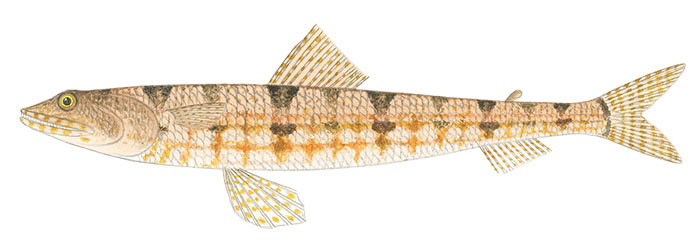 |
| 꽃동멸 기본 모습. Lateral view of Variegated lizardfish(Synodus variegatus) |
홍메치목 매퉁이과 분포; 인도-태평양/한국의 남해와 제주도, 일본 남부, 남중국해, 동중국해, 유구열도, 인도네시아, 홍해, 페르시아만, 동아프리카, 오스트레일리아에서부터 동으로 로드하우 섬 뉴질랜드, 라인제도, 라파제도까지, 마르키산 제도, 듀시 제도(Ducie islands), 하와이까지. 머리와 몸은 단단한 원형비늘이 덮고 있다. 전새개골(뺨)과 주새개골에도 비늘이 있으며 전새개골 가장자리에는 비늘이 없다. 양턱에도 비늘이 있다. 측선비늘 수는 60-63개인데 정보 자료에 따라 다소 차이가 있다. 첫 등지느러미는 기저부가 짧으며 뒤쪽에는 작은 기름지느러미가 있다. 등지느러미의 위치는 몸의 중간 부분에 있다. 꼬리지느러미는 안으로 깊게 패인 가랑이형이다. 가슴지느러미는 작으며 등지느러미의 기점과 배지느러미의 기점을 서로 이은 선에 다다르지 못한다. 배지느러미는 두껍고 강하며 바닥에서 먹이를 기다리는 자세를 취하고 있을 때 몸을 지탱해 주는 역할을 한다. 부레는 작거나 없다. 큰 개체는 몸이 두껍고 등이 곱사등처럼 올라간 모양일 수 있다. 꽃동멸(Variegated lizardfish)은 회색 계열에서부터 적색까지 색상 변이가 다양하다. 많은 개체들이 모래시계나 안장무늬 같은 무늬 8~10개를 체측에 가지고 있는데 체측 중앙에 수평으로 그어진 적색 선이 이 안장무늬들을 관통할 수 있다. 이 안장무늬의 배열 선 아래에는 백색 반점들이 열 지어 있다. 각 지느러미들의 기조에 여러개의 붉은 점이 일정 간격으로 있어서 여러 개의 붉은 줄무늬가 있는 것처럼 보인다. 라군이나 외해의 수심 4∼90m 범위 암초 지대에서 저서 생활을 한다. 산호 같은 단단한 바닥에서 쉬고 있을 경우가 대부분인데 가끔 모래 속에 몸을 숨기고 있는 개체가 발견되기도 한다. 두 마리가 쌍으로 있을 때가 많다. 작은 물고기와 새우류를 먹으며 먹이감 무리가 지나갈 때 낚아챈다. 여러 가지 장비로 어획되며 생선이나 염장 건어 상품, 어묵 등의 재료로 이용된다. 산란기는 5∼6월이다. ※ 영명(Variegated lizardfish)의 variegated(베리에게이티드)는 “얼룩덜룩한”의 뜻이다. |
Order Aulopiformes(Grinners). Family Synodontidae(Lizardfishes). Distribution; Indo-Pacific/South Sea and Jeju Island of Korea, southern Japan, South China Sea, East China Sea, Ryukyu Islands, Indonesia, Red Sea, East Africa, Persian Gulf, Australia, Lord Howe Island, New Zealand, Line Islands, Rapa, Marquesan, Ducie islands, Hawaii. Head and body with firm cycloid scales. Preopercular and opercular with scales, usually not scaled on preopercular margin. Lateral-line scales with 60-63 but there are some differences depending on the information data. Has a short-based first dorsal fin, a small adipose second dorsal fin. Dorsal fin about midway on back. Caudal fin deeply forked. Pectoral fin small, not reaching the line connecting origins of dorsal and pelvic fins. The strong, thick pelvic fins serve as props when the fish is resting on the bottom waiting for prey. Bladder absent or small. Large individuals are often thick-bodied, sometimes giving a hump-backed appearance. The variegated lizardfish varies in color from grey to red. Hourglass or saddle-shaped 8~10 markings along its side. A red stripe along the side of the body may run through these markings. Below these markings, a series of white blotches. There are several red dots at regular intervals on each rays of fins, so it appears as like several red stripes. Inhabits deep lagoon and seaward reefs from 4 to 90 m depths, Prefers to rest on hard surfaces, sometimes found on sandy bottoms concealing itself in the sand. Frequently occurs in pairs. Benthic. Feeds on small fishes by seizing these from passing schools, also shrimps. Caught with various types of artisanal gear. Sold fresh or dried salted and used as fish cake material. The spawning season is from May to June. |
t 꽃동멸 분포도. Distribution map of Variegated lizardfish(Synodus variegatus). Author/Kim iin young(fishillust.com) |
 산호 위에 앉아 있는 꽃동멸. Variegated lizardfish(Synodus variegatus) resting on the hard coral. Observed in Egypt. Author/Albertini maridom |
 꽃동멸 체형도. 수다꽃동멸(Synodus macrops)과 마찬가지로 비늘의 세로 열 방향이 수직이다. 1905년도 저작물. Illuatration of Variegated lizardfish(Synodus variegatus). 1905 work. Like Synodus macrops, the up and down direction of the scales is vertical. Author/David Starr Jordan(1851–1931) |
 테이블 산호 위에 앉아 있는 꽃동멸. Variegated lizardfish(Synodus variegatus) resting on a table coral. Observed in Tanzania. Author/Anne Laudisoit |
 산호 위에 앉아 있는 꽃동멸. Variegated lizardfish(Synodus variegatus) resting on the hard coral. Observed in Egypt. Author/Randall, J.E. |
 산호 위에 앉아 있는 꽃동멸. Variegated lizardfish(Synodus variegatus) resting on the hard coral. Locality/Maldives. Author/Gianemilio Rusconi |
 산호초 지대의 꽃동멸. Variegated lizardfish(Synodus variegatus) in coral reef. Author/David Burdick(NOAA). ※ 이 사진은 인터넷에서 검색되는 다른 수많은 사진들과 다르게 유일하게 옆구리의 무늬가 꽃송이 모양이다. 모든 자료에서 체측 무늬가 구름 무늬 또는 반점 무늬로 설명되어 있지 꽃송이 모양이라고 설명한 정보는 없다. 우연의 일치일지 모르지만 한국명의 뜻은 “flower lizardfish”이다. 그러나 한국명의 어원은 이 물고기의 컬러풀한 색상에서 나온 이름이지 꽃무늬를 가졌기 때문에 붙여진 이름이 아니다. 이 사진의 제출처가 권위 있는 NOAA 임으로 혹시 잘못 동종을 했는지 의심하기도 어렵다. ※ Unlike many other photos found on the Internet, this photo is unique in that the side pattern is flower shape. In all the data, the body pattern is not described as flower shape but cloud pattern or blotch pattern, It's hard to suspect whether the identification is mistake because this photo submitted by the authoritative NOAA, The Korean name of this fish means “flower lizardfish”, may be an accidental coincidence, the etymology of the Korean name comes from the colorful color of this fish, not because it has a flower pattern. |
 산호초 지대의 꽃동멸. Variegated lizardfish(Synodus variegatus) in coral reef. Author/Izuzuki |
 꽃동멸 묘사도. Illustration of Variegated lizardfish(Synodus variegatus). Author/David Starr Jordan (1851–1931). |
 산호초 지대의 꽃동멸. Variegated lizardfish(Synodus variegatus) in coral reef. Author/Rickard Zerpe |
 모래밭 위의 꽃동멸. 입과 이빨이 잘 나타난 사진. 이Variegated lizardfish(Synodus variegatus) on sand bottom. A picture showing the mouth and teeth well. Author/Elias Levy |
 복어((Torquigener brevipinnis)를 물고 있는 꽃동멸, 삼키는 것은 불가능해 보인다. Variegated lizardfish biting blowfish(Torquigener brevipinnis), it seems impossible to swallow. Locality/Lembeh, Indonesia. Author/Rickard Zerpe |


|
| Copyright ⓒ FISHILLUST.COM All rights reserved. All contents can not be used without permission of the copyright holder. |


 검색
