close_btn

납작전어(Reeves shad). Tenualosa reevesii(Richardson, 1846). Family 97


분류계통/경골상강→조기강→청어목→청어과→납작전어(Reeves shad; Tenualosa reevesii)
Superclass Osteichthyes→Class Actinopterygii→Order Clupeiformes→Family Clupeidae→Reeves shad(Tenualosa reevesii)

Copyright by Kim In Young. 김인영 그림
Tenualosa_reevesii_mypainting_700.jpg
납작전어 기본 모습. Lateral view of Reeves shad(Tenualosa reevesii)

[소하성/Anadromous]
청어목 청어과 Order Clupeiformes Family Clupeidae(Herrings, shads, sardine, menhadens)
납작전어(扁錢魚;편전어/Reeves shad)
Tenualosa reevesii(Richardson, 1846). Max length/61.6 cm TL). common length/ 40.0 cm TL
Korean name/nap-jak-Jeon-eo(납작전어)
Japanese name/hirakonoshiro
D/spines 3, soft ray 14-15. A/spines 2, soft rays 16-18. Belly scute/20~34. Vertebrae/44~45.

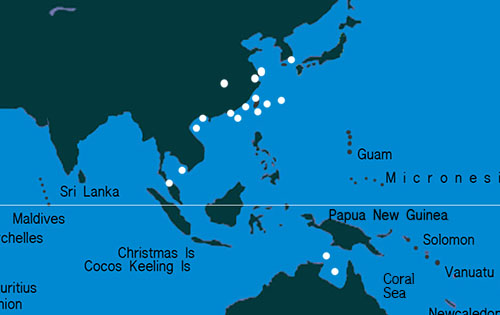
분포; 서북태평양/부산, 중국, 필리핀. 태국 푸켓 섬, 안다만 해, 및 오스트레일리아 중북부의 카펀태리아 만(Gulf of Carpentaria of)과 인접된 아라프라해. 
일반개요; 몸의 형태는 전어와 비슷하나 전어보다 좀 더 납작하고 몸이 조금 길고 넓으며 꼬리 부분이 약간 더 길다. 아가미갈퀴는 가늘고 길며 수가 많다. 아가미 활의 아래 쪽에 80~250개의 아가미갈퀴가 있다.  등지느러미의 마지막 기조는 실처럼 길게 연장되었다. 꼬리지느러미는 안으로 깊게 패였고 미세한 비늘이 들어있다. 배의 밑 쪽 중심선에 아주 날카로운 모비늘이 20~34개 있다. 아가미구멍 뒤에 검은 반점이 1개 있고 그 뒤로 체측에 몇 개의 검은 점이 열 지어 있다(그러나 사진들을 검색해 보면 이 체측 무늬가 없다). 등과 체측은 금속성 광택이 있는 푸른색이며 배쪽은 은백색이다. 아가미구멍 뒤 가장자리에 육질부분이 첨가되어 있지 않다. 아가미뚜껑 표면은 돌출된 골질의 선 같은 것이 없이 매끈하다. 측선 비늘 수는 42~ 45개이며 비늘 뒷부분에 구멍은 없다 

무리를 짓는 연안의 표층성 어류며 산란하기 위해 강으로 올라간다. 산란 후에 어미들은 바다로 돌아가지만 부화한 새끼들은 강 하구에서 1년을 보내며 2년째 되는 해에 바다로 나가기 시작한다. 물벼룩, 요각류, 윤충류 같은 갑각류 플랑크톤을 먹는다.


[Anadromous]
Order Clupeiformes Family Clupeidae(Herrings, shads, sardine, menhadens)
Reeves shad
Tenualosa reevesii(Richardson, 1846). Max length/61.6 cm TL). common length/ 40.0 cm TL
Korean name/nap-jak-Jeon-eo(납작전어)
Japanese name/hirakonoshiro
D/spines 3, soft ray 14-15. A/spines 2, soft rays 16-18. Belly scute/20~34. Vertebrae/44~45.

Distribution; Northwest Pacific/Northwest Pacific/Busan in Korea, China and possibly southward into South China Sea, but records uncertain. Eastern Indian Ocean: two specimens collected from Phuket Island, Andaman Sea. Gulf of Carpentaria of Auatralia including adjacent Arafra Sea.
General; Body shape similar to Konosirus punctatus, but more flattened sideways, slightly longer and broader body and with slightly longer caudal fin. Gill rakers fine, and numerous, 80 to 250 on lower part of arch. The last soft ray of dorsal fin extended like a long thread. Caudal fin deeply forked with minute scales. Abdomen with 20 to 34 fairly sharply-keeled scutes. A dark blotch behind gill opening and a series of spots along flank(However, if you search for related pictures on the Internet, you can't find this body pattern). Color: Metallic blue-green back that lightens to silver along the sides. No fleshy outgrowths on posterior margin of gill opening. Opercle smooth without bony striae. Scales moderate, 42 to 45 in lateral series, without perforations posteriorly

Schooling in coastal waters and ascending rivers to breed. After spawning, the adults go back to the sea while the larvae stay in river mouths during their first year. At the beginning of their second year, the juveniles swim to the sea. Feed on planktonic crustaceans like cyclopoids and other copepods, and rotifers

Map_Tenualosa-reevesii-납작전어_crop500.jpg 납작전어 분포도. Distribution map of Reeves shad(Tenualosa reevesii). Author/Kim in young(fishillust.com)


Copyright ⓒ FISHILLUST.COM  All rights reserved. All contents can not be used without permission of the copyright holder.